ENEnglish
 LTLietuviškai
 DEDeutsch
 FRFrançais
 RUРусский
 ESEspañol
 PLPolski
 ITItaliano
 UKУкраїнська
 CSČeština
 PTPortuguês
 JA日本語
 LVLatviešu valoda
 ETEesti
 HUMagyar
 IDBahasa Indonesia
 TRTürkçe
 HIहिन्दी
 ELΕλληνικά
 ARالعربية
 THไทย
 VITiếng Việt
 RORomână
 MSBahasa Melayu
 BNবাংলা
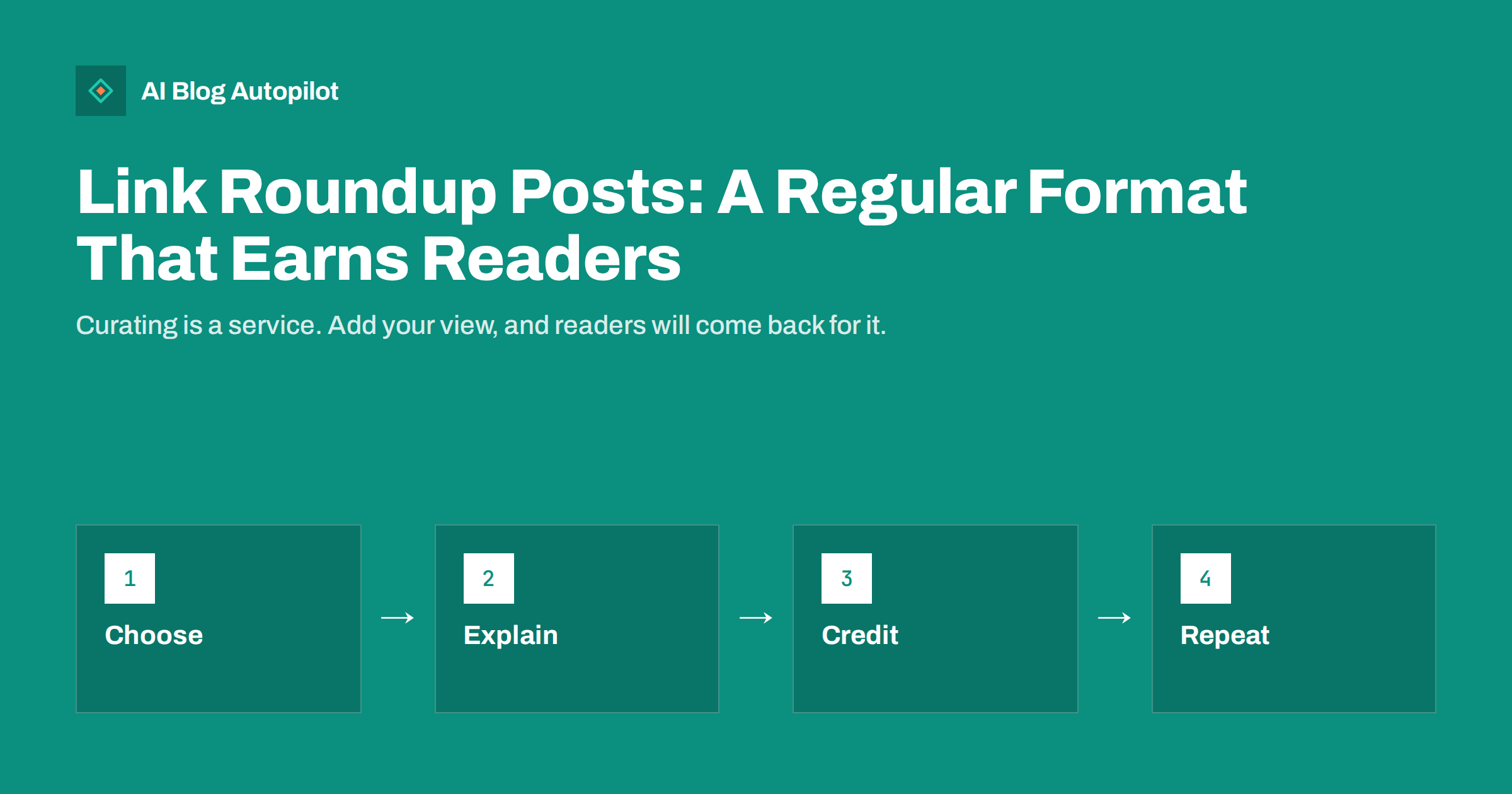
Short answer: a link roundup is a regular post that collects the best articles, tools and news on your topic, with a short comment on each one. It works when the links are well chosen, when you say why each is worth a reader’s time, when you credit the sources clearly and when you publish on a steady rhythm. Done without commentary, it is just a list of other people’s work, which readers and search engines do not value.
Blogs that cover a field with a lot of news and ideas can become a trusted guide, simply by sorting the noise for their readers. A weekly or monthly roundup is one of the easiest ways to do that. It needs less writing than a full article, it builds goodwill with the people you link to and it gives readers a reason to return. This guide explains how to plan one, how to write it and what to avoid.
The format suits many kinds of business, from a software company that follows an industry to a shop that follows trends in its products. The key is that you know your readers well enough to choose what they would want to see.
Why a roundup can work
Readers are short of time. Every field has many sources, and few people can follow them all. A roundup says: here is what mattered this month, and here is what we think. That saves time for the reader, and it shows that you follow the field closely, which builds trust in your own work.
It also helps relations with others. People like to be mentioned by a blog that they respect, and some will share the post with their own followers. This is not a promise of links in return, and you should never ask for any. But a record of fair, helpful mentions makes it easier to talk to other writers later, as discussed in digital PR on a small budget.
Finally, a roundup keeps a blog alive in a quiet period. When you have no big topic, a roundup gives you a post that is useful and quick to produce. It must not be a lazy substitute for original work, but it can be a regular part of a healthy mix.
Who the roundup is for
Decide on the reader before you collect links. Is it a beginner who wants an easy way into the field, a busy professional who needs headlines or a customer who wants tips on using a product? The answer shapes the choice of links, the length of the comments and the tone of the post.
Keep the focus narrow. A roundup on “marketing” is too wide, and it will end up as a random list. A roundup on “email marketing for small online shops” gives you a clear filter. If a link does not help that reader, leave it out, however interesting it is.
Write the promise in a single line at the top of the post, and use it every time. For example: “Every month, five pieces of reading that help small shops send better emails.” The line helps readers to understand the format, and it guides you when you choose.
Ask your own readers and customers, too. A short question in your newsletter or on a social network, such as “what was the best thing you read this month?”, gives you leads that you would never find alone, and it makes the roundup feel like a shared project. Credit the reader if they agree to be named.
How to find good links
Build a routine for collecting links through the month. Save interesting pieces as you meet them in a folder, a list or a shared note, with a line on why each one stood out. At the end of the period, you will have a pool to choose from, rather than a search to start from scratch.
Use a mix of sources: well-known sites, small blogs, research reports, tools and, from time to time, a video or a podcast episode. Do not include only the biggest names, since your readers can find them without you. A good small source that readers have not seen is often the most valued item.
Open every link before you include it. Check that it works, that it says what you think it says and that the site is trustworthy. Avoid pages that are mainly adverts, copied content or claims that you cannot support. The article on external links in blog posts explains how to link out with care.
Vary the length of the comments. Some links deserve a single line, others need a short paragraph, for example when you want to explain a method or a warning. A little variety keeps the post pleasant to read, while a fixed minimum of one useful sentence keeps every entry worth its place.
How to write each entry
Each entry needs three things: the title of the piece as a link, the source, and one to three sentences that say what it is about and why it matters to your reader. Add your own view, such as what is useful, where you disagree or how to apply it. This is the part that makes the post yours.
Be honest about what you think. If an article is good but too long, say so. If an idea is useful but needs a caution, mention it. Readers value a guide who is straight with them, and it also keeps the post from reading like a press release.
Do not copy long passages from the pages that you link. A short quote of a line or two, with credit, is fine, but your own summary is better. Respect the work of the authors, and let readers go to the source for the full text. See the guide to a simple reuse policy for how to think about quoting.
Links and search
A roundup contains many outgoing links, so think about how they are treated. Links that you choose freely, because you think they are good, are normal links. Links that you are paid for, or that come from an agreement, should be marked as sponsored. The article on nofollow, sponsored and UGC links explains the options.
For search, the roundup itself may rank for a phrase like “best resources on” your topic, but it will not carry the weight of an in-depth guide. Include internal links to your own relevant articles, so that the roundup also leads readers to your own work, in the way that the piece on internal linking describes.
Give the post a clear title with the period and the topic, such as “Email marketing reading list: November”. Make each post unique, and avoid reusing the same text. Do not create near-copies of old roundups, and consider an index page that lists all editions.
A simple example shows the shape. Open with two sentences on what the month was about. List six links, each with its source, a two-sentence summary and a line of your own opinion. Close with a link to your own article that fits the theme, and a question that invites readers to send links. The whole post can be written in under an hour.
Rhythm and length
Choose a rhythm that you can keep: weekly for fast fields, monthly for slower ones. Publish on the same day each time, so that readers learn when to expect it. Five to ten links are usually enough, and fewer, better links beat a long list.
Keep a standard shape, with a short opening, the links in a fixed order and a closing line that invites readers to suggest links. A repeated structure speeds up your writing, and it makes the post easy to scan. The format in how to write a list article that is not filler offers more ideas.
If you miss a period, do not worry. It is better to skip an edition than to publish a weak one. Say nothing, or say a short note, and return at the next date.
Keep a note of which kinds of links your readers click most. Over a few months you will see a pattern, such as a taste for tools over news, or for short guides over long reports. Use it to adjust the next editions, and to give ideas for your own original articles.
Sharing and measuring
Tell the people you link to. A short, friendly message or a tag on social networks, with no request, is polite and often leads to a share. Follow the habits in tagging and mentioning other accounts, and avoid tagging people in a way that looks like spam.
Use the roundup in your newsletter and in social posts. A good way is to take one link and give a short comment on a network, then link to the full post. The article on building a newsletter from your blog posts shows how.
Measure what matters: visits, time on the page, clicks on the links and the number of readers who return. If readers click on links but do not read your comments, the format may need more value from you. If few readers come, adjust the topic or the audience.
Mistakes to avoid
Do not publish a roundup that is only a set of links. Do not include links that you have not read. Do not promise coverage or exchange links, and do not change the order or the tone to please a source. Do not use the format to attack other writers, or to pass off their summaries as your own work.
Be careful with fast-changing facts. If a link covers news, say when you read it, since facts may change after the post is published. Review old editions occasionally and fix broken links, or add a note that the page has moved.
Finally, do not let the roundup replace your own thinking. Treat it as one part of a content plan, next to guides, case studies and opinion pieces.
How AI Blog Autopilot helps
AI Blog Autopilot writes full SEO articles for your WordPress blog from the topics, keywords, audience and tone you set, and shares each one to your social networks, so your original articles keep coming while you collect links for a roundup. The writer is instructed never to make up statistics, quotes or sources. See the pricing page for plans.
Related reading
- Curating Other People’s Content on Social Media Without Losing Your Voice
- External Links in Blog Posts: When and How to Link Out
- How to Write a List Article That Is Not Filler
The bottom line
A roundup works when you choose a clear reader, pick few good links, add your own view and publish on a steady rhythm. Credit every source and keep your original articles at the centre.
FAQ
How many links should a roundup have?
Five to ten is usually enough. A few well-chosen links with real commentary beat a long list.
How often should I publish one?
Weekly for fast-moving fields and monthly for slower ones. Pick a day and keep to it.
Do I need permission to link to other sites?
Normally not for a simple link, but do not copy long passages. Summarise in your own words and credit the source.
Should the links be nofollow?
Links you choose freely are normal links. Mark paid or exchanged links as sponsored.
Will a roundup help my SEO?
It can attract readers and mentions, but it will not replace in-depth articles. Add internal links to your own relevant posts.