ENEnglish
 LTLietuviškai
 DEDeutsch
 FRFrançais
 RUРусский
 ESEspañol
 PLPolski
 ITItaliano
 UKУкраїнська
 CSČeština
 PTPortuguês
 JA日本語
JA日本語 LVLatviešu valoda
 ETEesti
 HUMagyar
 IDBahasa Indonesia
 TRTürkçe
 HIहिन्दी
 ELΕλληνικά
 ARالعربية
 THไทย
THไทย VITiếng Việt
 RORomână
 MSBahasa Melayu
 BNবাংলা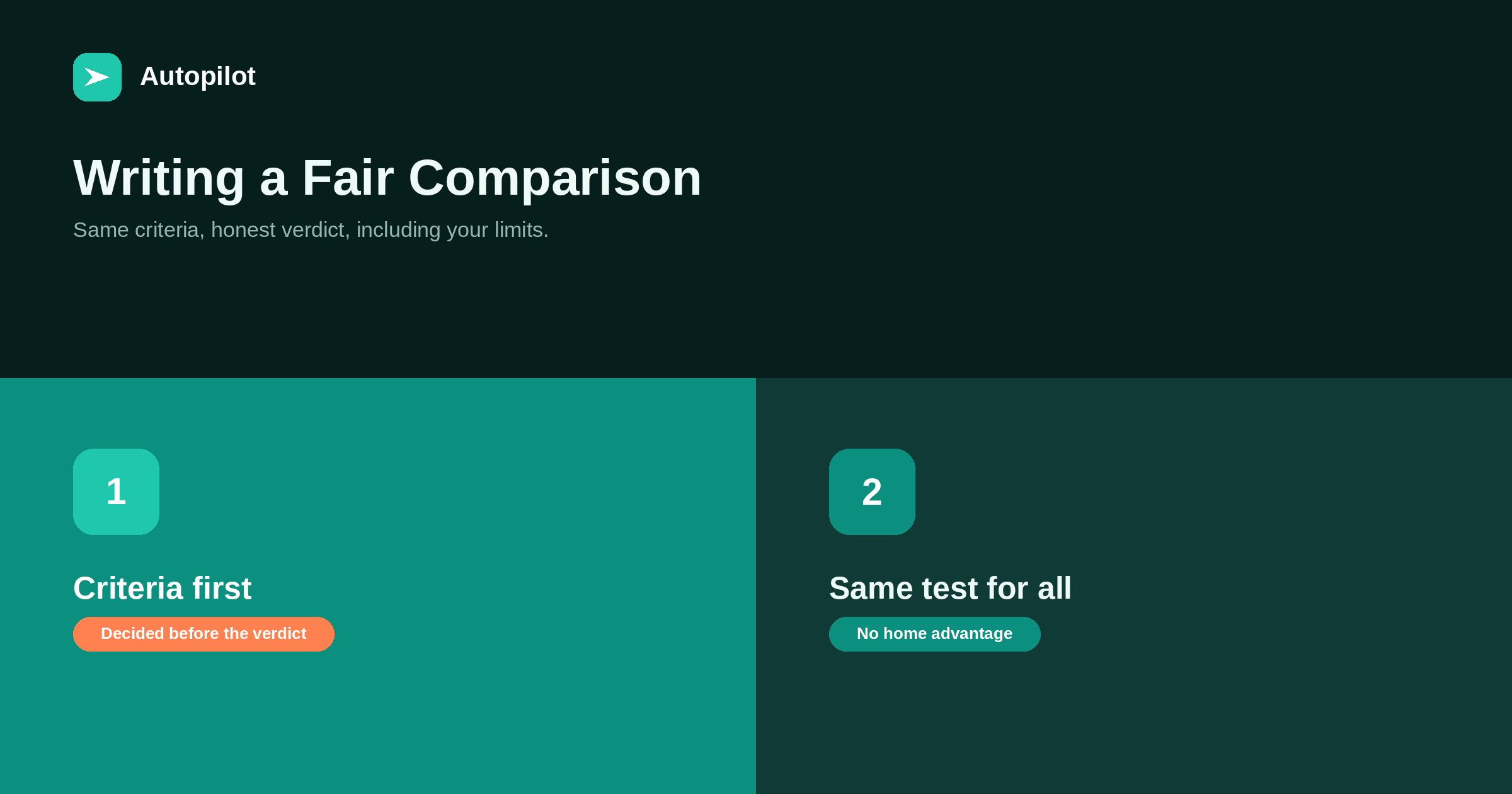
Short answer: decide the criteria before the verdict, based on what readers actually need to choose. Apply the same criteria to every option, using current, checkable information. Present the comparison as a table plus prose explaining the trade-offs. End with who each option suits rather than a single winner for everyone. If your own product is included, say so, and be honest about where it is not the best choice. Keep claims about other products accurate and dated, and review the article whenever any of them changes.
Comparison searches — this versus that, best option for, alternatives to — come from people close to a decision. That makes comparison articles valuable, and it is why so many of them are adverts dressed as analysis.
Readers have learned to spot the difference. A fair comparison earns trust in a way a rigged one never can, and it is not much harder to write.
Criteria before verdict
Decide what you are comparing on before you look at the results. The criteria should reflect what readers need to choose: cost, effort, suitability for particular situations, limits.
Choosing criteria after deciding the winner — picking the dimensions where your preferred option looks best — is the most common way comparisons become biased. Readers may not see the mechanism, but they sense the result.
The same test for every option
Apply every criterion to every option, using the same kind of evidence. If you tested one option yourself, test the others too, or say that you did not.
| Do | Do not |
|---|---|
| Use current official information for each | Use last year’s data for competitors |
| Note the date you checked | Present old details as current |
| Include each option’s real strengths | List only weaknesses of others |
| Say where information was unavailable | Guess and present it as fact |
| Disclose any relationship with an option | Hide affiliation or ownership |
fact-checking before you publish covers where to find reliable information fast.
The structure that works
A comparison article usually follows a clear shape.
- Short answer: who each option suits, in a few sentences.
- The criteria and why they matter.
- A comparison table across the criteria.
- A section per option explaining strengths, limits and fit.
- Scenarios: if you are in situation X, choose Y, because.
- FAQ for the leftover questions.
The table gives the overview; the prose explains trade-offs the table cannot. when a table beats three paragraphs covers keeping tables readable on a phone.
Who each suits, not one winner
Very few comparisons have a single honest winner for everyone. Options suit different situations, budgets and priorities.
Ending with best for small teams, best for highly specialised subjects, best if budget is the main constraint is more useful than declaring one champion, and more believable. Readers find their own situation and trust the recommendation because it clearly depends on it.
Including your own product
If your own product is one of the options, the reader should know. Say so plainly near the start.
Then be visibly fair: include the situations where another option is better. This feels risky and is usually the opposite. A comparison that admits its author’s limits is one of the few a reader will believe, and the readers it sends elsewhere were rarely going to be good customers.
Claims about other products
Statements about competitors or alternatives must be accurate, current and fair. Prices, features and limits change; an article describing an old version misleads readers and can create legal risk.
Link to each option’s official pages for details that change, note when you last checked, and avoid characterising others in ways you cannot support. Keep the tone factual rather than dismissive.
Comparisons of approaches, not just products
Some of the most useful comparisons are between approaches rather than brands: doing it yourself versus hiring, building versus buying, one method versus another.
These avoid many of the pitfalls of product comparisons, age more slowly, and serve readers earlier in their decision. freelancer, agency or automation is an example on this site.
Scenarios make the verdict useful
A scenarios section translates the comparison into decisions. It takes the reader’s likely situations and says what to choose in each, with the reason.
If you publish two articles a month and have a subject expert on staff, a freelancer may be enough. If you need thirty articles a month across several sites, automation with review is usually more practical. If your subject is regulated, whichever route you choose needs an expert reviewer. Each scenario should be specific enough that a reader can recognise themselves, and honest enough that some readers are pointed away from your own offer.
Scenarios are also the part of a comparison most often quoted and shared, because they answer the question the reader actually has: which is right for me?
Keeping comparisons current
Comparison articles decay faster than most, because every option in them changes. Review them at least twice a year, and whenever one of the options makes a significant change.
Keep a note of the facts each comparison relies on, so reviewing means checking a list rather than rereading everything. refreshing old posts covers the wider process.
Linking out and in
Link to each option’s official page for current details, and link to the comparison from related articles on your own site where readers are weighing the same choice. A good comparison becomes a hub for a decision.
What a comparison can and cannot do
A fair comparison helps readers decide and builds trust in your judgement. It will not persuade someone for whom another option is genuinely better, and it should not try.
No format guarantees rankings or sales. Comparisons are simply one of the formats where honesty is most visibly rewarded by readers.
Related reading
If this was useful, these cover the questions that usually come next.
- Search intent — why comparison queries are valuable
- Freelancer, agency or automation — an example of the format
- Fact-checking before you publish — checking claims about other options
The bottom line
Set the criteria before the verdict, apply them equally with current and dated information, and present a table plus prose on the trade-offs. End with who each option suits. Disclose your own involvement, admit where another option is better, keep claims about others accurate, and review the article whenever an option changes.
FAQ
How do I write a fair comparison article?
Decide the criteria first, apply them equally to every option using current information, present a table and prose on trade-offs, and end with who each option suits.
Can I compare my own product with competitors?
Yes, if you disclose it clearly and are honest about where other options are better. Readers trust comparisons that admit their author’s limits.
Should a comparison pick a single winner?
Rarely. Most options suit different situations. Saying who each suits is more useful and more believable.
How often should comparison articles be updated?
At least twice a year, and whenever one of the options changes significantly.
What should the comparison table include?
The criteria readers need to choose, applied to every option, with information that is current and checkable. Keep it to a few columns so it works on a phone.
Is it risky to mention competitors?
Only if claims are inaccurate or unfair. Keep statements factual, current and linked to official sources.