ENEnglish
 LTLietuviškai
 DEDeutsch
 FRFrançais
 RUРусский
 ESEspañol
 PLPolski
 ITItaliano
 UKУкраїнська
 CSČeština
 PTPortuguês
 JA日本語
JA日本語 LVLatviešu valoda
 ETEesti
 HUMagyar
 IDBahasa Indonesia
 TRTürkçe
 HIहिन्दी
 ELΕλληνικά
 ARالعربية
 THไทย
THไทย VITiếng Việt
 RORomână
 MSBahasa Melayu
 BNবাংলা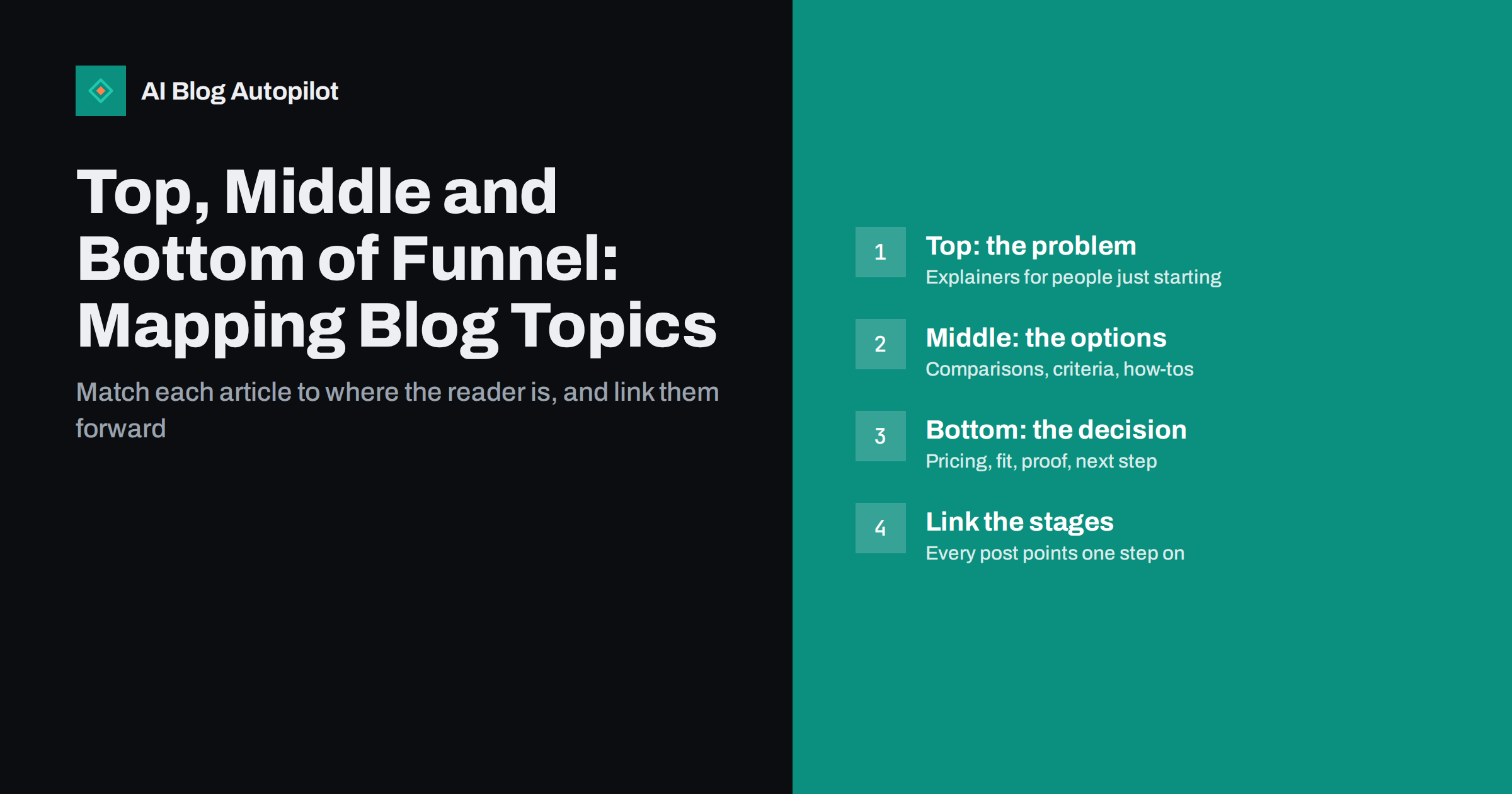
Short answer: funnel mapping means sorting blog topics by how close the reader is to a decision. Top-of-funnel articles help people understand a problem, middle-of-funnel articles help them compare approaches and options, and bottom-of-funnel articles help them decide whether a specific solution fits. Most blogs publish too much at the top and too little at the bottom. A balanced plan covers all three stages and links each article to the logical next step.
A blog can attract plenty of visitors and still produce almost no enquiries. When that happens, the cause is often not the quality of the writing but the mix of topics. The articles answer questions from people who are only curious, while the questions asked by people ready to choose go unanswered.
The funnel is a simple model for spotting that imbalance. It is not a precise science, and real readers do not move neatly from one stage to the next, but it is a useful lens for planning what to write next.
What the three stages mean
Different teams use different labels, such as awareness, consideration and decision, but the underlying idea is the same.
| Stage | Reader’s situation | Typical questions | Article types |
|---|---|---|---|
| Top (awareness) | Notices a problem or goal, may not know solutions exist | What is…, why does…, how to start… | Explainers, beginner guides, checklists |
| Middle (consideration) | Knows the problem, weighing approaches | How to choose…, X vs Y, best way to… | Comparisons, buying criteria, detailed how-tos |
| Bottom (decision) | Choosing a specific provider or product | Cost of…, is X worth it, X alternatives, X for my situation | Pricing explainers, use-case pages, honest fit guides |
A reader might enter at any stage. Someone who already knows exactly what they need may arrive straight from a search for pricing. Someone else may read a beginner guide, leave, and return months later. The funnel describes intent, not a fixed journey.
Top of the funnel: explaining the problem
Top-of-funnel articles reach the widest audience. They answer broad questions about the problem your business solves, before the reader is thinking about any particular solution.
For an accounting firm, that might be “how to keep receipts organised” or “what records a sole trader must keep”. For a software company, it might be “why projects miss deadlines” or “what a content calendar is”.
- Strengths: they attract new audiences, build familiarity with your name, earn links, and give you something to share on social media.
- Weaknesses: most readers are not ready to buy, and the topics are often competitive because every business in the field writes them.
- What they need: a clear, generous answer, and one natural link to a deeper article. Pushing a sales message at this stage usually backfires.
Middle of the funnel: comparing approaches
At the middle, readers know what the problem is and are exploring how to solve it. They compare categories of solution, learn what matters when choosing, and try methods themselves.
- Examples: “spreadsheet or accounting software”, “how to choose a project management tool”, “freelancer or agency for a website”, “what to look for in a standing desk”.
- Strengths: readers are engaged and actively researching, so they read more and remember who helped them.
- What they need: fair criteria, honest trade-offs and practical detail. This is where your expertise shows most clearly, because you can explain what really matters from experience.
Middle-stage content is also where an honest mention of your own offering can fit naturally, as one option among others, described accurately with who it suits and who it does not.
Bottom of the funnel: supporting the decision
Bottom-of-funnel articles answer the questions people ask just before choosing. These are the topics many businesses avoid because they feel too salesy or too exposed, yet they are the ones most likely to produce enquiries.
- Cost questions. What drives the price, what is included, what extra costs to expect. Link to your pricing page rather than repeating figures that may change.
- Fit questions. “Is this suitable for a team of three?”, “Does it work for restaurants?”, “Can I use it without a website?”
- Comparison with named alternatives. Fair comparisons of your approach against others, including when the alternative is the better choice.
- Setup and switching. What happens after signing up, how long it takes, and how to move from an existing solution.
- Objections. Honest answers to the concerns that stop people buying, such as contracts, cancellation, data ownership and support.
These topics often have low search volume, but the readers are highly qualified. One bottom-stage article that answers a question sales hears every week can be worth more than ten broad explainers.
How to map your existing blog
Before planning new content, find out where you are now. This takes an afternoon for most blogs.
- List your posts. Export titles and URLs from your CMS or XML sitemap into a spreadsheet.
- Label each one. Mark each post top, middle or bottom based on the question it answers. If you are unsure, ask how close to buying someone would be when searching for that title.
- Add performance. Pull traffic and, if you track them, enquiries or sign-ups that started on each post.
- Count by stage. Most blogs discover a heavy top, a thin middle and an almost empty bottom.
- Look for broken paths. For each top-stage post, check whether it links to a related middle-stage article. For each middle-stage post, check whether a relevant bottom-stage article exists.
Balancing the plan
There is no universal ratio. The right mix depends on how well known your category is, how long your sales cycle runs and how much traffic you already have. Some general patterns help, though.
- New blogs often do well to start with middle and bottom topics, because those are specific, less competitive and directly useful to the business. Broad top-stage topics can follow once the site has some authority.
- Established blogs with plenty of traffic but few leads usually need more bottom-stage content and better links from existing top-stage posts.
- Businesses in a new category, where people do not yet know the solution exists, need more top-stage content to create awareness of the problem.
- Long sales cycles with several decision-makers benefit from strong middle-stage content that people can share internally.
A practical approach is to plan each month with at least one article per stage, then adjust based on which stages produce results.
Linking the stages together
Mapping topics is only half the job. The other half is making sure a reader who finishes one article has an obvious, relevant next step.
- From a top-stage explainer, link to the guide that explains how to choose or how to do it properly.
- From a middle-stage comparison, link to the article that explains costs, fit or setup for your approach.
- From a bottom-stage article, link to the page where they can act: pricing, a demo request, a contact form or a free trial.
Calls to action should match the stage. Asking a reader of a beginner explainer to book a sales call is too big a jump. Offering a checklist or a deeper guide is not.
Measuring by stage
Judging all articles by the same number leads to bad decisions. Top-stage posts will always have more traffic and fewer conversions. Bottom-stage posts will have less traffic and more enquiries.
- Top: reach, new visitors, links earned and clicks through to deeper articles.
- Middle: engagement, return visits and clicks to bottom-stage content.
- Bottom: enquiries, sign-ups and assisted conversions, even if the reader first arrived through another post.
Assisted conversions matter because readers rarely convert on the first article they read. A top-stage post that introduced someone who later bought through a bottom-stage page contributed to that sale.
Common mistakes with funnel mapping
- Forcing every post into a stage. Some articles serve several stages at once, such as a thorough guide that explains a problem and compares solutions. Label them by their main purpose and move on.
- Writing bottom-stage posts as adverts. Decision content works because it is honest. An article that only praises your offer and ignores trade-offs reads as a sales page and is rarely trusted or shared.
- Ignoring the middle. Jumping from beginner explainers straight to pricing leaves readers without the criteria they need to choose, so they look for that help elsewhere.
- Judging stages against each other. Comparing the traffic of a pricing explainer with the traffic of a broad guide leads to cutting the content that produces enquiries.
How AI Blog Autopilot fits in
AI Blog Autopilot plans a month of articles from the topics, keywords, audience and tone you set, and topics can carry different weights. Giving it a mix of broad topics, comparison topics and decision topics, weighted by what your blog lacks, lets it fill each funnel stage steadily. It writes 2,000–3,000-word SEO articles with FAQ, tags and meta, publishes them to your WordPress blog and shares each one to your social networks. You can see how topic planning works on the AI Blog Autopilot home page.
Related reading
- Traffic or Leads: Which Number Should a Blog Chase?
- Content for a Buying Committee
- Calls to Action That Fit the Article They Sit In
- Turning Customer Questions Into Useful Blog Topics
The bottom line
Map every article to a stage: understanding the problem, comparing approaches, or deciding. Most blogs are top-heavy, so the fastest gains usually come from writing the honest bottom-stage articles that answer cost, fit and switching questions, and from linking every post to the logical next step. Measure each stage by what it is supposed to do, not by traffic alone.
FAQ
What is top-of-funnel content?
Top-of-funnel content helps people understand a problem or goal before they are looking at specific solutions. Typical formats are explainers, beginner guides and checklists. It attracts the widest audience but the fewest immediate enquiries.
What counts as bottom-of-funnel blog content?
Articles that help someone decide whether a specific solution fits them: cost explainers, use-case articles, honest comparisons with alternatives, setup and switching guides, and answers to common objections. These usually have lower traffic but higher conversion.
What is a good ratio of funnel stages for a blog?
There is no universal ratio. New blogs often benefit from starting with middle and bottom topics, while businesses in unfamiliar categories need more top-stage content. Review results by stage and shift the mix toward what your blog lacks.
Should every blog post have a call to action?
Yes, but it should match the stage. A top-stage explainer might point to a deeper guide, while a bottom-stage article can point to pricing or a contact form. A mismatched call to action tends to be ignored.
How do I know which stage an article belongs to?
Ask how close to a purchase someone would be when searching for that title. Questions about what something is sit at the top, questions about how to choose sit in the middle, and questions about cost, fit and specific providers sit at the bottom.