ENEnglish
 LTLietuviškai
 DEDeutsch
 FRFrançais
 RUРусский
 ESEspañol
 PLPolski
 ITItaliano
 UKУкраїнська
 CSČeština
 PTPortuguês
 JA日本語
JA日本語 LVLatviešu valoda
 ETEesti
 HUMagyar
 IDBahasa Indonesia
 TRTürkçe
 HIहिन्दी
 ELΕλληνικά
 ARالعربية
 THไทย
THไทย VITiếng Việt
 RORomână
 MSBahasa Melayu
 BNবাংলা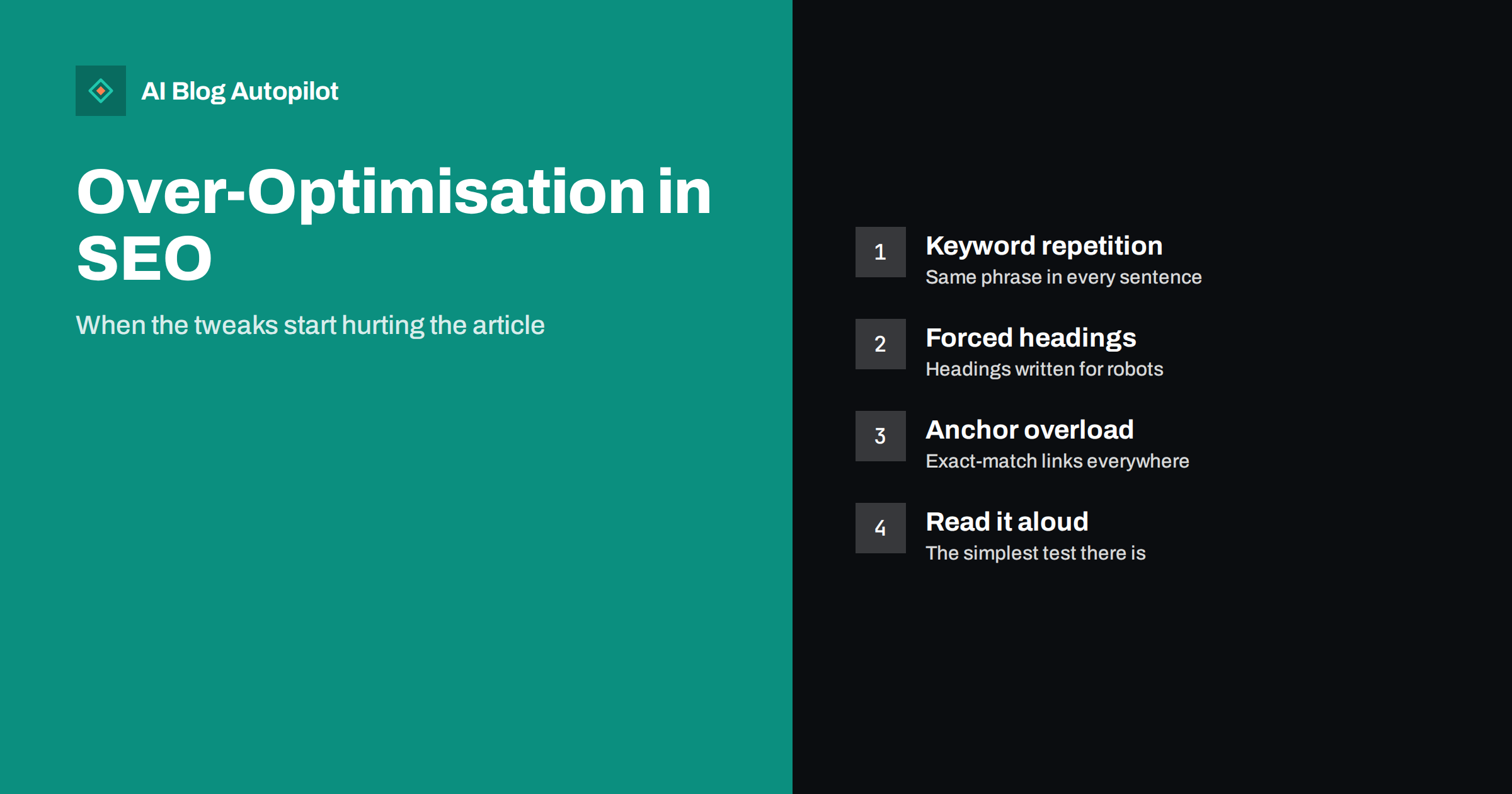
Short answer: over-optimisation is SEO applied past the point where it helps readers: the same keyword repeated in every paragraph and heading, awkward exact-match phrases, internal links with identical anchor text, padded length and sections written for search engines rather than people. Modern search engines understand synonyms and context, so this adds little and can make a page read as spam, which Google’s spam policies explicitly cover. The fix is to write for the reader first, use the main phrase where it fits naturally, and let related language and clear structure signal relevance.
Most SEO advice is about doing more: more keywords, more headings, more links, more words. Past a certain point, more starts to cost. Articles become harder to read, less trustworthy and, in the worst cases, look like the manipulation search engines are designed to ignore.
Over-optimisation is common on blogs that follow checklists too literally, and on content produced at volume with a rigid template. This article explains what it looks like, why it no longer works, and how to fix an over-optimised page without losing its strengths.
What over-optimisation looks like
It is usually easy to recognise once you know the signs. An over-optimised article typically has several of these:
- The exact target phrase in the title, the first sentence, most headings, the conclusion and scattered through almost every paragraph.
- Grammatically awkward phrases, because the keyword was inserted as typed into a search box, such as “best plumber London cheap”.
- Headings that repeat the keyword with small variations rather than describing what each section covers.
- Paragraphs that restate the same point to reach a word count.
- Internal links that all use the same exact-match anchor text.
- Lists of keyword variants or locations at the end of the page.
- Bold text applied to keywords rather than to genuinely important points.
The common thread is that the text was shaped for a search engine’s imagined preferences at the expense of the reader.
Why it stopped working
Early search engines relied heavily on matching words on the page to words in the query. Repeating a phrase could genuinely make a page look more relevant. That has not been true for a long time.
- Search engines understand language. They recognise synonyms, related concepts and the meaning of a passage, not just exact strings. A page that explains a topic thoroughly is understood as relevant without repeating one phrase.
- They measure usefulness in many ways. Ranking systems are designed to reward content that helps people, and awkward, repetitive text does not.
- Keyword stuffing is explicitly spam. Google’s spam policies list keyword stuffing, including repeating words unnaturally and lists of cities a page tries to rank for.
There is also a reader-side cost that is easy to underestimate. People who land on a page full of repeated phrases quickly sense that it was written for a machine, and they leave or stop trusting it. A reader who does not trust the page will not act on it, however well it ranks.
In mild cases, over-optimisation simply wastes effort. In severe cases, it can cause a page, or a site, to be treated as low quality.
Keyword repetition: how much is too much
There is no correct keyword density, and tools that calculate one measure something search engines do not use in that form. A more useful approach is to ask where the main phrase belongs.
- In the title, naturally worded.
- Early in the article, usually in the opening answer, because that is where readers expect the topic to be named.
- In one or two headings where it genuinely describes the section.
- Elsewhere, only where it reads naturally. Use pronouns, synonyms and related terms the rest of the time, as you would in normal writing.
A practical test: read the article aloud. If a phrase keeps jumping out and you would never say it that way in conversation, it is over-used. How many keywords one article should target covers the planning side.
Headings written for robots
Headings help readers scan and help search engines understand structure. Over-optimised headings do neither well.
| Over-optimised | Better |
|---|---|
| Email Marketing Tips for Small Business | Build your list before you write your first email |
| Best Email Marketing Tips for Small Business Owners | How often to send without losing subscribers |
| Email Marketing Tips for Small Business: Conclusion | The bottom line |
The better versions describe what each section actually answers, which makes them more useful for skimming, better as potential featured snippet targets and more natural as passages for AI answers. They also cover more related searches, because they contain different words.
Length padding
Because longer articles often rank well, some writers stretch articles to hit a word count. But length correlates with rankings because thorough coverage takes space, not because words are counted.
Padding shows up as:
- Long introductions that explain why the topic matters before saying anything about it.
- Repeated summaries after each section.
- Generic sections that could appear in any article, such as “why this is important” for an obviously important topic.
- Obvious statements stretched into paragraphs.
The right length is whatever it takes to answer the query well and cover the follow-up questions. How long a blog post should be explains how to judge that from the results page.
Internal link and anchor text overload
Internal links are valuable, and they too can be overdone.
- Too many links in one paragraph make text hard to read and dilute the importance of each.
- Identical exact-match anchors across the whole site look mechanical. Varied, descriptive anchors are more natural and give search engines more context.
- Irrelevant links added to push a page, where the reader gains nothing from following them.
- Linking the keyword every time it appears rather than once, where it helps.
A good internal link is one a reader would plausibly click at that point in the text. Internal linking on autopilot covers how to build links at scale without them becoming noise.
Other forms of over-optimisation
- Meta titles crammed with variants separated by pipes. They are often rewritten by search engines and look spammy in results.
- Image alt text stuffed with keywords instead of describing the image. Alt text exists for accessibility first. The alt text guide explains how to write it.
- FAQ sections with invented questions that only repeat the keyword, rather than questions people actually ask.
- Structured data that overstates what the page contains.
- Many near-identical pages targeting small keyword variations, such as one page per town with only the name changed.
The last item deserves emphasis because it tends to happen at scale. Twenty pages that differ only in a place name or product variant add little for readers and can drag down how search engines view the site as a whole. One strong page, with specific sections where locations or variants genuinely differ, is almost always better.
How to fix an over-optimised article
Fixing is usually quick, and it rarely needs a rewrite.
- Check what the page ranks for in Search Console before editing, so you know what to protect.
- Read the article aloud and mark every place that sounds unnatural.
- Reduce the exact phrase to the title, the opening, one or two headings and places where it reads naturally. Replace the rest with pronouns, synonyms or more specific wording.
- Rewrite headings to describe what each section answers.
- Cut padding: repeated summaries, generic sections and warm-up paragraphs.
- Vary internal link anchors and remove links a reader would not click.
- Fix the meta title and alt text if they are stuffed.
- Add substance where you cut: an example, a specific step, a common mistake. Replacing filler with value is better than simply shortening.
After the change, monitor the page for four to eight weeks. Pages usually hold or improve. If one drops noticeably, compare with the old version to see whether a section serving a particular query was removed.
Preventing it in the first place
A few habits stop over-optimisation from creeping into new content:
- Plan each article around one reader question, not a list of phrases to include.
- Write the draft for the reader, then check SEO basics once at the end.
- Treat SEO plugin scores as reminders, not targets. Aiming for a green light on every metric is a common cause of stuffing.
- Give writers, human or automated, a brief that describes the reader and the question, not a quota of keyword uses.
- Review a few published articles each month with fresh eyes. Patterns such as the same heading formula in every post are easier to spot across several articles than within one.
- Include over-optimisation on your pre-publication checklist: read aloud, check headings, check anchors.
How AI Blog Autopilot approaches this
AI Blog Autopilot plans each article around a real search query and writes long-form articles with FAQ, tags and SEO meta. Its automatic quality check covers length, structure, keyword and meta, and articles that fall short wait for you instead of going live. Reading a sample of articles aloud now and then is still a good habit for any blog. See the AI Blog Autopilot home page for details.
Related reading
- How to Edit an AI Draft: The Four Passes That Matter
- Readability: Writing So People Finish the Article
- Why Your Blog Posts Aren’t Ranking: Eight Real Causes
The bottom line
Over-optimisation is SEO that no longer serves the reader: repeated keywords, robotic headings, padded length, identical anchors and stuffed metadata. Search engines understand language well enough that none of it helps, and keyword stuffing is explicitly treated as spam. Write for the reader, use the main phrase where it fits naturally, describe sections honestly and replace filler with substance. The result reads better and usually performs at least as well.
FAQ
What is over-optimisation in SEO?
It is applying SEO techniques beyond the point where they help, such as repeating keywords unnaturally, forcing them into every heading, padding length and over-using exact-match links. The result reads poorly and can be treated as low quality or spam.
Is there an ideal keyword density?
No. Search engines understand synonyms and context, so there is no percentage to hit. Use the main phrase in the title, the opening and where it fits naturally, and write normally everywhere else.
Can over-optimisation cause a ranking drop?
Mild over-optimisation mostly wastes effort, but severe cases such as keyword stuffing fall under search engine spam policies and can lead to pages being demoted. Over-optimised text also tends to perform worse with readers.
Should I aim for a perfect score in my SEO plugin?
No. Plugin scores are simplified checklists. Chasing every green light often leads to repeated keywords and awkward phrasing. Use the checks as reminders, then judge the article by how well it reads.
How do I fix an article that repeats its keyword too often?
Keep the phrase in the title, opening and one or two headings, and replace the other uses with pronouns, synonyms or more specific wording. Read the result aloud to confirm it sounds natural.