ENEnglish
 LTLietuviškai
 DEDeutsch
 FRFrançais
 RUРусский
 ESEspañol
 PLPolski
 ITItaliano
 UKУкраїнська
 CSČeština
 PTPortuguês
 JA日本語
 LVLatviešu valoda
 ETEesti
 HUMagyar
 IDBahasa Indonesia
 TRTürkçe
 HIहिन्दी
 ELΕλληνικά
 ARالعربية
 THไทย
 VITiếng Việt
 RORomână
 MSBahasa Melayu
 BNবাংলা
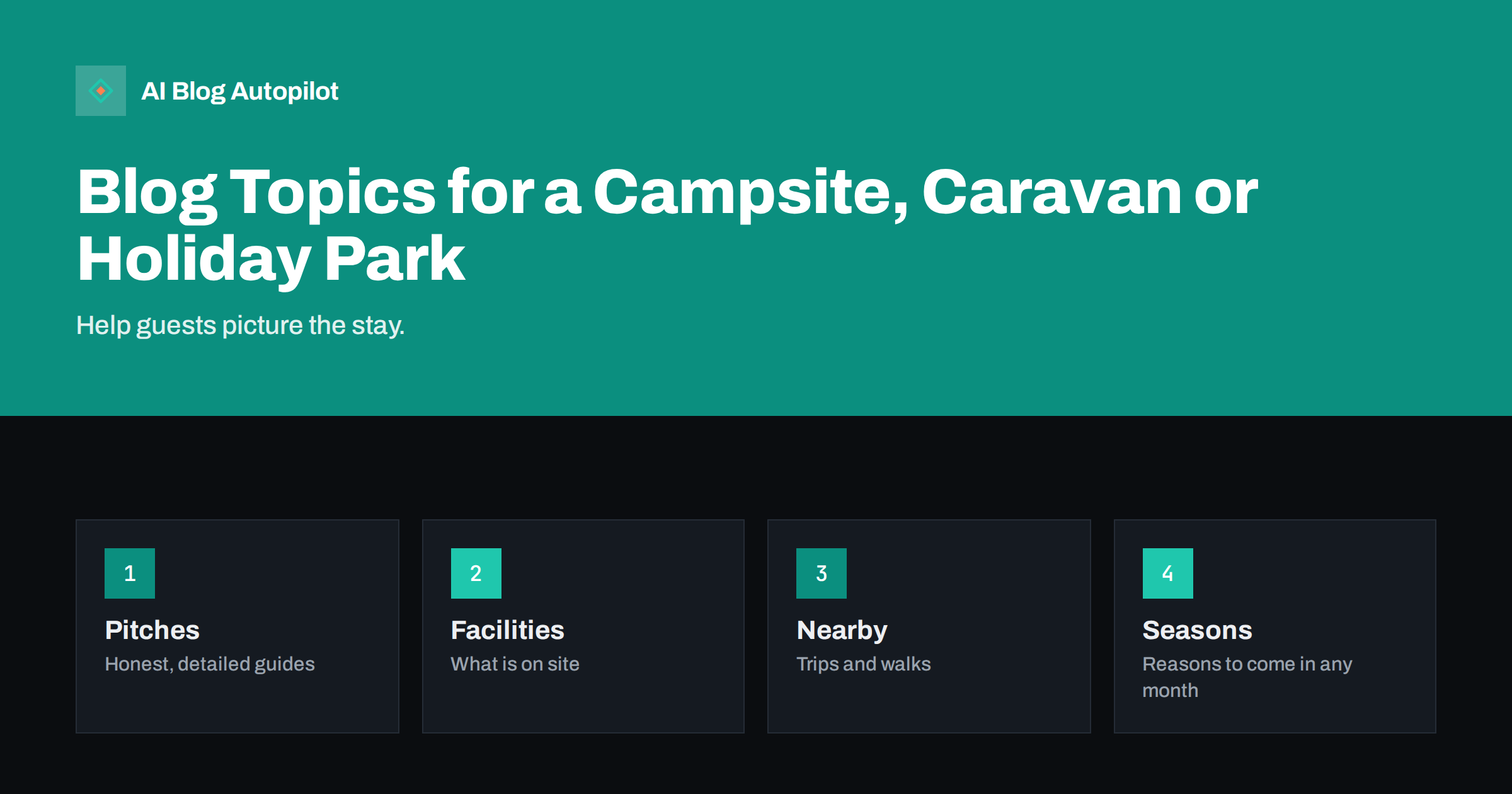
Short answer: a campsite or holiday park blog works best when it describes pitches and facilities honestly, explains how a stay works, suggests walks, trips and rainy-day plans nearby, answers family and pet questions and gives guests a reason to visit outside the peak weeks. Keep rules, prices and opening dates accurate and dated.
People choose a holiday site with care. They study photographs, read reviews, check distances and worry about noise, mud, toilets and weather. A blog gives you room to answer these worries in detail and to show what makes your site different from the next field along the road.
This guide suggests topics for campsites, caravan and motorhome parks, glamping sites and small holiday parks. It covers the booking journey, daily life on site, the area around you and the off-season, with advice on wording that is honest and welcoming.
Describe pitches and accommodation honestly
Guests cannot walk the site before they book, so describe it in detail. Write a guide to each type of pitch or unit: size, surface, slope, shade, hook-up availability, distance from toilets and from the road. Include photographs taken at ordinary times, not only on perfect sunny days, and a simple map that shows where each type is located.
Explain what suits whom. A large motorhome needs a different pitch from a small tent, and a family with young children may want to be close to the play area while a couple seeking quiet will not. Honest guidance reduces disappointment and complaints, and it helps guests choose the right booking the first time.
For glamping and fixed accommodation, list what is included: bedding, kitchen equipment, heating, towels, outdoor furniture. Say what guests should bring. Few things annoy visitors more than discovering on arrival that something they assumed was provided is not. Link to a clear page for arrival times, departure times and late arrivals.
Show the facilities and the daily routine
Write about what is on site and how it works: toilets and showers, laundry, washing-up areas, shop, café, play area, pool, electric hook-ups, waste disposal and charging for electric vehicles. State opening hours, any extra charges and the season when each is available. Mention cleaning routines in plain terms, since cleanliness is a main concern.
Describe a typical day on site. A short, friendly article about morning, afternoon and evening, from the first coffee to the campfire rules, helps first-time campers picture the stay. Explain quiet hours, how the site handles noise and what guests can do in bad weather.
Tell guests what to expect at check-in. Explain what documents or payment are needed, how pitches are allocated, where to park and how to find help after hours. A clear arrival guide, sent before the stay and kept on the website, eases the first hour and sets a pleasant tone for everything else.
Cover the local area
Guests come for the surroundings, so write about them with first-hand knowledge. Suggest walks and cycle routes starting from the site, with distances, difficulty and what to see. Recommend local restaurants, shops, markets and attractions you trust, and say why. Check each recommendation is still open and accurate before publishing.
Create rainy-day guides. Wet weather is the biggest worry for many campers, and a page of indoor options nearby, such as museums, swimming pools, cafes and covered markets, can persuade people to book anyway. Update it every year and note prices and opening hours as approximate.
Offer itineraries for different guests: families, couples, walkers, anglers, cyclists and people with limited mobility. Be careful with safety advice and local rules. Link to official pages for tides, trail conditions and protected areas, and encourage guests to check them before they set out. The guide to near-me searches explains why local specifics matter.
Write a short page on what to bring and what to leave at home. Campers appreciate checklists: tent pegs and a mallet, a ground sheet, a torch, adaptors for hook-ups, a long extension cable, rubbish bags and warm layers. Add items particular to your site, such as insect repellent for a lakeside field or a lock for bicycles. Link it from every booking confirmation so that guests arrive prepared.
Explain how guests can get supplies. If you have a shop, state what it sells and when it opens. If the nearest supermarket is a drive away, say how far and suggest a first-day shopping plan. Mention local delivery options, a nearby farm shop or a baker who brings bread to the site, if those are real services that you can rely on.
Explain rules, prices and policies
State your rules clearly and kindly: quiet hours, speed limits, fires and barbecues, visitors, pets, drones, waste and what happens if rules are broken. Guests who understand the reason behind a rule are more likely to follow it. Put the rules on one page and link to it from booking confirmations and from relevant articles.
Explain pricing without surprises. List what the nightly price includes, what costs extra, such as electricity, extra adults, extra vehicles, pets and tourist taxes, and how deposits and cancellations work. Give examples of full costs for a typical stay. Check consumer rules in your country, which may require specific information on prices and cancellations.
Describe how you handle weather problems, closures and emergencies. If part of the site floods or a heatwave brings fire restrictions, how will you inform guests and what will you offer? Having an honest page ready before a problem arises builds trust and reduces stress for your team. See incident and outage posts for a model of calm communication.
Say something about safety on site in practical terms: where the first aid kit is kept, how to contact staff after hours, where the nearest hospital and vet are, and what the arrangements are for fire and for severe weather. Guests do not expect a long legal text; they want clear, calm information they can find at once. Put a one-page emergency guide on the website and also on the noticeboard at reception.
Cover electric vehicles and modern needs in a plain way. Explain whether you offer charging points, which connectors they use, how billing works and what mobile signal and wi-fi to expect. Visitors who work remotely or travel with electric cars often search for these details, and an honest answer, even a limited one, is better than silence.
Write for families, dogs and groups
Families want to know about safety, play areas, children’s activities and facilities such as baby changing and baths. Write what is on offer, ages it suits and how supervised it is. Do not promise supervision or safety standards you cannot ensure, and encourage parents to stay responsible for their children.
Dog owners search specifically for pet-friendly places. Explain your pet policy, whether dogs are allowed on all pitches, whether they must be on a lead, where they can run, nearby walks and vets. State fees and limits on numbers. A clear page on pets will win guests who are tired of ambiguous rules.
Groups, clubs and events need special information: group bookings, minimum numbers, rally fields, barbecue areas and noise rules. A page with a simple enquiry route makes you easier to choose. Cover accessibility too, with honest details on surfaces, distances and adapted facilities.
Give reasons to visit outside the peak
Many sites are full in summer and quiet in spring and autumn. Write about the benefits of visiting off-peak: quieter paths, cooler walking weather, wildlife, autumn colours, spring flowers, stargazing and lower prices. Be honest about what is closed or limited at those times, so guests are not disappointed.
Create seasonal pages that you update each year, not new ones with different addresses. A page on “spring on the coast” or “autumn walks near the site” can build search value over time. Give practical details such as heating, drying rooms and appropriate equipment.
Consider special events: a harvest weekend, a stargazing evening, a bird count or a winter break. Announce them early, with dates and booking details, and publish a short report afterwards. The guide to seasonal content planning shows how to plan ahead.
Collect a set of frequently asked questions and answer them in one place: can I arrive early, can I bring a second car, are fires allowed, is there a shop open on Sundays, what happens if it rains for a week. Update the list each season after reviewing the questions your team actually received. This is an easy way to turn daily conversations into content, and the resulting page often becomes one of the most visited on the site.
Share the people and the place
Guests like to know who runs the site. Write about the owners and the staff, how the site began, what has changed and what values guide it. A friendly story about a family-run business is more memorable than a list of amenities. Include seasonal workers and local suppliers where appropriate.
Explain your approach to the environment and community in specific terms: what you recycle, how you save water and energy, how you support local producers. Avoid vague claims, and describe real actions. If you are not perfect, say what you are working on.
Publish guest stories and photographs only with consent, and give credit. Reviews and guest comments can be powerful, but check the permission and avoid selecting only the best ones in a misleading way. The guide to testimonials in blog posts offers advice.
How AI Blog Autopilot helps
A campsite team is busiest when guests are on site, which is also when content matters. AI Blog Autopilot plans and writes articles around real search queries and shares them to your social networks at suitable times, so your blog stays active. See the plans and try the three free articles.
Related reading
The bottom line
Describe pitches and facilities honestly, guide guests through the stay and the area, state rules and prices clearly, and give people reasons to come in every season.
FAQ
What should a campsite blog write about?
Pitch and facility guides, arrival information, local walks and trips, rules and prices, family and pet advice and off-season stays.
How detailed should pitch descriptions be?
Very detailed: size, surface, slope, shade, hook-ups, distance to facilities, plus photographs taken in ordinary conditions.
Should a holiday park publish its rules online?
Yes, on one clear page with reasons, linked from confirmations and relevant articles.
How can a blog help fill the off-season?
With honest seasonal pages on walks, wildlife, events and lower prices, updated every year at the same address.
How should I handle bad weather in content?
Offer rainy-day guides to indoor options nearby, and keep a ready page explaining how you inform guests of closures.