ENEnglish
 LTLietuviškai
 DEDeutsch
 FRFrançais
 RUРусский
 ESEspañol
 PLPolski
 ITItaliano
 UKУкраїнська
 CSČeština
 PTPortuguês
 JA日本語
 LVLatviešu valoda
 ETEesti
 HUMagyar
 IDBahasa Indonesia
 TRTürkçe
 HIहिन्दी
 ELΕλληνικά
 ARالعربية
 THไทย
 VITiếng Việt
 RORomână
 MSBahasa Melayu
 BNবাংলা
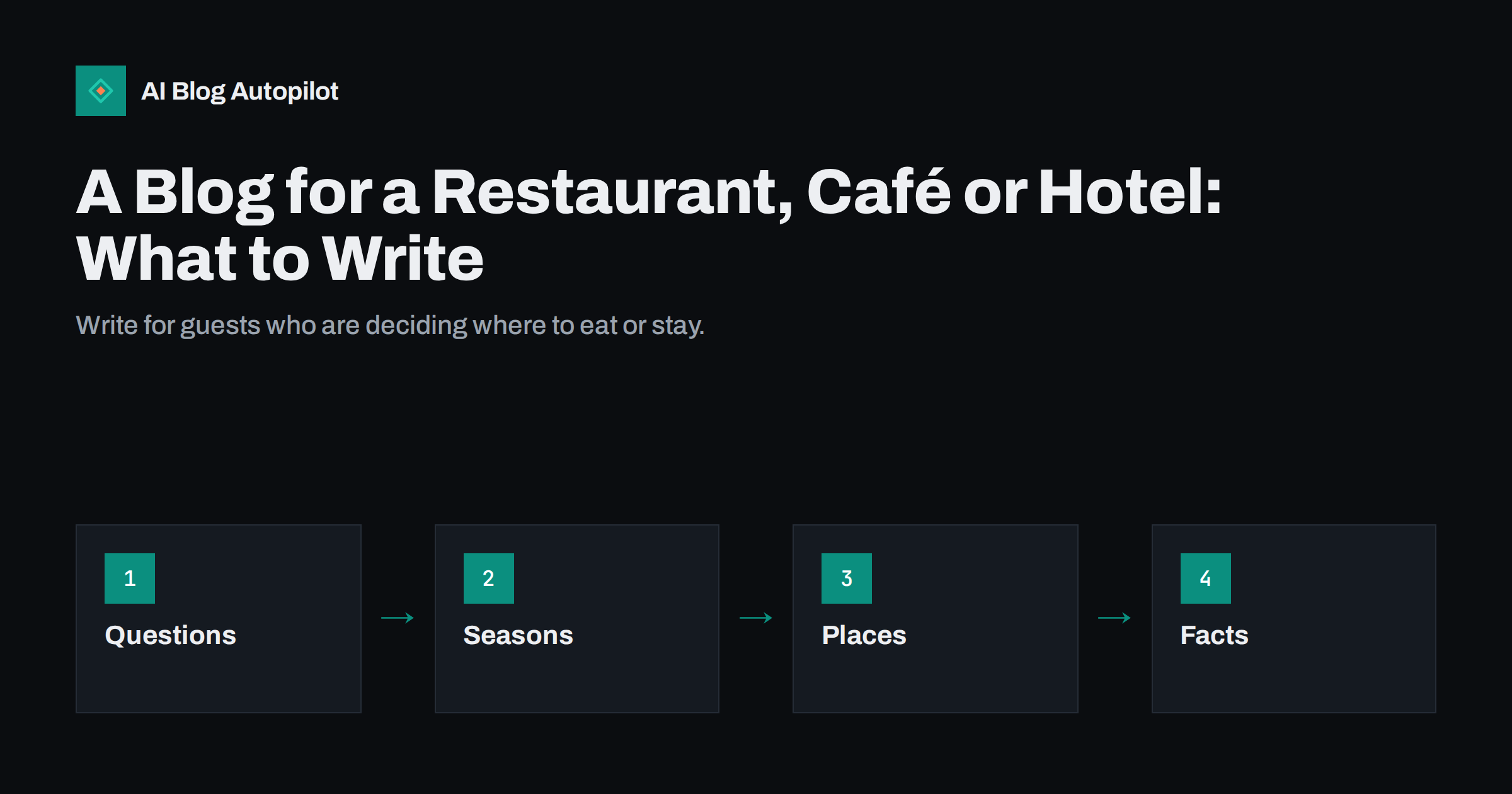
Short answer: a hospitality blog works when it answers the questions guests ask before they choose you: what the menu or rooms are like, who the place suits, how to get there, what is nearby and what changes with the seasons. Write practical, accurate pages in your own voice, keep opening hours, prices and dietary details current, and treat the blog as a long-term source of local searches and bookings, not as a place for general food or travel news.
Restaurants, cafés, bars and hotels already have a website, and most of it is static: a menu, a gallery, a booking button. A blog adds the pages that match what people type into a search box when they are still deciding. It also gives you a place to explain what makes your place different, which a menu page rarely does. This article covers what to write, how to organise it and what to avoid.
Why a blog helps a hospitality business
Most guests choose on a mix of reviews, photos, location and a quick look at your website. Search is part of that journey. People search for “brunch with a view”, “pet-friendly hotel near the old town” or “restaurants for a group of twelve”, and a single static homepage cannot rank for all of those. Separate articles can, if each one answers a real question clearly.
A blog also supports trust. A guest who reads how you source ingredients, how breakfast works or what the quietest rooms are like arrives with the right expectations, which usually means fewer complaints and more repeat visits. Finally, the articles give you material for social media, newsletters and replies to common questions, so the work is reused many times.
Topics that match what guests search for
Start from the questions your staff answer every week. Reception and front-of-house teams know them better than any keyword tool. Group them into a few themes and write one article for each question.
- The experience: what a typical evening, breakfast or stay is like, written plainly, with details about noise, portions, dress code and timing.
- Who it suits: families, couples, business travellers, large groups, people with dogs, guests with limited mobility.
- Food and dietary needs: how you handle vegetarian, vegan, gluten-free and allergy requests, and what you cannot guarantee.
- Practical details: parking, public transport, check-in and check-out, booking rules, accessibility and children’s facilities.
- Occasions: birthdays, weddings, business lunches, weekend breaks, Sunday family meals.
- The area: walks, museums, markets, events and other places guests ask about, with honest directions.
Avoid generic lists such as “top ten foods in the world”. They attract readers who will never visit, and they compete with large publishers that you cannot outrank.
Seasonal and event content
Hospitality is seasonal, and that is an advantage for planning. A calendar of recurring moments gives you topics well in advance: the start of the terrace season, a new autumn menu, local festivals, school holidays, Christmas and New Year bookings, Valentine’s Day, spring weekends. Publish early enough that people can find the page while they are still planning, not on the day itself.
Keep one page per recurring event and update it every year instead of creating a new address each time. A page called “Christmas dinner at our restaurant” can gather links and history, while the details change annually. Add the year and the main details at the top, and remove anything that is out of date. Our guide to seasonal content planning explains how to build this kind of calendar.
Menus, rooms and offers as real web pages
Many hospitality sites publish the menu as a PDF or an image. Search engines can read some PDFs, but a menu in plain HTML is easier to find, easier to read on a phone and easier to update. Treat the menu and the room descriptions as pages with text, headings and clear prices.
- Write a short introduction for each menu section and each room type, in normal sentences.
- List the dishes or room features as text, not only in pictures.
- Show prices and dietary markers where you can, and state the date the information was last checked.
- Describe signature dishes and rooms in a few sentences with the story behind them.
- Link from blog articles to the relevant menu or room page so that readers can take the next step.
Allergen and dietary information deserves special care. Only publish what your kitchen can actually deliver, follow the rules that apply in your country and make it easy for guests to ask a person before they order or book.
Photos, reviews and local signals
Hospitality is visual, so use your own photographs. Show the real room, the real plate and the real terrace, because stock images set expectations that you cannot meet. Add a short alt text that describes what the picture shows, and write captions that say something useful. Compress images so that pages load quickly on mobile networks, where many guests will read them.
Reviews and local listings work alongside the blog. Keep your name, address, phone number and opening hours identical on your website and your business listings, and mention the neighbourhood and the street naturally in your articles. You can quote a review with permission, but never invent one or edit a quote to change its meaning. Our article on keeping a Google Business Profile up to date covers the listing side in more detail.
The people behind the place, and the next step
Guests choose a place partly because of who runs it. An article about how the kitchen plans a seasonal menu, where the bread comes from, why the hotel was converted from an old building or how the team handles a busy weekend gives readers something that a competitor cannot copy. Keep these pieces concrete: names of suppliers you are happy to mention, the reason for a decision, a small problem you solved. Ask permission before naming staff or suppliers, and keep the tone friendly and factual, without superlatives you cannot back up.
Short interviews work well. A five-minute conversation with the chef, the head receptionist or the owner can become a useful article with a few headings and a quote or two. Photograph the person at work, not posed in front of a wall, and add a line about what a guest can order, book or ask for as a result. This links the story to a next step and keeps the article from becoming pure marketing.
Every article should lead somewhere. At the end of a post about a group dinner, link to the page with group menus and the contact form. After an article about a weekend in the area, link to the relevant rooms and the booking page. Use plain link text such as “see the family rooms” or “book a table for six or more”, and make sure the booking tool or phone number works on a phone screen. A clear next step matters more than a clever call to action, because many readers decide in a few seconds and on a small screen.
Also check that the booking path works when a guest arrives from an article. Test it yourself on a phone: open the article, tap the link, choose a date and see whether anything breaks. Small faults in a booking flow cost far more than any improvement in a headline.
Keeping hours and details current
Out-of-date information is the most common hospitality website problem. A guest who turns up on a day you are closed, or books a room type that no longer exists, will not blame the website for long. Decide who owns each fact and when it is checked.
- List the facts that change: opening hours, holiday closures, prices, menus, room types, parking, booking policies.
- Store each one in a single place and link or copy from there, so that you do not have to edit ten articles.
- Review the list at fixed times, such as the start of each season and before every holiday.
- Add “last checked” dates to pages where details matter.
- When a page is no longer correct and cannot be fixed, update it or redirect it to the best replacement.
How to run it with little time
Few owners have hours to spare, so keep the routine small. Publish one useful article a week or even every two weeks, and spend the effort on accuracy and photographs. A simple routine can look like this: collect questions from staff on Monday, choose one, record a short voice note or write bullet points, draft the article, check the facts with the person who knows them best, add photos and publish.
Ask a manager or head chef to read every article that includes operational facts. They will spot a wrong opening time or an ingredient you no longer use in seconds. Measure results by what matters to you: bookings, enquiries, calls and direction requests, not only visits.
How AI Blog Autopilot helps
AI Blog Autopilot plans and writes SEO articles from topics you give it, with keywords, audience and tone, and publishes them to your WordPress site, with AUTO as the default and approval available if you want to read each article first. For a hospitality business the sensible approach is to supply the questions your guests ask and to check the factual details, such as hours, prices and allergens, yourself. Plans are listed on the pricing page.
Related reading
- Blog Strategy for a Local Business
- Seasonal Content Planning for a Business Blog
- Image SEO for Blog Posts
- Google Business Profile Updates and Your Blog
The bottom line
A restaurant, café or hotel blog earns its place by answering the questions guests ask before they book. Write about the experience, who the place suits, practical details and your area, plan around seasons and events, publish menus and rooms as real pages and keep every operational fact current. Use your own photographs, ask the people who know the details to review each article and keep the routine small enough to maintain.
FAQ
How often should a restaurant or hotel publish blog articles?
One useful article every one or two weeks is enough. Accuracy and regular checking of details matter more than a high number of posts.
Should I put my menu in a PDF?
Prefer a web page with text. It is easier to search, read on a phone and update, and you can still offer a PDF as an extra download.
What should a hospitality blog avoid?
Generic travel or food lists that attract readers who will never visit, and any claim about food, allergens or facilities that you cannot guarantee.
Can I use guest reviews in articles?
Yes, with permission and without changing the meaning. Never invent a review or present a paraphrase as a direct quote.
How do I keep opening hours correct on the blog?
Keep the facts in one place, review them each season and before holidays, and add last-checked dates to pages where the details matter.