ENEnglish
 LTLietuviškai
 DEDeutsch
 FRFrançais
 RUРусский
 ESEspañol
 PLPolski
 ITItaliano
 UKУкраїнська
 CSČeština
 PTPortuguês
 JA日本語
JA日本語 LVLatviešu valoda
 ETEesti
 HUMagyar
 IDBahasa Indonesia
 TRTürkçe
 HIहिन्दी
 ELΕλληνικά
 ARالعربية
 THไทย
THไทย VITiếng Việt
 RORomână
 MSBahasa Melayu
 BNবাংলা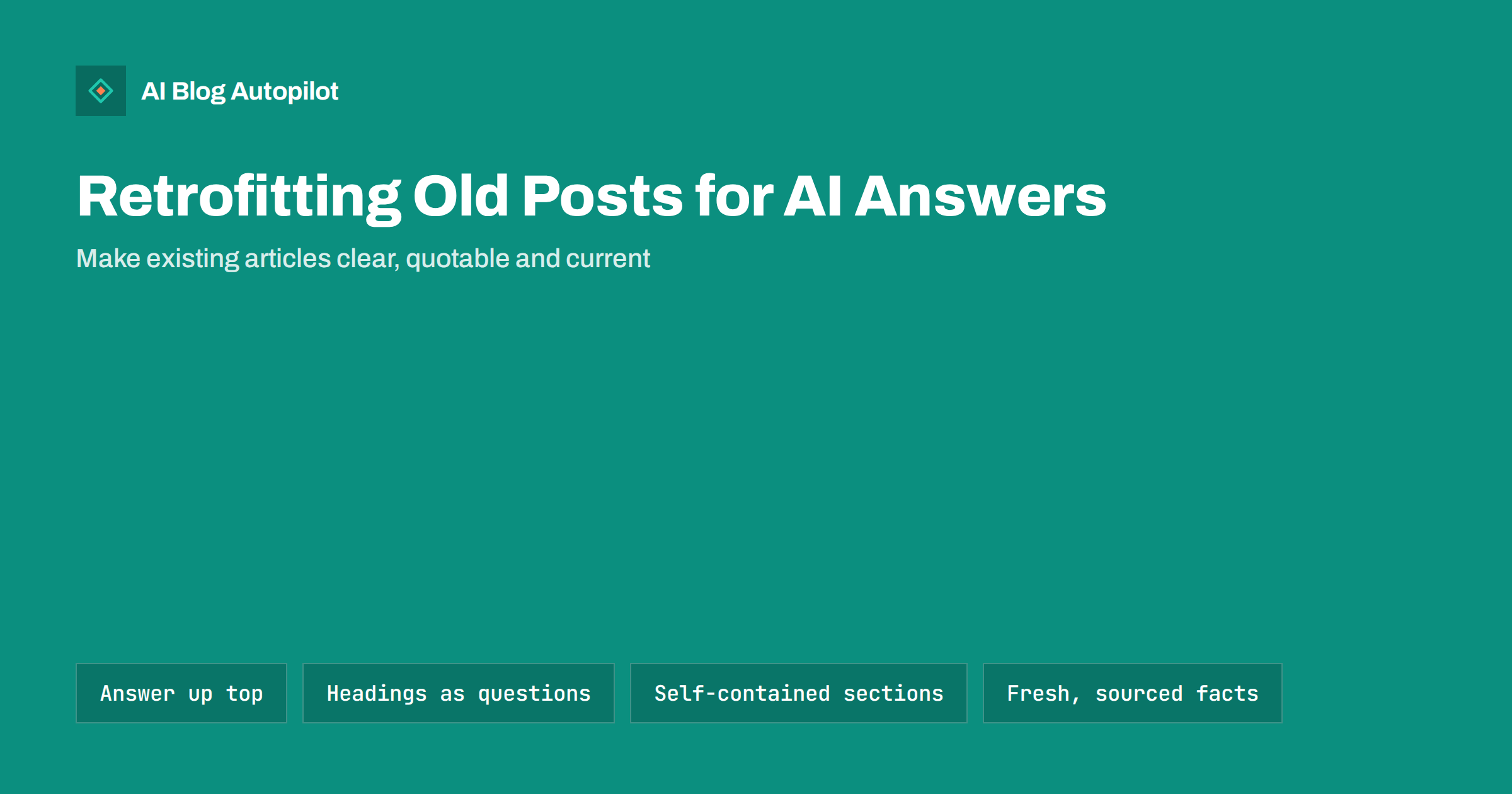
Short answer: many older blog posts contain good information that AI answers rarely use, because the answers are buried in long introductions, vague headings and paragraphs that only make sense in context. Retrofitting them means adding a direct answer near the top, rewriting headings so they say what each section answers, opening each section with its answer, making paragraphs self-contained, updating facts and dates, and adding a short FAQ. Keep the URL, keep what already ranks, and prioritise the posts that matter most to the business.
Most established blogs have a back catalogue written for an earlier style of search: long warm-up introductions, clever headings, and the actual answer somewhere in the fourth paragraph. Those articles may still rank, but they are awkward for answer engines, which look for clear passages that address a specific question.
Rewriting everything is rarely sensible. A focused retrofit of the right posts usually achieves most of the benefit in a fraction of the time. This article explains which posts to choose and exactly what to change.
Why older posts are often overlooked by AI answers
AI search features generally retrieve pages from a search index, select passages that answer the question and summarise them with links to sources. Anything that makes a good passage hard to find or hard to lift out works against a page.
Older posts commonly have these patterns:
- Long introductions that set the scene for several paragraphs before saying anything specific.
- Headings chosen for style, such as a pun or a single word, which say nothing about the content below.
- Context-dependent paragraphs that rely on “this”, “it” and “as mentioned above”.
- Outdated details: old interface steps, discontinued features, stale figures and dates.
- No summary of the answer anywhere on the page.
None of these makes a post wrong. They make it harder to use. The same changes also help human readers who skim, which is most readers.
Choosing which posts to retrofit first
Work on a short list rather than the whole archive. Good candidates:
- Posts that answer important questions for your business, such as how a service works, what it costs, how to choose between options.
- Posts with impressions but few clicks in Search Console, which search engines consider relevant but readers are not choosing.
- Posts ranking around positions 5 to 20, where clearer answers may help them move up.
- Posts built around a question, since those are exactly what answer engines respond to.
- Posts with outdated information that could mislead readers today.
Ten to twenty posts is a good first batch. A content inventory makes the selection easier if you have not already listed your articles.
Change one: add a direct answer at the top
Add a short answer of two to four sentences immediately after the title, before any scene-setting. It should state the answer to the post’s main question plainly, with the most important condition or exception.
A useful test: if this paragraph were the only thing someone read, would they have a correct, useful answer? If yes, it is doing its job. If it only promises that the answer is coming, rewrite it.
An illustration of the difference, using an imaginary post about backups. A typical old opening might say that backups are something every site owner thinks about eventually, and that this guide will walk through everything you need to know. A retrofitted opening says instead that a small business blog should keep automatic daily backups stored away from its hosting server, keep several weeks of copies, and test a restore at least a few times a year. The second version is quotable on its own; the first is not.
The existing introduction can usually stay below it, trimmed. Readers who want context still get it; readers who want the answer do not have to wait. Introductions that don’t waste time covers the writing side.
Change two: rewrite headings to say what they answer
Go through every H2 and H3 and ask whether someone could tell, from the heading alone, what question the section answers. Replace vague or clever headings with descriptive ones.
| Before | After |
|---|---|
| Getting started | What you need before setting up automatic backups |
| The catch | Why free plans limit the number of sites |
| Numbers game | How often a small business should post each week |
| Wrapping up | The bottom line |
Where it reads naturally, phrase headings the way people ask questions. Do not force every heading into a question; clarity is the goal, not a format.
Change three: lead each section with its answer
Under each heading, make the first one or two sentences answer the heading directly. Then explain, qualify and give examples.
This is the single most useful structural change. Answer engines often select passages at the section level, and a section whose first sentence is the answer is easy to use. It also makes the article far easier to skim, because a reader can move from heading to first sentence to heading and get the whole argument.
Then read each key paragraph as if it had been lifted out of the page. Does it still make sense?
- Replace “it” and “this” at the start of a paragraph with the actual subject.
- Replace “as mentioned above” with the point itself, briefly.
- Name the product, method or situation being discussed, rather than assuming the reader remembers.
- Split paragraphs that cover two different ideas.
The result can feel slightly more repetitive to write, but it reads clearly, and it is much easier for any system to quote accurately.
Change four: update facts, dates and sources
Outdated content is a reason for any system to prefer another page, and a risk to your credibility.
- Check every step, screenshot and setting name against the current version of the product or process described.
- Replace old figures with current ones, and name the source. Remove statistics you cannot trace.
- Remove references to discontinued tools, features or rules, or explain what replaced them.
- If the update is substantial, update the modified date shown on the page. Do not change dates for trivial edits.
Fact-checking content before publishing covers a practical checking routine that works just as well for updates.
Change five: add a short FAQ
Most older posts end without addressing the follow-up questions a reader naturally has. A short FAQ of four to six questions fixes that.
- Take questions from Search Console queries the page already appears for.
- Add questions from related-question boxes on the results page for the main topic.
- Answer each in two to four sentences that stand on their own.
- Add FAQPage structured data that matches the visible questions and answers exactly.
The visible FAQ is the valuable part: compact, self-contained question and answer pairs are exactly what answer engines look for. Writing FAQ sections that rank explains how to pick and phrase them.
What not to change
A retrofit should improve a page without disturbing what already works.
- Keep the URL. Changing it loses accumulated signals and requires redirects.
- Keep content that ranks. Check which queries the page appears for before editing, and make sure sections serving those queries remain.
- Do not cut depth for brevity. Adding a short answer at the top does not mean removing the detailed explanation below.
- Do not stuff question phrases into headings and text. One clear question-style heading beats five repetitive ones.
- Do not add claims you cannot support to make the page look more authoritative.
It also helps to save a copy of the original version before editing, either through your platform’s revision history or a simple export. If a retrofitted page loses clicks over the following weeks, you can compare the two versions and see exactly what changed, instead of guessing.
Finally, update internal links as you go. When a retrofitted post now answers a question clearly, link to it from other articles that mention the topic, using descriptive anchor text. Clearer pages deserve more internal links, and those links help search engines find the improved version sooner.
Measuring the effect
Measuring visibility in AI answers is still imperfect, so use several signals together.
- Search Console clicks and impressions for each retrofitted page, compared across equal periods before and after the change, allowing four to eight weeks.
- Featured snippets and answer boxes for the main question, checked manually.
- Referral traffic from AI assistants in your analytics, where it is identifiable.
- Manual checks of a fixed set of questions in AI search tools every few weeks, noting whether your site is cited.
Answers vary between searches, so track trends across a batch of pages rather than reacting to single results.
How AI Blog Autopilot structures new articles
AI Blog Autopilot writes new articles with the structure described here built in: planned around a real search query, with FAQ, tags and SEO meta, and checked automatically for length, structure, keyword and meta before publishing. Retrofitting your existing posts remains a separate editorial job, but new content starts in the right shape. See the AI Blog Autopilot home page for details.
Related reading
- How to Refresh Old Blog Posts
- How to Get Your Blog Cited by AI Search
- Writing for Featured Snippets Without Chasing Them
- How AI Search Picks Which Pages to Cite as Sources
The bottom line
Older posts often hold good answers in a shape that is hard to use. Retrofit the ones that matter most: add a direct answer at the top, make headings descriptive, open each section with its answer, make paragraphs self-contained, update facts and add a short FAQ with matching markup. Keep URLs and ranking content intact, measure over weeks, and treat the gains for human readers as part of the payoff.
BUJ
Should I rewrite old blog posts for AI search?
Usually a targeted retrofit is better than a full rewrite. Adding a direct answer, clearer headings, self-contained sections, updated facts and a short FAQ improves a post for AI answers and readers while keeping what already ranks.
Which old posts should I update first?
Start with posts that answer important questions for your business, posts with many impressions but few clicks, and posts ranking just outside the top results. Posts with outdated information also deserve early attention.
Should I change the publish date after updating a post?
Update the modified date when the changes are substantial, such as new sections or corrected facts. Do not change dates for small edits, and keep the original publish date visible if your theme shows both.
Will adding an FAQ help my post appear in AI answers?
It can help, because short, self-contained question and answer pairs are easy for answer engines to use. The benefit comes from the visible FAQ content; matching FAQPage markup describes it but does not guarantee anything on its own.
How long until updated posts show results?
Allow four to eight weeks for search engines to recrawl and reassess the page, then compare equal periods. Results in AI answers vary between searches, so judge trends across several posts.