ENEnglish
 LTLietuviškai
 DEDeutsch
 FRFrançais
 RUРусский
 ESEspañol
 PLPolski
 ITItaliano
 UKУкраїнська
 CSČeština
 PTPortuguês
 JA日本語
 LVLatviešu valoda
 ETEesti
 HUMagyar
 IDBahasa Indonesia
 TRTürkçe
 HIहिन्दी
 ELΕλληνικά
 ARالعربية
 THไทย
 VITiếng Việt
 RORomână
 MSBahasa Melayu
 BNবাংলা
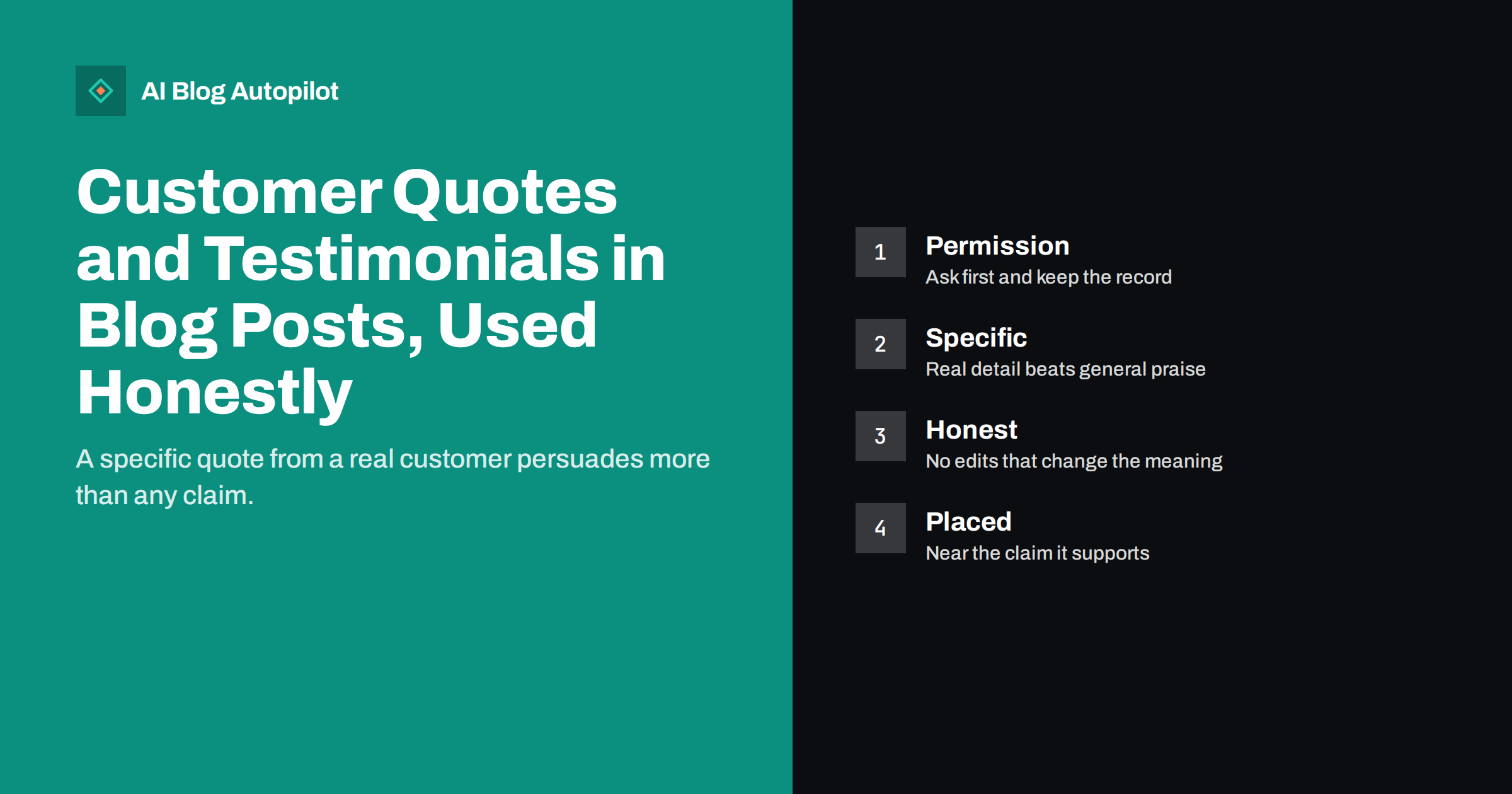
Short answer: use customer quotes in blog posts when they are real, specific and given with permission, and place each one next to the claim it supports. Do not invent, merge or edit quotes so that they say more than the customer meant, show the name and context where the customer agrees, and review the quotes regularly. A few honest quotes are worth more than many glowing ones.
Readers are tired of claims. They know that every business says it is friendly, fast and reliable, and they look for evidence from somebody who has nothing to gain. A quote from a real customer, with a concrete detail, is one of the strongest pieces of evidence a blog post can contain. It is also one of the easiest to misuse, and misuse is expensive: fake or misleading testimonials break consumer protection rules in many countries and destroy trust once discovered.
Ask permission and keep the record
Never publish a customer’s words without their agreement. Ask in writing, say where the quote will appear, how it will be shown and for how long, and let them see the final text. Offer a choice of name, first name only with a town, a job title or anonymous, and respect it. Keep the message in which they agreed, so that you can show consent later.
Make it easy to say no or to withdraw. If a customer asks you to remove a quote, do so promptly and check that it has also gone from social posts, emails and the cached versions where you can control them. A business that handles this gracefully is more likely to receive recommendations in future.
Take special care with names, photographs and anything that identifies a child, a patient, a client of a professional service or a person in a sensitive situation. In regulated fields, such as health, finance or law, the rules on testimonials can be strict, so check the rules in your country or ask an adviser. Our guide to YMYL topics on a business blog explains why these subjects need extra care.
Collect feedback at the right moment. Ask a few days after delivery or completion, when the memory is fresh and the result is visible, and keep the request short: two or three questions, with a reply that takes a minute. Offer to write the quote from a phone call if the customer prefers, and read it back to them. People are more generous with their time when the request is considerate.
Choose specific words over general praise
“Great service, highly recommended” tells the reader nothing. A quote such as “they replied within an hour and fixed the problem the same afternoon” tells them what to expect. When you ask customers for feedback, ask specific questions: what problem did you have, what did we do, what changed, and what would you tell someone who is unsure? The answers produce detail that readers can trust.
Look for quotes that mention a result, a number, a timeframe or a surprise. Look also for quotes that mention a limit, such as “it took a few days to learn, but now it saves me an hour a week”. A mildly critical sentence makes a testimonial more believable, not less. Readers are suspicious of perfect scores.
Keep each quote short and put it in a block quote with the name and context. If you use long quotes, break them into the parts that matter. Our article on pull quotes and blockquotes shows how to format them so that they are readable and accessible.
Keep the original message safe and publish only text that matches it. If you edit for length, show the customer the edit. If a quote refers to a person on your team, check that the person is happy to be named, and remove the reference when they leave. Small courtesies like these prevent awkward requests later.
Never change the meaning
You may correct spelling and trim a long quote, but you must not alter what the person meant. Do not combine several comments into one quote, do not add praise that was not said and do not remove words that qualify a statement. If you shorten a quote, use an ellipsis or a clear break, and if the customer wrote in another language, translate faithfully and say that it is a translation.
Do not write a quote and ask a customer to approve it unless it truly reflects their opinion. A scripted testimonial that the customer would not have written is a fake in practice, even if they sign it. It is better to publish a plain quote in the customer’s own words, even if it is less polished.
Avoid inventing “typical” customers or composite stories without labelling them as such. If you tell a scenario to illustrate a point, say that it is an example, as in the advice on examples and analogies in posts.
Mark up the quote semantically with a block quote and a visible attribution, so that screen readers and search engines can recognise it. Do not use images of text for quotes, since they cannot be read by assistive tools or indexed. If you use a photograph of the customer, add alt text that describes it plainly and make sure you have the right to use it.
Place each quote next to the claim it supports
A quote works best close to the statement it backs. If a paragraph says that setup is quick, put a customer’s comment on setup right after it. A page of quotes collected at the bottom behaves like decoration, while the same quotes placed in context behave like evidence.
Use quotes within posts as well as on a dedicated page. A short quote in a how-to article can reassure a reader who is about to try something, and a quote in a comparison can address a worry. Do not overdo it: one or two well-placed quotes in an article are enough, and more than that begin to look like an advertisement.
Think about what the quote does for the reader. It should answer a doubt, confirm a result or add a human voice. If it only says that the customer is happy, leave it out or use it on a page where general praise belongs.
If you cannot publish a quote because the customer prefers privacy, you can still describe the experience in your own words, if it is accurate and you say that it is your summary. A sentence such as “a customer told us the switch saved about an hour a week” is honest as long as you can back it up from your records. Do not present such a summary as a direct quote.
Combine quotes with other evidence
Quotes work best alongside facts: a number, a date, a photograph, a before-and-after or a case study. A comment that says “our enquiries doubled” is more convincing if the page also shows the period and the measure. Our guide to how to write a case study explains how to gather and present that evidence, and evidence for marketing claims covers what to keep on file.
Be careful with results. A customer’s experience may not be typical, and a statement of a large gain can mislead if it is presented as normal. Add context such as the starting point, the time and what else changed, and avoid language that suggests a guaranteed outcome. In many countries advertising rules require you to make clear what results are typical.
Think too about where else the quote will go. A comment that suits a blog post may not suit an advertisement, a sales deck or a social post, and the permission you received may cover only one of them. Keep the scope of each permission in your file, and ask again before reusing a quote somewhere new. The few minutes it takes are cheap compared with a complaint.
Handle reviews and third-party ratings with care
Quotes taken from review sites carry the rules of those sites and the law. Check whether you may reproduce the text, attribute it properly and show the date. Do not select only the best reviews and imply that they are representative. If you show a star rating, say where it comes from, how many reviews it is based on and when it was last updated.
Never pay for reviews, write them yourself or ask staff and friends to post them, and do not reward only positive feedback. Respond to negative reviews politely and factually, and learn from them. Our guide to how reviews appear in AI answers shows why the pattern of real reviews also affects how assistants describe you.
Look for gaps. Do you have quotes from each type of customer you want to attract, or only from the easiest ones? Do you have a quote that addresses the most common doubt, such as price, time or trust? Ask for those specifically, and treat the gaps as a short list of requests for the next quarter.
Review and refresh your quotes
Quotes age. Products change, staff leave and customers move on. Once a year, check each quote: is it still accurate, does the customer still agree and does it refer to something you no longer offer? Remove those that no longer apply, and replace them with newer ones.
Keep a simple file of every quote with its source, the date of permission, the version of the text and where it is published. When a question arises, you will be able to answer within minutes. This small piece of administration is what makes it safe to use testimonials at all.
How AI Blog Autopilot helps
AI Blog Autopilot writes full SEO articles for your WordPress blog from the topics, keywords, audience and tone you set, with FAQ sections, tags and SEO meta included, and it shares each one to your social networks. You add real customer quotes where they belong, and approval mode lets you read each article first, which matters for anything that quotes a person. See the pricing page for plans.
Related reading
- How to Write a Case Study
- Evidence for Marketing Claims: What to Keep on File
- Pull Quotes and Blockquotes in Blog Posts
The bottom line
Ask permission and keep the record, choose specific quotes, never change their meaning, place them beside the claims they support, combine them with other evidence and review them every year.
BUJ
Do I need permission to quote a customer?
Yes. Ask in writing, say where and how the quote will appear and keep the reply as a record.
Can I shorten a testimonial?
You may trim and fix spelling, but you must not change the meaning or combine several comments into one quote.
Should I show full names?
Only if the customer agrees. A first name and town, a job title or an anonymous quote can also work.
Are testimonials regulated?
In many countries, yes. Fake or misleading endorsements are prohibited, and some fields have stricter rules, so check locally.
How often should I review quotes?
At least once a year. Remove quotes about things you no longer offer and replace them with newer ones.