ENEnglish
 LTLietuviškai
 DEDeutsch
 FRFrançais
 RUРусский
 ESEspañol
 PLPolski
 ITItaliano
 UKУкраїнська
 CSČeština
 PTPortuguês
 JA日本語
JA日本語 LVLatviešu valoda
 ETEesti
 HUMagyar
 IDBahasa Indonesia
 TRTürkçe
 HIहिन्दी
 ELΕλληνικά
 ARالعربية
 THไทย
THไทย VITiếng Việt
 RORomână
 MSBahasa Melayu
 BNবাংলা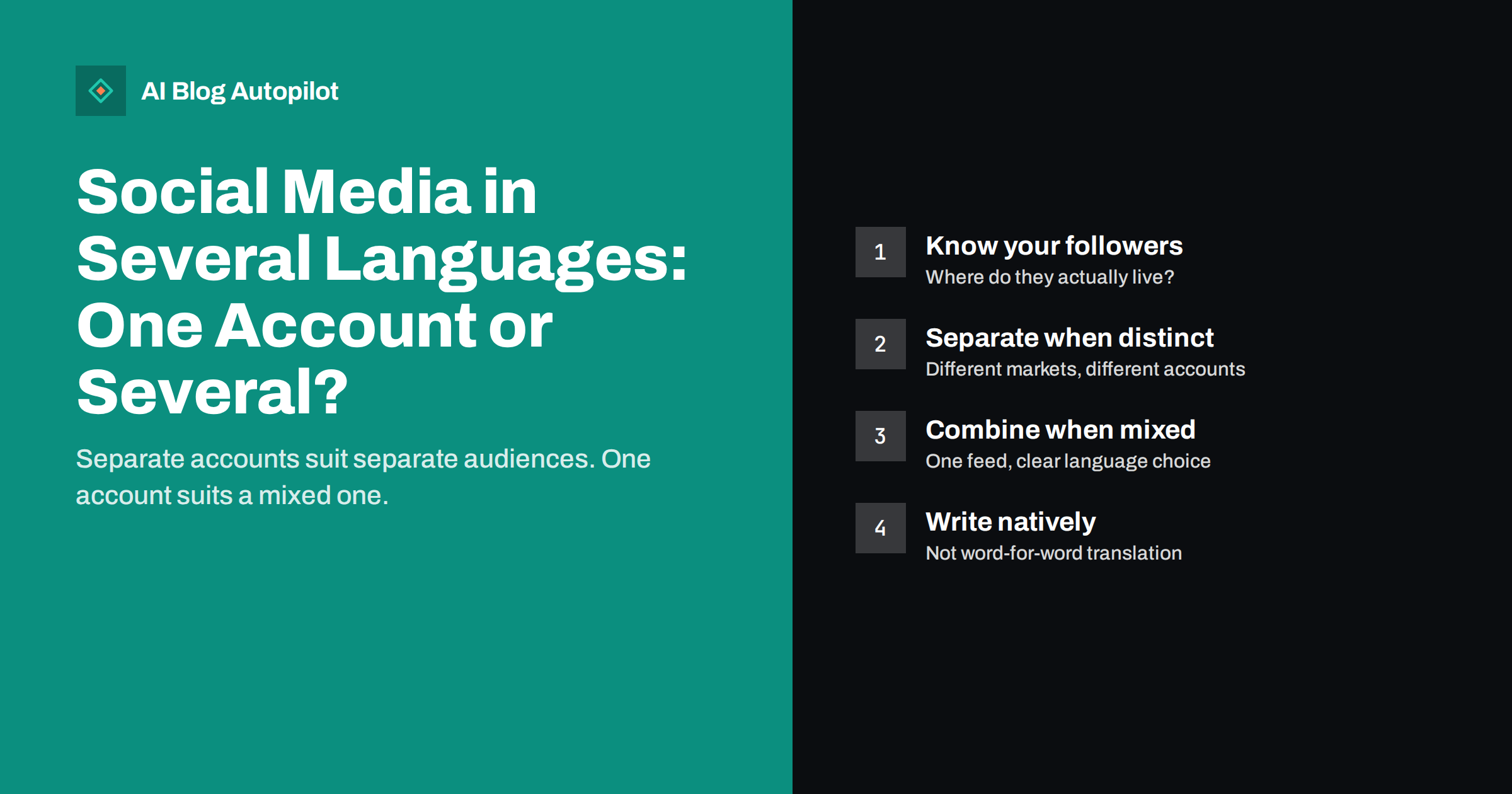
Short answer: if your audiences in different languages are clearly separate, for example customers in different countries who rarely speak each other’s language, separate accounts per language usually work better, because each feed stays readable for its followers. If most followers understand more than one of your languages, or the audience is small, one account with posts in a main language and occasional posts in others is simpler to manage. Avoid putting two full languages in every post. Whichever you choose, write each language natively rather than translating word for word.
A business that publishes its blog in several languages soon faces the same question on social media. Should the Spanish articles go to the same Facebook page as the English ones? Should there be a separate LinkedIn page for German customers? There is no single right answer, but there are clear signals that point one way or the other. This guide explains the options, how the main networks handle languages, the practical costs of each approach and how to decide for your own business.
The three common approaches
Most multilingual businesses end up with one of these setups:
- Separate accounts per language or market: for example one Instagram account for Lithuanian followers and one for English-speaking followers. Each account posts only in its language.
- One account, mixed languages: one account posts in a main language and adds posts in other languages from time to time, each post in a single language.
- One account, bilingual posts: every post contains the same text in two languages.
Some businesses combine them: a global account in English plus separate accounts for one or two key markets. That can work well, as long as each account has a clear purpose.
When separate accounts make sense
Separate accounts are the better choice when:
- Audiences are distinct. Customers in one country rarely read the other language, so posts in it are noise for them.
- Content differs by market. Prices, offers, events, holidays and local news are different, so the posts would differ anyway.
- You have enough content for each. Each account needs a steady stream of posts in its language to look active.
- You can answer comments in each language. An account that posts in a language but cannot reply in it frustrates followers.
The cost is more accounts to manage: more logins, more profiles to keep current, more comments to check and a smaller follower base on each account at the start.
When one account is enough
One account works better when:
- Most followers understand your main language, even if it is not their first language.
- The audience is small, and splitting it would leave every account with too few followers to feel alive.
- Content is mostly the same, such as a product or service that does not change by market.
- You publish only occasionally in the second language.
In a mixed-language account, keep each post in one language and make the pattern predictable, for example most posts in English with a post in Spanish when a Spanish article is published. Followers can then scroll past posts they cannot read without feeling that the whole feed is not for them.
Why bilingual posts rarely work
Putting the same text in two languages in every post seems inclusive, but it usually makes posts long and awkward. On networks with character limits, it halves the space for each language. On networks that cut posts after a few lines, readers of the second language may never see their part. It also looks cluttered in feeds. Bilingual posts can work for short announcements in genuinely bilingual communities, but for most businesses they are best kept for special cases.
How the main networks handle languages
Networks offer different features, and they change over time:
- Facebook pages: Facebook has offered ways to show different language versions of a post to different users, and it can show automatic translations. Many businesses with distinct markets still use separate pages or regional page structures.
- LinkedIn: company pages can have their name and description in several languages, shown according to the member’s language settings. Posts themselves are usually written in one language each.
- Instagram: there is no built-in way to target posts by language from one account, so businesses with distinct audiences often run separate accounts.
- X, Threads and Bluesky: posts are written in one language each, and some networks detect or let users mark the language. Automatic translation is offered in some apps.
- Mastodon: posts can be tagged with a language, and users can filter which languages they see, which makes mixed-language accounts easier to follow.
- Telegram: channels are simple, so separate channels per language are common when audiences are distinct.
Automatic translation by the network helps readers understand a post, but it does not replace writing in their language. Machine translations often lose tone, idioms and local references.
Writing natively in each language
Whether you use one account or several, posts in each language should read as if they were written for that audience. Practical rules:
- Adapt, do not translate. Keep the message, but use phrases, examples and humour that work locally.
- Use local formats. Dates, prices, units and spelling should follow local conventions.
- Use local hashtags. Hashtags rarely translate directly; check which ones people in that language actually use.
- Link to the right article. A post in German should link to the German version of the article if you have one.
- Time posts for the audience. Followers in another time zone need posts at their local hours, not yours.
The same principle applies to the blog itself: articles written directly in each language usually read better and match local search queries better than word-for-word translations.
Managing several accounts without chaos
If you choose separate accounts, a little structure prevents most problems:
- Use a clear naming pattern, such as the brand name plus a country or language code, so followers find the right account.
- Link the accounts to each other in their bios, so a visitor on the wrong account can switch easily.
- Keep branding consistent, with the same logo and visual style, while the language and local content differ.
- Decide who answers comments in each language, including at weekends and holidays.
- Review all accounts monthly: which ones grow, which ones get engagement and which ones may not be worth the effort.
Store access details safely and make sure more than one trusted person can manage each account, so a market does not go silent when one person is away.
An example setup
Imagine a small online shop based in Lithuania that sells across the Baltic states and to English-speaking customers elsewhere. Its blog publishes in Lithuanian, Latvian, Estonian and English. A sensible social setup might be one Facebook page and one Instagram account per Baltic market, because customers there expect local language, local delivery details and local holidays, plus one English LinkedIn page for partners and wholesale buyers, who mostly read English anyway.
Each local account shares the article in its own language and adds market-specific posts, such as delivery cut-off dates before holidays. The English LinkedIn page shares only the English articles that suit a business audience. Nothing is posted twice in two languages, and each team member knows which accounts they answer.
Profiles and bios
Even with one account, the profile can help readers of other languages. A short line in the bio such as “Posts in English and Spanish” sets expectations. Where the network allows several language versions of the page name or description, fill them in. Link to the matching language version of your website, or to a language selection page, rather than to a page in one language only.
How to decide for your business
A few questions usually settle it:
- Where do your current followers live, and which languages do they use? Network analytics often show location and sometimes language.
- Do your markets need different content, or only different words?
- Can you produce a steady stream of posts in each language?
- Can someone reply to comments in each language?
- Which networks matter in each market? The answer may differ by country.
If the answers point to distinct audiences, different content and enough capacity, use separate accounts. If not, start with one account and add a separate one later when a market grows. Starting simple is safer than creating accounts you cannot keep active.
Whatever you decide, measure each language separately. Compare engagement per post and clicks to the blog for each language, not just totals, because a small but very engaged audience in one language can be worth more than a larger, passive one.
It also helps to revisit the decision once a year. A market that started as a handful of followers may grow enough to deserve its own account, and an account that never gained traction may be better merged back into the main one. When you merge, post a short note on the old account pointing followers to the new home before it goes quiet.
How AI Blog Autopilot helps
AI Blog Autopilot writes articles and social posts directly in each language, not machine-translated, and supports 25 languages. Each network gets its own text, length and timing. The number of languages and networks depends on the plan; see the pricing page for details.
Related reading
- Choosing Which Languages to Publish In
- Translating Articles or Writing Natively in Each Language
- Blogging in 25 Languages: How to Reach International Readers with AI
- Hashtags for Blog Posts on Social Media: How Many and Which
The bottom line
Use separate social accounts per language when your audiences are distinct, need different content and you can keep each account active and answered. Use one account with single-language posts when followers overlap or the audience is small. Avoid bilingual posts as a default, write each language natively with local hashtags and timing, and start simple, adding accounts as markets grow.
BUJ
Should I have separate social media accounts for each language?
Yes, if the audiences are clearly separate, need different content and you can keep each account active and reply in its language. Otherwise one account with posts in a main language is usually simpler.
Can I post in two languages in one post?
You can, but it makes posts long and cluttered and halves the space on networks with character limits. For most businesses, one language per post works better.
Is automatic translation on social networks enough?
It helps readers understand a post, but it often loses tone, idioms and local references. Posts written natively in each language usually perform better.
How do followers find the right language account?
Use a clear naming pattern, such as the brand plus a country or language code, and link the accounts to each other in their profile bios.
When should I add a new language account?
When a market has enough followers or customers to justify it, you can produce steady content for it and someone can reply to comments in that language.