ENEnglish
 LTLietuviškai
 DEDeutsch
 FRFrançais
 RUРусский
 ESEspañol
 PLPolski
 ITItaliano
 UKУкраїнська
 CSČeština
 PTPortuguês
 JA日本語
JA日本語 LVLatviešu valoda
 ETEesti
 HUMagyar
 IDBahasa Indonesia
 TRTürkçe
 HIहिन्दी
 ELΕλληνικά
 ARالعربية
 THไทย
THไทย VITiếng Việt
 RORomână
 MSBahasa Melayu
 BNবাংলা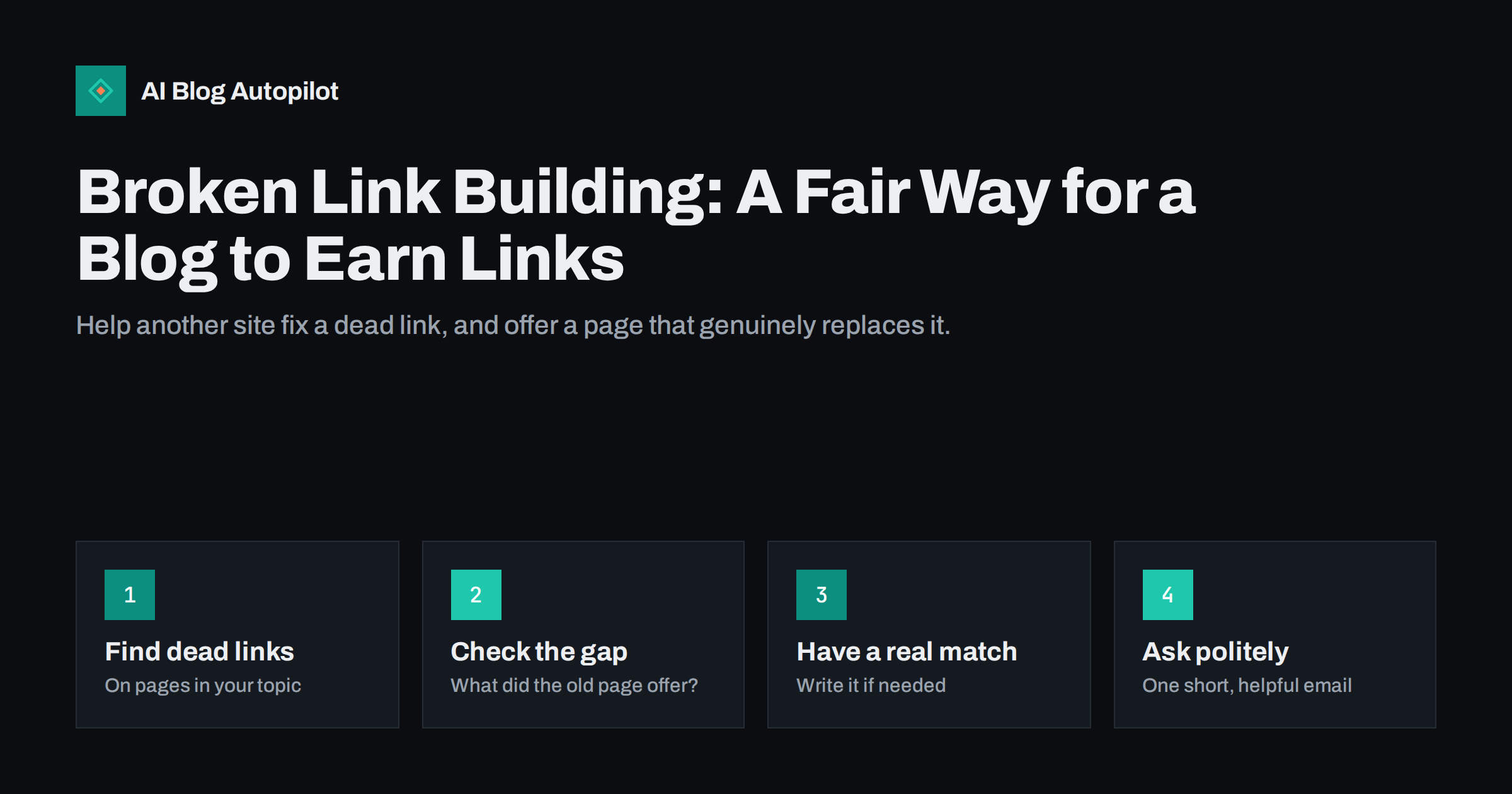
Short answer: broken link building means finding links on other websites that point to pages which no longer exist, then letting the site owner know and suggesting a page of yours that covers the same thing. It works because you are helping the other site fix a problem, not just asking for a favour. It succeeds only when your page is a genuinely good replacement for what the dead link used to offer, and when your message is short, polite and easy to act on. Expect a modest reply rate and treat it as one steady link building method among several.
Links from other relevant websites still matter for search, and small blogs often struggle to earn them. Asking strangers to link to you rarely works. Broken link building changes the conversation: instead of asking for something, you start by pointing out a problem on their page. Many site owners are glad to hear about it, and some will use your page as the replacement. This guide explains how the method works, how to find good opportunities without paid tools, how to write outreach that does not feel like spam and how to keep it honest.
How broken link building works
Websites link to resources all the time: guides, tools, studies, glossaries. Over months and years, many of those resources disappear. Businesses close, articles are deleted, sites are rebuilt and URLs change without redirects. The links remain on other sites, pointing to error pages.
The method has four steps:
- Find a dead link on a page that is relevant to your topic.
- Work out what the dead page used to offer, often by looking at an archived copy.
- Make sure you have a page that covers the same need, or create one if the topic fits your blog.
- Tell the site owner about the broken link and mention your page as a possible replacement.
The site owner gets a fixed page and a useful resource for their readers. You get a chance at a relevant link. Nobody is tricked, and nothing is paid for, which keeps the method within search engine guidelines.
Finding broken links in your niche
You do not need expensive software to find opportunities, although link analysis tools make it faster. Practical methods for a small blog:
- Resource pages: search for pages that collect useful links in your topic, using phrases such as “useful resources”, “recommended reading” or “helpful links” together with your topic. These pages often contain several dead links.
- Older guides: long articles from a few years ago often link to tools and studies that no longer exist.
- A browser link checker: extensions that highlight broken links on a page let you scan a resource page in seconds.
- Your competitors’ old content: if a competitor removed or moved a popular article, other sites may still link to the old address.
- Your own field knowledge: you may already know of a well-known resource or business in your field that closed or rebuilt its site.
Keep a simple spreadsheet with the page that has the dead link, the dead URL, what it used to be, the contact for the site and the status of your outreach.
Before contacting anyone, check the dead link yourself. Open it in a normal browser window, not only in a checker, because some sites block automated tools or show errors only for a moment. Confirm that the page really returns an error or redirects to an unrelated page, and note the date you checked it. A site owner who receives a report about a link that actually works will not read your next message.
Checking what the dead page offered
Before suggesting a replacement, find out what the dead link pointed to. Web archive services often have copies of old pages. Look at the topic, the depth and the format: a checklist, a calculator, a long guide, a definition. Your replacement needs to meet the same need, otherwise the site owner has no reason to use it.
Choosing which opportunities are worth it
Not every broken link deserves an email. Prioritise pages that:
- Are closely related to your topic, so a link to your page makes sense to their readers.
- Are maintained by a real person or business, since abandoned sites rarely reply.
- Get some traffic or attention, judged by how recent the content is and whether the site is active.
- Link to something you can genuinely replace, with a page that is as good or better.
Skip link directories, obvious link farms and sites that sell links. A link from those pages does little good and can look like part of a link scheme.
Creating a replacement page when you have none
Sometimes you find a dead resource that many sites linked to, and you have nothing like it. If the topic fits your blog, that is a good reason to write a page. You already know there is demand, because several sites wanted to link to the original.
When you create a replacement:
- Cover the same need, not the same words. Never copy the archived page.
- Make it more current, with updated facts, examples and links.
- Keep the format useful, such as a checklist, a table or a step-by-step guide if that is what people linked to.
- Make it part of your blog, linked from related articles so it is not an isolated page.
A page built this way is useful even if nobody replaces their dead link with it. It answers a real need in your topic and can rank and earn links on its own.
Writing the outreach email
The email decides whether anything happens. Site owners receive many link requests, and most are ignored. A broken link email stands out when it is genuinely helpful and very short:
- Use the person’s name if you can find it.
- Name the page and the broken link precisely, so they can find it in seconds.
- Mention your page once, as an option, with one sentence on what it covers.
- Keep it to a few sentences, with no flattery, no pressure and no follow-up threats.
An example of the tone: “Hi Anna, I was reading your resources page on starting a bakery and noticed that the link to the food safety checklist goes to an error page now. In case it helps, we have a current checklist on the same topic here. Either way, thought you would want to know about the broken link.”
That message helps even if they do not use your page, which is exactly what makes it acceptable. Send one follow-up at most, a week or two later, and then let it go.
What not to do in outreach
- Do not send the same template to hundreds of sites without reading their pages.
- Do not offer money or a link in exchange; that turns a fair suggestion into a link scheme.
- Do not exaggerate your page or claim it is “the definitive resource”.
- Do not invent broken links or misrepresent what the old page was.
- Do not contact the same site repeatedly about different links in quick succession.
What results to expect
Broken link building is slow and steady. Many emails will get no reply, and some replies will fix the link without using your page. A few will replace it with your page. That is normal. The method works best as a regular habit, such as a few carefully chosen emails each week, rather than a single big campaign.
Track your results in the same spreadsheet: emails sent, replies, links fixed and links gained. After a few months you will see which kinds of pages and sites respond best, and you can focus there.
Remember that links are only one part of search performance. A blog with consistently useful content, good internal linking and a clear topic focus will earn more natural links over time than any outreach can create on its own.
Fixing broken links on your own site first
Before pointing out other people’s broken links, check your own. A blog that asks others to fix dead links while its own articles are full of them makes a weak impression if the site owner looks. Run a link check on your site, update or remove dead outbound links and redirect any of your own pages that have moved. It also helps your readers, which is the point of the whole exercise.
The same thinking applies in reverse: when you delete or move pages on your own blog, use redirects so that other sites linking to you do not end up with broken links pointing at your site.
How AI Blog Autopilot helps
AI Blog Autopilot plans and publishes full articles on your WordPress blog around your topics, so you build up a library of useful pages that can serve as replacements when you find a dead resource in your field. It also shares each article to your social networks. Outreach itself is personal work and stays with you. See the pricing page for plans.
Related reading
- Earning Backlinks Honestly: What Works for a Small Site
- Broken Links on a Blog: How to Find and Fix Them
- Unlinked Brand Mentions: Turning Them Into Real Links
- Digital PR on a Small Budget
The bottom line
Broken link building is a fair way for a small blog to earn relevant links: find dead links on pages in your topic, check what the dead page offered, make sure you have a genuinely good replacement and send a short, polite email that helps the site owner even if they do not use your page. Expect modest results, keep it steady and focus on relevant, active sites.
BUJ
What is broken link building?
It is a link building method where you find links on other sites that point to pages that no longer exist, tell the site owner, and suggest your own page as a replacement if it covers the same need.
Is broken link building allowed by search engines?
Yes, when it is done honestly. Pointing out a broken link and suggesting a relevant page is normal outreach. Paying for the link or trading links turns it into a link scheme.
How do I find broken links on other websites?
Look at resource pages and older guides in your topic, and use a browser extension or link checker to highlight dead links. Link analysis tools can speed this up but are not essential.
What should a broken link outreach email say?
Name the page and the broken link precisely, mention your replacement page in one sentence and keep the email short and polite. It should be useful even if they do not use your page.
How many sites will replace the link with mine?
Usually only a minority. Many emails get no reply and some owners simply remove the link. Treat it as a steady habit rather than a quick win.