ENEnglish
 LTLietuviškai
 DEDeutsch
 FRFrançais
 RUРусский
 ESEspañol
 PLPolski
 ITItaliano
 UKУкраїнська
 CSČeština
 PTPortuguês
 JA日本語
 LVLatviešu valoda
 ETEesti
 HUMagyar
 IDBahasa Indonesia
 TRTürkçe
 HIहिन्दी
 ELΕλληνικά
 ARالعربية
 THไทย
 VITiếng Việt
 RORomână
 MSBahasa Melayu
 BNবাংলা
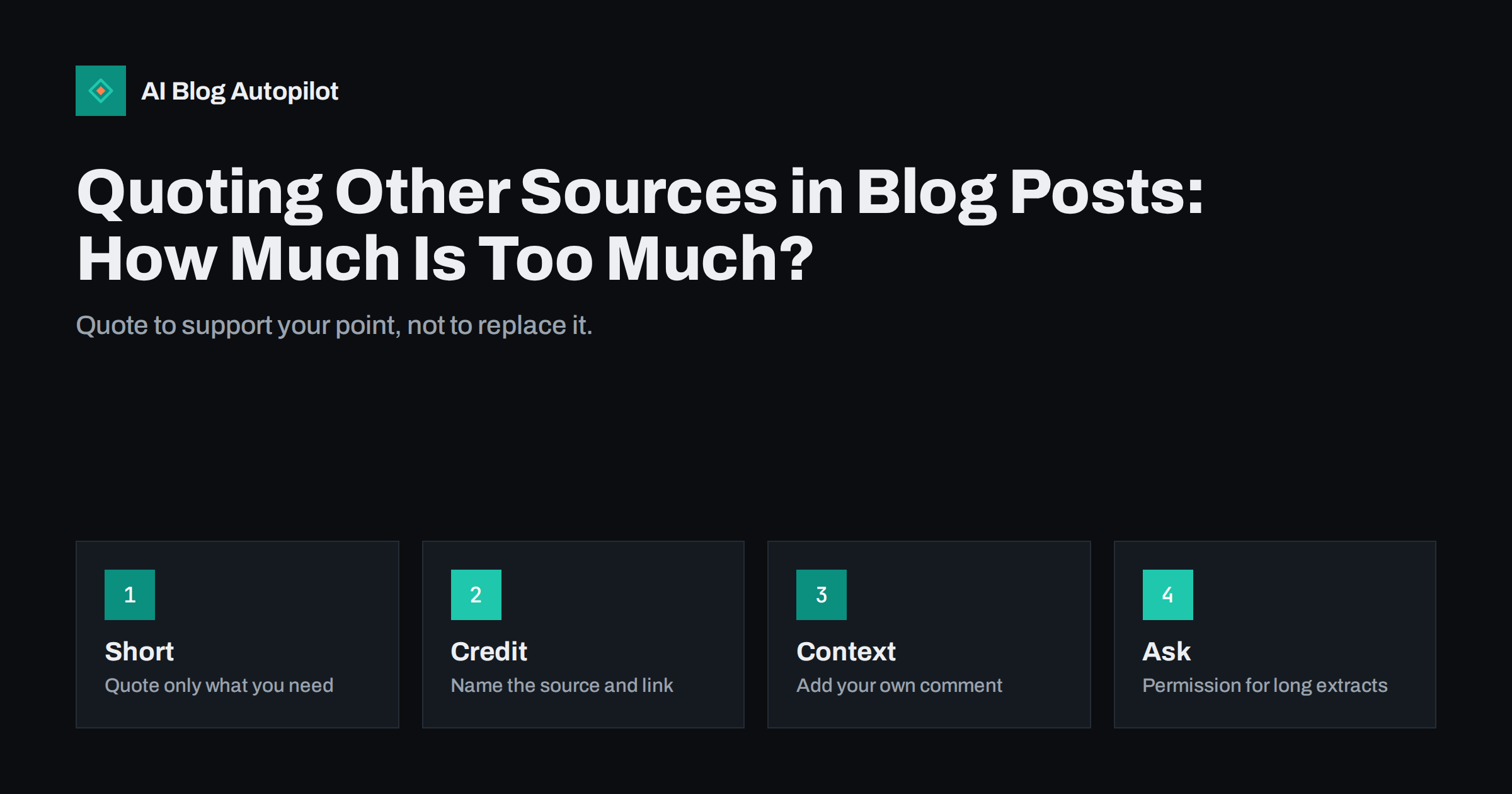
Short answer: quote briefly, quote only what supports your point, name the source and add your own comment next to every quotation. A sentence or two from a published work, with clear credit and a link, is normal practice on the web. Long extracts, whole paragraphs or copied tables are different, and they need permission or a different approach. Rules vary from country to country, so treat this guide as practical advice and not as legal advice.
Every business blog quotes someone sooner or later. You may want the words of an expert, a line from a report, a sentence from a customer review or a definition from an official page. Quotations show that you have done your reading, and they give readers a way to check a claim. They also carry risks, from copyright complaints to duplicate content and plain lazy writing.
This guide explains how to decide what to quote, how much to quote, how to credit it and what to do when you need more than a short extract. It is written for publishers who produce articles at a steady pace, so the focus is on habits that a team can repeat.
Why quote at all
A good quotation does a job that your own words cannot do. It gives the voice of a named person, it proves that a claim comes from a source, or it shows the exact wording of a rule, a policy or a product description. When the exact words matter, a quotation is better than a summary.
Quotations can also add trust. Readers and search engines look for signs that an article rests on real sources. The guide on citing sources in blog posts explains why clear attribution helps, and the same logic applies to short quotations with a link back to the original.
A quotation is not a substitute for thinking. If a section of your article is mostly someone else’s text with a line of introduction, you have not written a section. You have collected one. Readers notice, and so do search systems that compare pages with the rest of the web.
How much is too much
There is no magic number of words that is always safe, and anyone who gives you one is simplifying. What matters is the proportion and the purpose. A short extract that supports your own argument is very different from a long extract that readers could use instead of the original.
A practical rule for a business blog is to keep each quotation to a sentence or two, and to keep all quotations together to a small share of the article. If a reader could skip the source because your page already gives them the best part, you have probably quoted too much. The original author loses a visitor, and you take on the risk.
Pay special attention to the heart of a work. Quoting the key finding of a report, the punchline of an article or the main table of a study is more sensitive than quoting a minor detail, even when the number of words is small. If your quotation is the reason people would visit the original, summarise it instead and link to the source.
Credit the source every time
Name the author or the organisation, say where the words come from and link to the page when it is available online. Place the credit next to the quotation, not in a list at the bottom, so the reader sees at once whose words they are reading. Use quotation marks or a block quote so that the borrowed words are clearly separate from yours.
Do not change the words inside quotation marks. If you must shorten a quotation, mark the cut clearly, and if you add a word for clarity, put it in square brackets. Changing the meaning of a quotation, even slightly, is a serious editorial mistake and can mislead readers.
Check the quotation against the original, not against another site that copied it. Quotations travel across the web and pick up errors. A quick look at the first source takes a minute and saves you from repeating a misquote. The article on how to fact-check content before you publish lists a routine for this.
Add your own comment
After each quotation, explain why it matters. A good pattern has three parts: introduce the speaker or source and the point, give the quotation, then say what it means for your reader. That structure keeps your voice at the centre and the quotation in a supporting role.
Your comment can agree, disagree, add an example or show how the idea applies to a small business. It should say something that the quotation does not. If your comment only repeats the quotation in other words, cut one of them.
When you have several quotations on the same topic, compare them. Which parts agree, and where do experts disagree? A short comparison gives the reader something that no single source offers, and it is the kind of original value that makes a page worth reading.
Placement matters too. Do not open an article or a section with a long quotation, because the reader has not yet learned why it matters. Start with your own sentence that frames the point, then bring in the quoted words. Ending a section on a quotation can work, but only when your own comment has already done the explaining. This keeps the structure of the page in your hands and makes each quotation earn its place.
Quotations from customers, staff and partners
Quotes from people connected to your business need a different kind of care. If you quote a customer review, a message or an interview, ask for permission to publish it with their name or a description they are happy with. Some customers prefer to stay anonymous, and some messages were never written for publication.
Do not edit a customer’s words to make them more flattering. Light corrections to spelling are fine, but changes that alter the meaning are not. If you are unsure, send the final text back to the person and ask them to approve it. The guide on testimonials in blog posts covers the use of customer words in more detail.
Keep a note of the permission, with the date and the wording that the person approved. A simple line in your content inventory is enough. If a question comes up a year later, you will be able to answer it quickly.
When you need more than a short extract
Sometimes a long extract is the whole point, for example when you review a poem, analyse a contract clause or discuss a piece of text line by line. In those cases, ask the owner for permission, or check whether the work has a licence that allows reuse. Many publishers and authors say yes when asked politely, especially if you promise a clear credit and a link.
Look at the licence of the source before you assume anything. Some works are published under open licences that allow reuse with credit, while others are marked as all rights reserved. The licence text is usually in the footer or on an about page. If you cannot find any licence, assume that the usual rules apply and keep your quotation short.
If permission is not possible, change the method. Summarise the idea in your own words, describe the structure of the original, or point readers to it with a link and a one-line description. You can often serve the reader just as well without copying any text.
Quotations, duplicate content and originality
Copied text can also affect how a page performs. Search engines compare pages, and a page made mostly of material that appears elsewhere gives them little reason to rank it. A few quotations inside original writing are not a problem, but a page built from extracts is. The article on originality and plagiarism on a business blog explains how to check for this.
Run a simple check before publishing. Highlight every quoted passage in a draft and compare the quoted words with the total. If the highlighted text is a large part of the page, rewrite. Also check that each quotation has a source, a link and a comment from you.
Be careful with machine-written drafts as well. A draft can contain phrases that look like quotations but have no source, or lines that repeat a well-known text too closely. Treat any sentence that sounds like a famous line or a policy statement as something to verify before it goes live.
A simple quotation policy for your team
Write down a short policy and keep it with your style guide. It can fit on a few lines: quote no more than one or two sentences from any source, always use quotation marks or a block quote, always name the source and link to it, always add a comment, and ask permission for anything longer or for words from customers and staff.
Add a line about what to do with doubtful cases, such as who decides and where the question is recorded. A rule that says “ask the editor” is easy to follow and prevents hours of guesswork. The article on an editorial style guide in one page shows where such rules belong.
Review the policy once a year. As your blog grows, you may find that certain sources come up again and again, and you may want to set up a standing agreement with them or choose different sources.
How AI Blog Autopilot helps
AI Blog Autopilot writes full articles with FAQ sections, tags and SEO meta, and it can publish them to your WordPress blog with an approval step if you want to see each piece first. Whichever mode you use, treat quoted material as something to verify, and check the sources before a post goes live. See the pricing page for plans and monthly credits.
Related reading
- Citing Sources in Blog Posts: Why AI Answers Reward It
- Originality and Plagiarism on a Business Blog
- How to Fact-Check Content Before You Publish
The bottom line
Quote short, credit clearly and add your own comment. Ask permission for long extracts or customer words, and summarise when you cannot get it.
BUJ
How many words can I quote from another article?
There is no safe number for every case. Keep each quotation to a sentence or two, use it to support your own point and link to the source.
Do I need permission to quote a short sentence?
Often not, when it is brief, credited and used to support your own text. Rules differ by country, so ask for permission when you are unsure.
Should I put quotations in a block quote?
Yes for longer quotes. A block quote or clear quotation marks show readers which words are not yours.
Can quotations hurt my SEO?
A few short quotations do no harm. A page made mostly of copied material gives search engines little reason to rank it.
What is better than a long quotation?
A summary in your own words with a link to the source. It serves the reader and avoids copying.