ENEnglish
 LTLietuviškai
 DEDeutsch
 FRFrançais
 RUРусский
 ESEspañol
 PLPolski
 ITItaliano
 UKУкраїнська
 CSČeština
 PTPortuguês
 JA日本語
 LVLatviešu valoda
 ETEesti
 HUMagyar
 IDBahasa Indonesia
 TRTürkçe
 HIहिन्दी
 ELΕλληνικά
 ARالعربية
 THไทย
 VITiếng Việt
 RORomână
 MSBahasa Melayu
 BNবাংলা
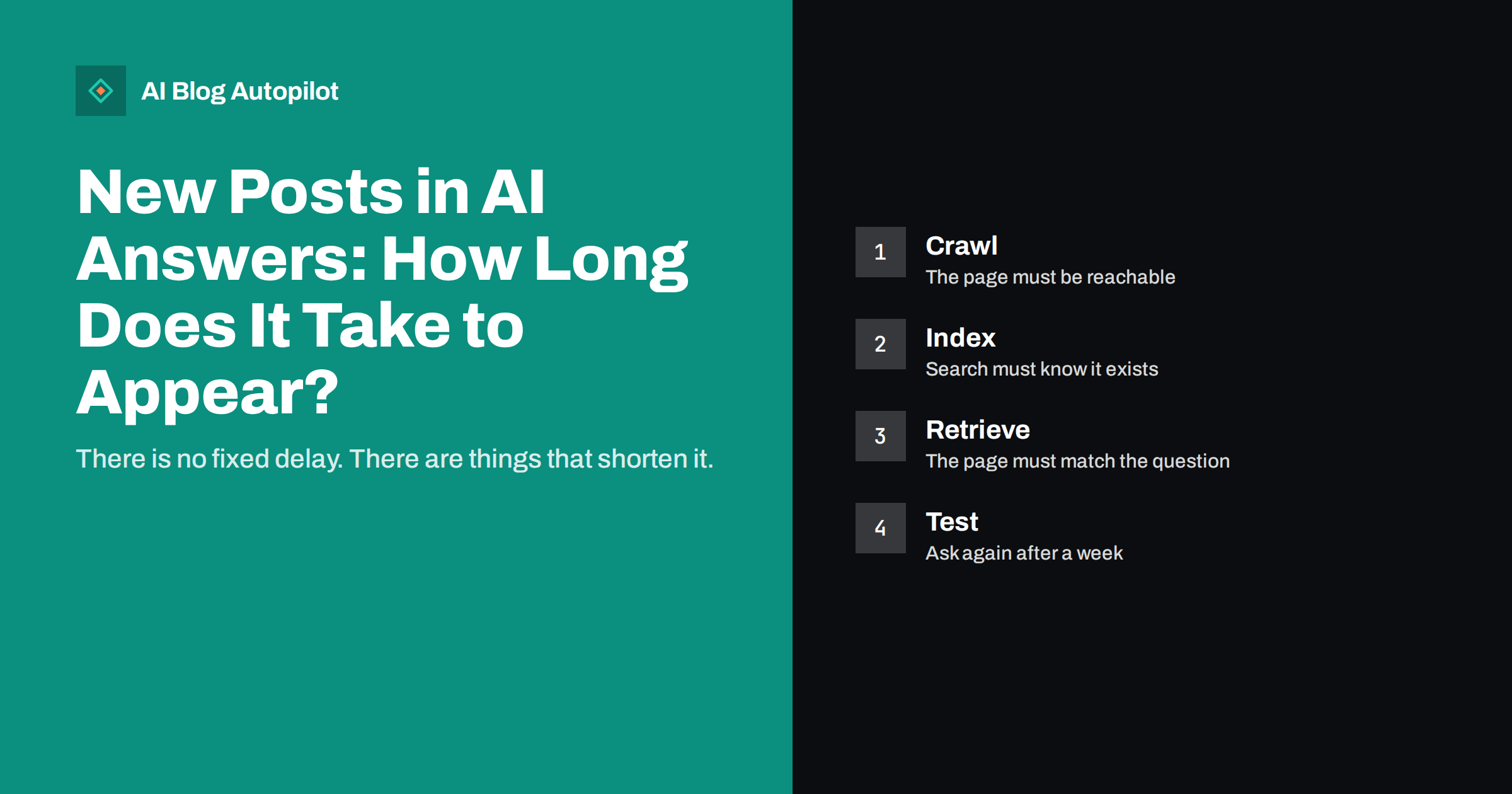
Short answer: there is no standard delay. Some AI assistants search the live web and can quote a new page within days, while others rely mostly on older knowledge and only pick up fresh pages through a search index. The practical path is the same for all of them: make the page easy to crawl, get it indexed, make the answer easy to quote and test your questions again after a week or two.
Blog owners often publish a careful article and then ask an assistant about the topic the same afternoon. When the page is not mentioned, they conclude that it does not work. That test is too early and too narrow. This article explains why timing varies, which steps you control and how to check progress without guessing.
Some assistants also use their own crawlers or partner indexes, which are different from the search engine you look at every day. That is one more reason why a page can be visible in a normal search and still be missing from an assistant answer, or the other way round. You cannot see these indexes directly, so you work on the shared basics that every system needs.
Two ways an assistant knows things
An AI assistant can answer from what it learned during training, from a live search at the time of the question, or from both. Training knowledge is fixed at a point in the past, so it cannot include a post that you published this week. Live search can. Many assistants and search features now look things up on the web before they answer, then write a summary and show some sources.
This means that a new page can only appear in an answer in two ways: through a search step that finds it or through a later update of the underlying model. The second path takes a long time and you cannot influence it. The first path depends on how quickly the page enters the indexes that the assistant uses. We cover how those sources are chosen in how AI search picks sources.
Because each assistant has its own habits, the same question can give different results in different tools. A page that appears in one place may be missing in another for weeks. Treat that as normal and look at the trend, not a single answer.
What decides the delay
Four things matter most. The first is discovery: does the crawler know the page exists? Links from your own pages, a clean sitemap and a feed all help. The second is crawling: can the bot fetch the page without errors, blocks or heavy scripts? The third is indexing: does the search engine decide that the page is worth keeping? The fourth is retrieval: does the page match the wording of questions that people ask?
A new site or a site with few links is usually crawled less often than an established one. A blog that publishes regularly and is linked from the home page tends to be revisited sooner. This is the same pattern that governs ordinary search, described in how long until a new blog ranks, and the basics are in crawl, index, rank explained.
The type of question also changes timing. For topics with fresh news, assistants lean on recent pages. For stable topics, they may prefer older pages that have many links and citations. A new post on an old topic must therefore earn its place with clarity and evidence, not just with the date.
Steps that shorten the wait
Start with the technical basics. Make sure that the post is not marked noindex by mistake, that the robots file does not block it and that it returns a normal successful response. Add it to the sitemap, link to it from the home page or a category page, and link to it from at least two older posts. These steps give crawlers several ways to find it.
Next, ask for indexing where you can. In Search Console you can inspect the address and request indexing, as shown in the URL inspection tool guide. Some search engines also support instant notification of new addresses, described in IndexNow and fast indexing. These do not guarantee a result, but they remove avoidable delay.
Finally, make the content easy to use. Put a direct answer near the top, use clear headings and keep key facts in plain sentences, as explained in answer-first writing. A page that is easy to quote is more likely to be chosen once it is available.
If you find the page in search but your key sentences are not shown in the snippet, read the first screen of the page as a stranger would. Is the answer visible without scrolling? Is the topic named in the title and the first heading? Quotable pages state the main point early and avoid long introductions before the first useful sentence.
Checking whether a page is indexed first
Before you test an assistant, test the search index, because many assistants depend on it. Search for the exact title in quotes and check whether your page appears. Use the URL inspection tool to see whether the page is known and when it was last crawled. If the page is not indexed after a week or two, fix that problem first. No assistant can quote a page that no index holds.
If the page is indexed but you see no mentions, move to the content. Ask what question the page answers and whether the first lines answer it directly. Compare it with the pages that do appear for that question. Often those pages state the answer more plainly, name the same entities and carry clearer evidence.
Keep notes. Write the date you published, the date it was indexed and the date you first saw a mention. After a few posts you will know your own typical delay, which is more useful than any general rule.
Keep the test list small and stable. Ten questions asked in the same way each time are more useful than fifty questions that change every month. If you add new questions, add them to the end and keep a column for the date, so that you can compare like with like. Do not change the wording to fish for a result.
How to test fairly
Use a fixed list of questions that real customers ask, written in natural language. Ask the same list in two or three assistants at the same interval, for example one week, two weeks and a month after publishing. Record whether your page is cited, whether your brand is mentioned and what the answer says. Our guide to checking visibility in AI answers explains a simple routine.
Avoid testing with the exact title of your post. That proves only that the page exists. A better test is a question that a customer would ask without knowing your page. If your page is not used for that question, the issue may be topic coverage, not timing.
Remember that answers vary between sessions and over time. Repeat each question a couple of times and look for consistent patterns. A single appearance or absence is weak evidence.
Another useful habit is to write the next post while you wait. Time spent refreshing assistant answers is better spent on improving the page, adding a clear example or linking it from related posts. Patience and steady publishing usually win over frequent checking.
What not to expect
Do not expect a guaranteed mention. Assistants choose from many pages and may name none of them. Do not expect an instant effect from an indexing request either, because requests are hints, not commands. And do not trust services that promise fast placement in AI answers for a fee. Nobody outside the assistants controls their choices.
It is fair to expect that a good, clear page on a useful question will be found more often over time. Pages gain strength as they collect links, mentions and consistent facts across the web. That is why updating old posts for AI answers matters as much as publishing new ones.
Also be careful with dates. A fresh date on an article that has not changed does not make it fresher in a meaningful way, and it can reduce trust if readers notice. Change the date when the content really changes.
Be realistic about scale as well. A site with a handful of links and a short history will usually wait longer than a well-known brand, whatever it publishes. The answer is not to give up but to build the signals that speed things up: useful content, clear structure, links from other sites and consistent facts about your business wherever it is mentioned.
A simple routine for each new post
Publish, then run a short routine. Confirm that the page loads and is indexable. Check the sitemap entry and the internal links. Request indexing for important pages. After a week, search for the topic and see whether the page is indexed. After two weeks, ask your question list in the assistants you care about. After a month, record the result and decide whether the page needs a stronger answer, more evidence or better links.
This routine takes a few minutes per post and turns a vague worry into a record. Over several months you will see which kinds of posts are picked up fastest, and you can write more of them.
How AI Blog Autopilot helps
AI Blog Autopilot writes full SEO articles for your WordPress blog from the topics, keywords, audience and tone you set, with FAQ sections, tags and SEO meta included, and it shares each one to your social networks. A steady flow of new, well-structured articles gives crawlers regular reasons to return, and approval mode lets you read each one before it is published. See the pricing page for plans.
Related reading
The bottom line
New posts can reach AI answers in days or take much longer, depending on the assistant and the index behind it. Make the page crawlable, get it indexed, write quotable answers and test again after a week or two.
BUJ
How long until my new post shows up in AI answers?
There is no fixed time. Assistants that search the live web may find it within days, while others depend on indexes or updates that take longer.
Can I ask an AI assistant to read my page?
You can paste an address into some tools, but that only helps you. It does not add the page to the sources other people see.
Does requesting indexing help?
It can shorten the wait for search indexes, which many assistants rely on. It is a hint and carries no guarantee.
Why does my page appear in one assistant and not another?
Each assistant uses different sources and rules. Track the trend across several tools instead of judging by one answer.
Should I change the date to look fresher?
Only when the content really changes. A new date on unchanged text adds nothing and can reduce trust.