ENEnglish
 LTLietuviškai
 DEDeutsch
 FRFrançais
 RUРусский
 ESEspañol
 PLPolski
 ITItaliano
 UKУкраїнська
 CSČeština
 PTPortuguês
 JA日本語
JA日本語 LVLatviešu valoda
 ETEesti
 HUMagyar
 IDBahasa Indonesia
 TRTürkçe
 HIहिन्दी
 ELΕλληνικά
 ARالعربية
 THไทย
THไทย VITiếng Việt
 RORomână
 MSBahasa Melayu
 BNবাংলা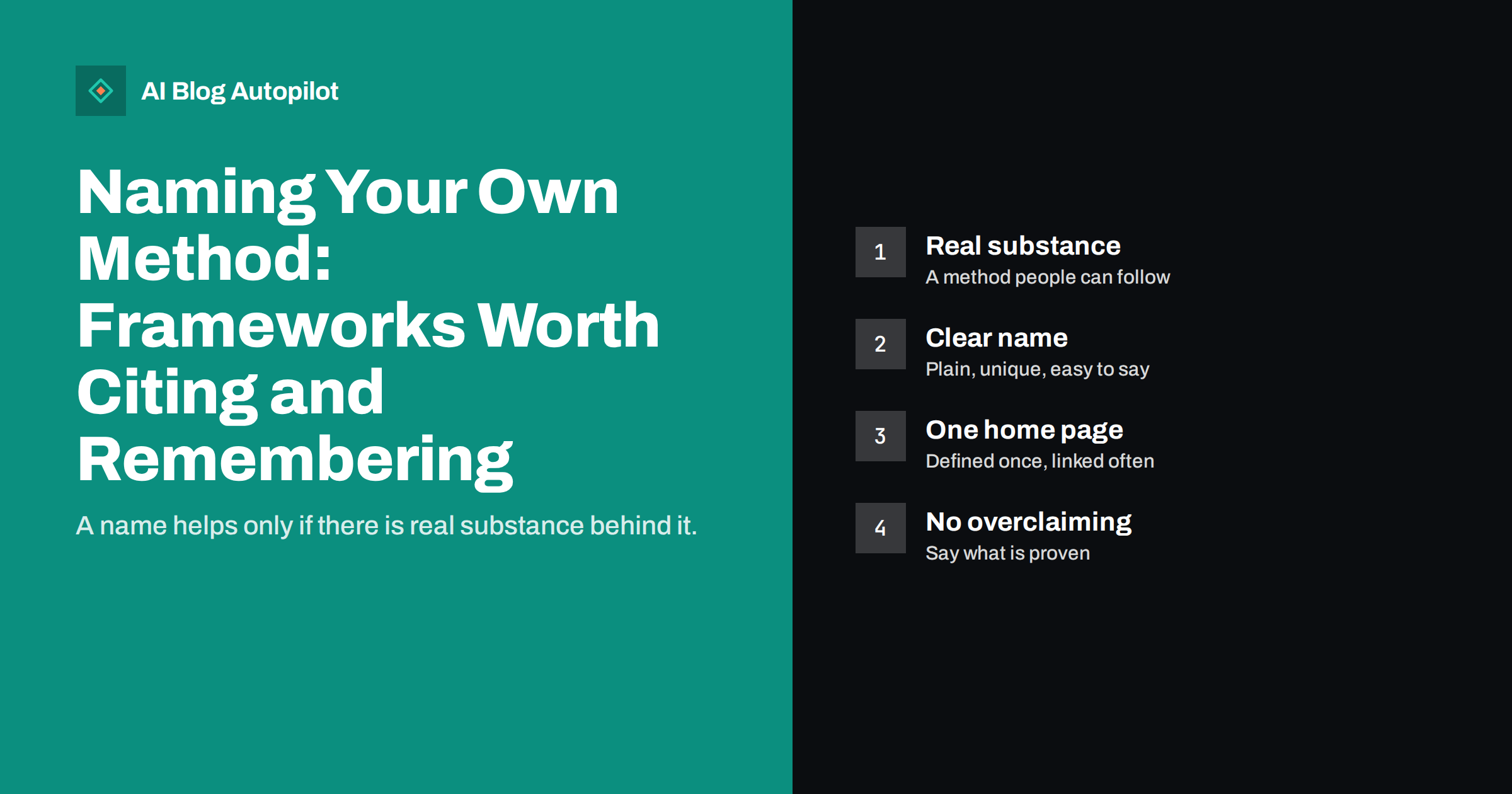
Short answer: giving your own approach a clear name can make it easier for readers to remember, for others to cite and for search systems to recognise as a distinct idea. It only works when there is a real method behind the name, a plain description that stands on one page, and consistent use across your site. Check that the name is not already used for something else, avoid claiming that you invented what you merely adapted, and do not expect a name alone to produce citations. Substance first, label second.
Many experts and small businesses have a way of working that clients like: a sequence of steps, a checklist, a scoring method or a set of principles. Without a name, it is described differently each time, and nobody can refer to it. With a name, it becomes a unit that can be shared, linked and quoted. This article explains how to turn a working approach into a named, citable resource without slipping into hype.
Why a name helps
A name is a handle. People use handles to recall, recommend and compare. A client who says “we followed the three-pass edit” can point colleagues to the same page. A journalist or a blogger who wants to refer to your approach can do so in a few words and link to a definition. Search systems and assistants also work with named things: a distinct term with a clear definition is easier to identify, and easier to associate with its source, than a loose description repeated in different words.
- Memory: a short name sticks better than a paragraph.
- Sharing: people can recommend it in a sentence.
- Consistency: your team and clients use the same language.
- Attribution: the idea has a clear home on your site.
None of this is automatic. A name for a weak idea will be forgotten, and a good idea with a confusing name will still help clients who work with you. The goal is to make something good easier to find and refer to.
Start with substance
Before thinking about names, check that you have something worth naming. A useful method is specific, repeatable and has a clear result. It should be possible for a stranger to follow it from your description and get a sensible outcome.
- Write the steps in the order you actually use them, with the purpose of each.
- Test it on someone new. Ask a colleague or client to follow the description without your help and note where they struggle.
- Find the boundaries. When does the method work, and when should someone use another? Honest limits make a method more credible.
- Collect examples, ideally real ones, with the permission of anyone involved, or clearly labelled hypothetical ones.
- Note the sources. If the method adapts established practice, say so and credit the origin.
This work also gives you the content for the definition page and for articles that explain or apply the method.
Choose a name that works
A good name is short, plain and distinctive. It should tell the reader roughly what the method does, be easy to say aloud and spell, and be different enough from other things that a search for it points to you.
- Describe, don’t dazzle. “The Quarterly Content Review” tells people more than an invented word.
- Keep it brief, usually two to four words.
- Avoid heavy acronyms, unless the letters spell something useful. Acronyms that stand for long phrases are hard to remember and often already taken.
- Check the language. Make sure the name does not mean something unwelcome in the markets you serve.
- Prefer one name. Avoid renaming later, which splits the references.
Say it in a sentence, such as “We use the Quarterly Content Review for every client”. If it sounds natural, it is probably workable.
Check for clashes before you commit
Search for the name in quotation marks on the web and in a few assistants. See whether other people use it, for what, and whether results would bury yours. Check domain names and social handles if they matter to you, and look at trademark registers in your main markets. If the name is a registered mark for related services, choose another. This is general advice, not legal advice. For anything you plan to invest in heavily, speak to a professional who knows the rules in your country.
If the name is already common, consider adding a qualifier that makes it clearly yours, or pick another. A name that shares search results with a larger, older idea will rarely become associated with you.
Here is a short example. A bookkeeping firm helps freelancers prepare for year-end. Over the years it has settled on a routine: gather records, match them to bank entries, flag gaps, ask the client three standard questions and file a summary. Clients call it “the usual checklist”. The firm decides to name it the Year-End Readiness Check, writes a page that defines it in one sentence, lists the five steps with a short example for each, and adds a printable worksheet. It states plainly that the routine reflects its own experience with freelancers and does not replace professional advice for complex cases. Within months, clients refer to the check by name, and the firm’s articles on records, receipts and deadlines all link to the one definition page.
Notice what the firm did not do. It did not claim a discovery, invent an acronym or promise results. It put a plain name on something that already worked and made it easy to find and understand.
Give it one home page
The most important step is to create a single page that defines the method. Treat it as the canonical source, the page that everything else links to. A strong definition page has a predictable structure.
- A one-sentence definition at the top: “The Quarterly Content Review is a four-step check that…”
- Who it is for and what problem it solves.
- The steps, each with a short explanation and an example.
- When to use it and when not to.
- Results you have seen, stated honestly and with context, or a note that evidence is limited.
- The history: who developed it, when and from what.
- Links to related articles, a template or a worksheet.
Use the same wording for the name and the definition wherever you refer to the method. Articles, newsletters and social posts should link to the home page rather than repeat and slightly change the explanation. Consistency lets readers and systems connect everything to one place.
Be honest about what you claim
It is tempting to present a method as a breakthrough. Resist that. Claims of invention, proof or guaranteed results are easy to challenge and damage trust. Write what is true: “we developed this approach from our work with small shops and refined it over several years”. If you have data, describe its source, size and limits. If you do not, say that the method is based on experience.
Credit others. If your steps resemble a well-known approach, name it and explain how yours differs. Readers value the clarity, and honest credit makes it more likely that others will cite you in return. Never present someone else’s framework as your own.
Help others use and cite it
A method spreads when it is easy to use. Offer a short summary others can quote, a simple diagram with a text description, and a one-page worksheet. Use a clear heading and a short definition sentence so that the core idea can be lifted out of the page. Allow sharing, and tell people how you would like to be credited, for example with the name and a link to the home page.
- Use the name in headings and in natural sentences, not in forced repetition.
- Mention it in your about page, talks, podcasts and guest articles, with a link.
- Describe it in structured, plain text, so that it does not depend on images alone.
- Answer questions about it in an FAQ on the home page.
Take care with visuals. A diagram of the method can help, but always add the same information in text near it, so that readers who cannot see the image, and systems that read text, get the full picture. Give the image a descriptive file name and alt text that states what it shows, and avoid putting the only copy of the steps inside the picture.
Measure and maintain
Every few months, search for the name and see what appears: your page, mentions by others, confusion with other things. Note the queries in Search Console that include it. Ask assistants what the method is, and check whether the description matches yours. If it does not, improve the home page and the pages that link to it, and correct inaccurate third-party descriptions politely where you can.
Keep the method alive. Update the page when the steps change, record the date and describe the change. If the method no longer fits your work, retire it clearly and redirect the page to its replacement.
How AI Blog Autopilot helps
AI Blog Autopilot asks for your topics, keywords, audience and tone, and writes full SEO articles with FAQ, tags and meta for your WordPress blog. Listing your named method among your topics lets the articles explain and apply it in your own words, with links back to your definition page. See the pricing page for plans.
Related reading
- Topical Authority: What It Means in Practice
- Unlinked Brand Mentions: Turning Them Into Real Links
- Writing Clear Definitions That AI Answers Can Quote
- How to Put Something Original in an Article You Automated
The bottom line
A named method is useful when it is real, specific and honestly described. Write the steps and test them, choose a short plain name, check that it is free to use, give it one definition page and use it consistently. Credit your sources, avoid inflated claims and keep the page current. The name will not guarantee citations, but it makes your expertise easier to remember, link and quote.
BUJ
Will naming a method make AI assistants cite me?
There is no guarantee. A clear name and definition make your idea easier to recognise and refer to, but citations depend on many factors.
Should I trademark the name?
That is a business and legal decision. Check existing registrations in your markets and take professional advice before investing in the name.
Can I name an adaptation of someone else’s method?
Yes, if you credit the original and explain what you changed. Never present another person’s framework as your own.
How long should the definition page be?
Long enough to define the method, show the steps with examples and state limits, usually a few hundred to a thousand words.
What if my chosen name is already in use?
Add a clear qualifier or choose another. A name that shares results with a bigger, older idea rarely becomes linked with you.