ENEnglish
 LTLietuviškai
 DEDeutsch
 FRFrançais
 RUРусский
 ESEspañol
 PLPolski
 ITItaliano
 UKУкраїнська
 CSČeština
 PTPortuguês
 JA日本語
 LVLatviešu valoda
 ETEesti
 HUMagyar
 IDBahasa Indonesia
 TRTürkçe
 HIहिन्दी
 ELΕλληνικά
 ARالعربية
 THไทย
 VITiếng Việt
 RORomână
 MSBahasa Melayu
 BNবাংলা
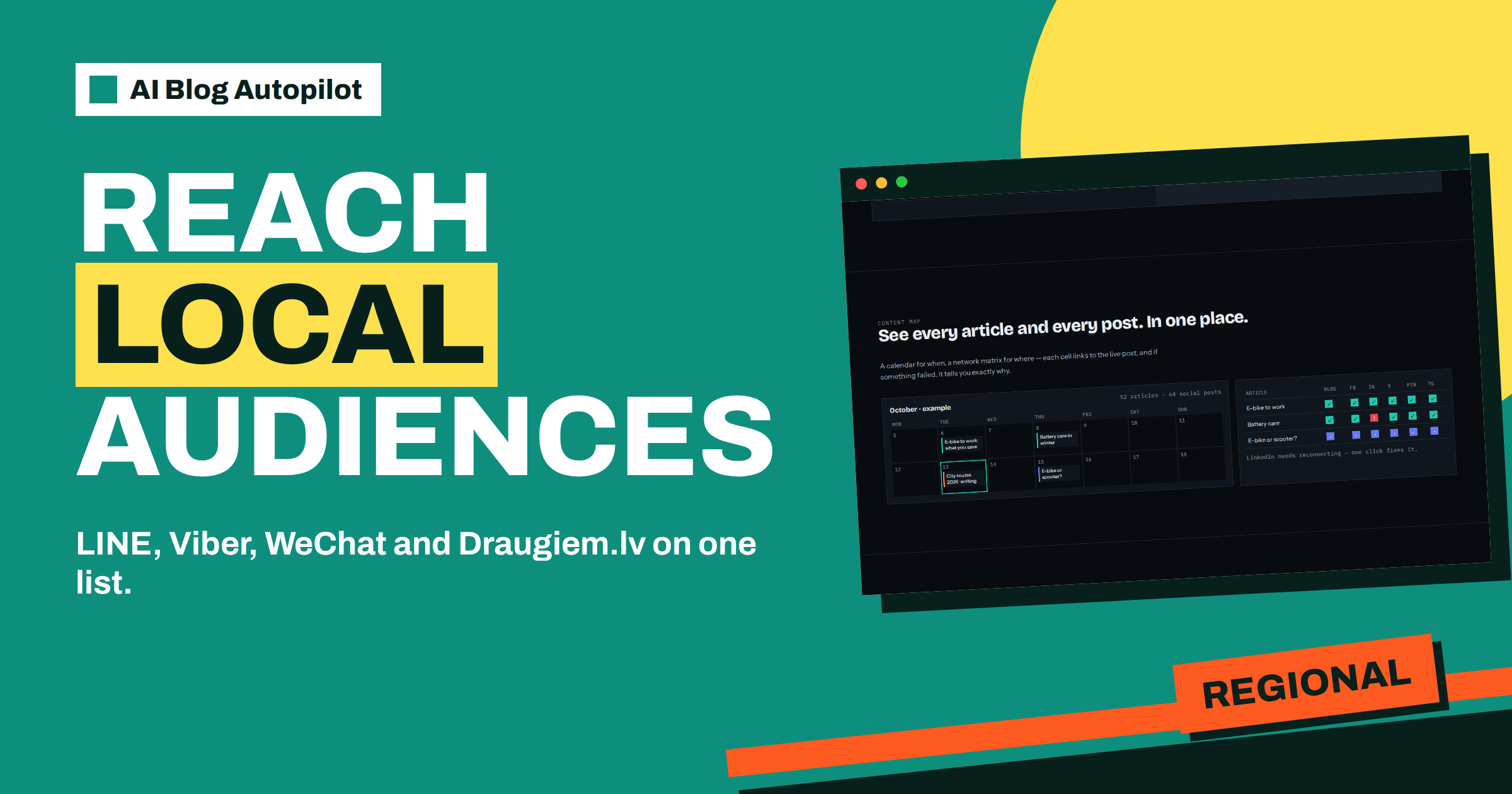
Short answer: Besides the global names, the AI Blog Autopilot networks page lists regional networks and messengers such as LINE, Viber, WeChat, Draugiem.lv, MAX, Bale, Eitaa and Rubika. They matter when your customers live where those apps dominate. Choose by your audience, write natively in their language, read each platform’s rules and start with one network.
A business that sells in one country may find that most of its customers use an app that never appears in global advice. A shop in Latvia, a tour operator selling to travellers from East Asia or an importer serving Eastern European communities each meet customers where those customers already talk. If you ignore the local apps, you ignore the audience.
This guide explains how to use the regional networks on the AI Blog Autopilot list. The product facts come from the networks page, which names the networks but does not describe each in detail. Where this article describes a platform’s popularity, it relies on general knowledge, so confirm what is current for your market before you invest effort.
Which regional networks are on the list
The networks page lists its networks by type. Among social networks it includes VK and Draugiem.lv, regional networks with their audiences in particular countries. Among messaging channels, it lists Telegram, Discord, Matrix, LINE, Viber, WeChat, MAX, Bale, Eitaa, Rubika and Stoat. Among team chats, it includes Chatwork, Feishu or Lark, DingTalk and WeCom, which are widely used in East Asia.
LINE is a leading messenger in Japan, Taiwan and Thailand. Viber has a strong base in Eastern and Central Europe and in some other regions. WeChat is a central app in China. Draugiem.lv is a Latvian network. Bale, Eitaa and Rubika are messengers used in Iran. MAX is a messenger used in Russia. Chatwork is popular with Japanese companies, DingTalk and WeCom in China, and Feishu or Lark across several Asian markets.
The page also says the list keeps growing, and that new networks appear automatically when they become available in your account. So the choice today is not final; you can add networks as your markets change.
Start from your customers, not the list
A long list of networks is not a to-do list. Start by asking where your customers are. Look at the messages and calls you receive: which apps do people use to contact you? Check your website statistics for countries and languages. Ask your staff which channels customers prefer, and look at what your competitors in the region use.
Match networks to markets. If a large share of your visitors come from Japan, LINE and the Japanese blogging platforms may be worth a trial. If you serve Latvian-speaking customers, Draugiem.lv deserves a look. If you sell to the Viber-using communities in your region, a Viber channel may reach them. If none of your customers use a network, skip it.
The article on choosing social networks for a blog offers a short method for picking a few channels from many.
Language comes first
A regional network needs the local language. The home page says Autopilot writes in 25 languages, each natively and not translated from English, and lists languages such as Japanese, Latvian, Arabic, Thai, Turkish, Polish and more in its language menu. A post for a Japanese messenger should be in Japanese, and a post for a Latvian network should be in Latvian.
Check the plan too. The pricing page lists 1 language on Social and Starter, 3 on Growth and all 25 on Pro and Agency. If you want a regional audience in a second or third language, plan for that. Choose languages that match both your markets and your ability to review them.
Find a reader for each language. Someone who knows the language and the culture can tell whether a post sounds right, and whether a phrase is too formal, too casual or unsuitable. The article on social media in several languages offers tips on organising this.
Know what each network is for
Networks differ in purpose, even within one country. Messengers are private and personal, so a post in a channel should feel like a useful message, not an advertisement. Team chats are used inside companies, and a post there makes sense for business-to-business content. Social networks are public and suit broader content.
The networks page says Autopilot writes a separate text for each type: a headline and summary for team chats, a summary with bullet points for Telegram and so on. For regional messengers, the same principle holds. A short, clear message with a link usually works better than a long text.
Use channels as opt-in places. Where a messenger works through channels that people join, make sure your audience has chosen to follow you. Do not add people without consent. The article on messaging channels on Autopilot explains how channels differ from other networks.
Check the rules and the law
Every platform has terms, and some regions have laws about messaging, advertising and data. Before you connect a network, read its rules for businesses and automatic posting. Some apps require a business account or approval. Some limit promotion. Some are restricted or blocked in certain countries.
Take care with data and consent, too. If you collect contact details or send messages to individuals, local privacy and marketing rules may apply. Posting a public article to a channel is different from messaging people directly, but check what is allowed in your market. When in doubt, ask a local adviser.
The home page says approval can be switched on at any time. For a new regional network, use approval at first and read each post, so that you can catch anything that looks wrong for the audience.
Start with one network and measure
Connect one regional network, not five. The networks page says you connect each network once in your Autopilot account and no other tools are needed. Pick the one that matches your largest foreign audience or your most active local one.
Run it for eight to twelve weeks. Look at visits to your site, replies, followers or members, and any enquiries that mention the post. The content map shows each article and each post and links every cell to the live post, so you can read what went out and how it appeared.
If the network brings results, keep it and consider a second one. If not, disconnect it, note what you learned and try another. The aim is a small number of channels that bring real readers, not the longest list.
Consider a short story. A small travel agency in Riga sells city breaks to visitors from several countries, but most of its local customers prefer Latvian-language content. It connects Draugiem.lv and a Viber channel for the Latvian audience, writes its brief in Latvian and asks a colleague to review the first posts. After two months, the Viber channel gains regular readers, and the agency notices that posts about weekend trips draw the most replies. Draugiem.lv brings fewer visitors, so the agency keeps it quiet and spends its attention on Viber.
The lesson is that regional networks reward focus. One channel in the right language, with a reader who checks the posts, beats a long list handled carelessly.
Mixing regional and global channels
Regional networks work best as part of a mix. Keep one or two global channels that suit your business, such as LinkedIn for professional content or Facebook for local customers, and add a regional channel where a defined audience lives. This avoids putting all your effort into a single platform, and it keeps your reach if one network changes its rules.
Avoid repeating the same text everywhere. The networks page says each network gets its own text, length and timing, and this matters most when audiences differ by language and culture. A post that works in one country may sound odd in another, so let the local reviewer adjust the tone in the brief for each language.
Keep your link target in mind. If a post in a regional messenger sends readers to an English article, many will leave. Where possible, send readers to a page in their language. Autopilot writes in 25 languages natively, and your plan decides how many you can use, so check the language limit when you plan the mix.
What to do when a network changes
Regional platforms sometimes change rules, move servers or lose popularity. Keep an eye on the content map, which the home page describes as a calendar and a network matrix with each cell linked to the live post, and which tells you exactly why a post failed. A pattern of failures on one network is a signal to check your connection, the platform’s status or its rules.
Review your list every quarter. Remove networks that bring nothing, and add one when you see customers asking for it. The networks page says the list grows over time, so a platform that is missing today may appear later. Staying flexible costs little when each connection is made once in your account.
Keep a simple record for each regional channel: the date you connected it, the language, the reviewer, the rules you checked and what you expect to see. After two months, compare the record with the results. This habit prevents the common problem of connecting a channel, forgetting why and leaving it running with no one reading what it posts.
Be patient with new audiences. A regional network may take months to respond, especially if your brand is unknown there. Consistency, clear language and useful content do more than clever tricks. If you cannot commit to that for a quarter, wait until you can, because a half-attended channel can look worse than none.
Finally, listen to your customers. If someone writes to you through a messenger you did not use before, take that as a signal. Customers often tell you where they would like to find you, and a short question such as which app they prefer can guide the next network you add.
How AI Blog Autopilot helps
The product lists regional networks beside the global ones, writes a native post for each in your chosen language and times it for the audience, so local reach does not need local copywriting for every channel. Try it with the three free articles on AI Blog Autopilot, no card needed, and see the plans on the pricing page.
Related reading
- Messaging Channels on Autopilot: Telegram, Discord and Viber
- Social Media in Several Languages: A Practical Guide
- Choosing Social Networks for a Blog
The bottom line
Pick regional networks by where your customers are, write in their language with a reader who can check it, read each platform’s rules, start with one network and keep it only if it brings real readers.
BUJ
Which regional networks are on the list?
The networks page includes VK, Draugiem.lv, LINE, Viber, WeChat, MAX, Bale, Eitaa, Rubika and team chats such as DingTalk and WeCom.
Do I need to write each post myself?
No. Each network gets its own text, length and timing, written in the language you choose.
Which languages can I use?
Autopilot writes in 25 languages. The plan limits are 1 on Social and Starter, 3 on Growth and all 25 on Pro and Agency.
Should I connect many regional networks at once?
No. Start with one that matches your audience and measure it for a couple of months.
Can I check the posts before they go out?
Yes. Approval can be switched on at any time.