ENEnglish
 LTLietuviškai
 DEDeutsch
 FRFrançais
 RUРусский
 ESEspañol
 PLPolski
 ITItaliano
 UKУкраїнська
 CSČeština
 PTPortuguês
 JA日本語
 LVLatviešu valoda
 ETEesti
 HUMagyar
 IDBahasa Indonesia
 TRTürkçe
 HIहिन्दी
 ELΕλληνικά
 ARالعربية
 THไทย
 VITiếng Việt
 RORomână
 MSBahasa Melayu
 BNবাংলা
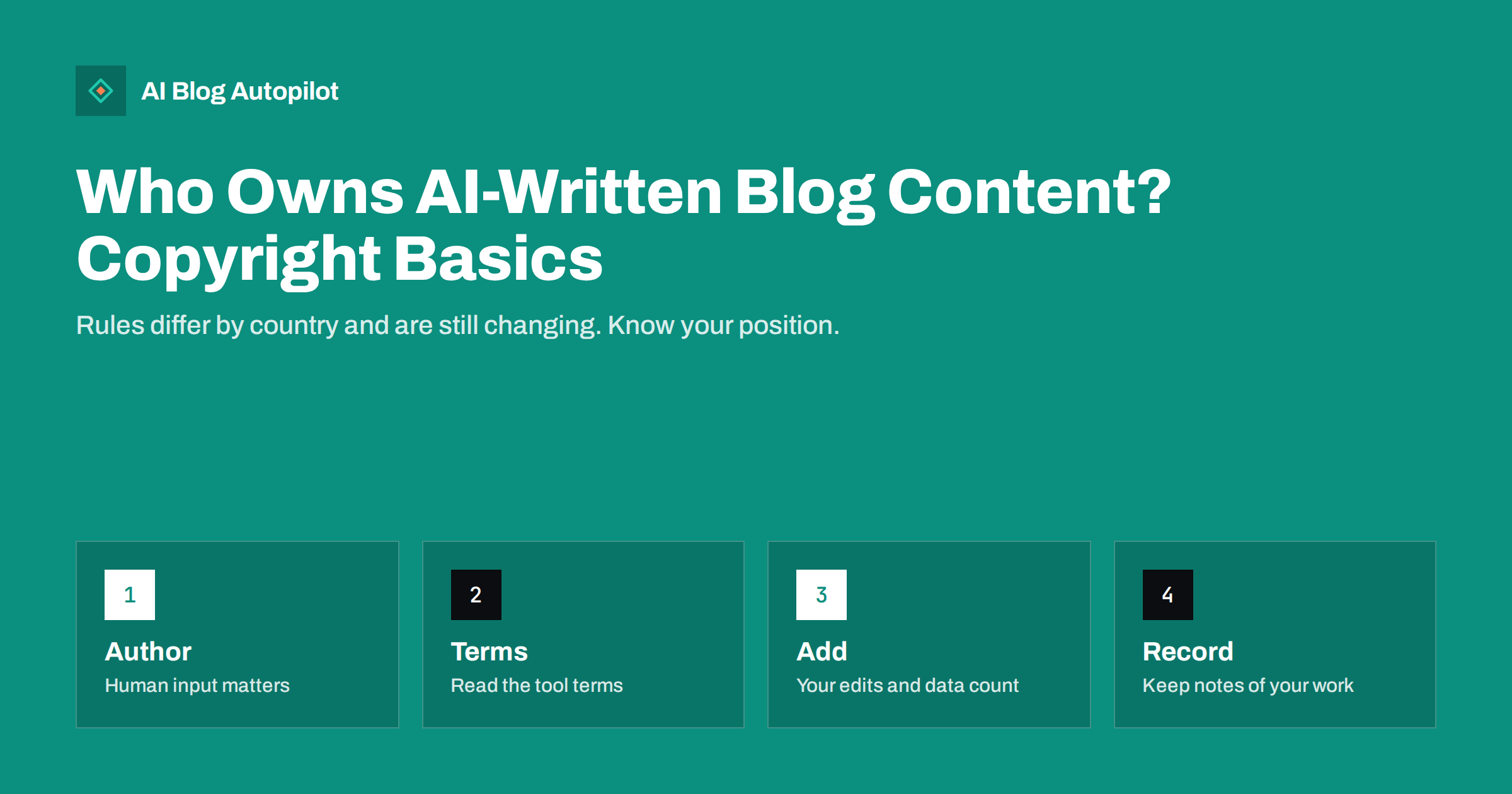
Short answer: the law on who owns text written with an AI tool is still developing, and it differs by country. In several places, copyright protection depends on a human making real creative choices, so text produced with little human input may receive weaker protection than text that you plan, edit and shape. The terms of the tool you use also matter. This article is general information and not legal advice, so check the rules in your country for anything important.
Business owners ask this question for practical reasons. Can a competitor copy an article that a tool wrote for me? Can I be accused of copying when I publish a draft? Who is responsible if the text contains a mistake? This guide sets out the main points in plain words and suggests habits that protect you whatever the final rules turn out to be.
The aim is not to give a verdict, but to help you ask the right questions, keep useful records and avoid assumptions that could cost you later.
Why the question is not simple
Copyright law was written for works created by people. In many countries, the central idea is that a work must be the author’s own intellectual creation. When a machine produces text from a short instruction, it is not obvious that a person has made the creative choices that the law looks for.
Authorities in some countries have said that works made without meaningful human authorship cannot be registered, while works where a person selects, arranges or edits material can be protected for that human contribution. Other countries have not yet given clear answers, or they apply older rules that were not designed for this situation.
Because the position changes, avoid relying on a single claim you read online, including this one. If a piece of content is central to your business, such as a book, a course or a brand text, ask a qualified adviser in your own country. For ordinary blog posts, careful habits are usually enough.
Keep evidence of your input. Save the brief that you gave, the topic list, the notes from any interview and the edited versions of each draft. You do not need a formal archive, only a folder per article with the main files. If anyone ever questions who wrote or approved a piece, these records answer the question in a few minutes.
What your own contribution adds
The more you shape a text, the stronger your claim to it is likely to be. Planning the topic and structure, giving detailed instructions, adding your own examples and data, rewriting parts, checking facts and choosing what to keep are all human contributions. A blog post that has gone through these steps is closer to a work with a real author.
Original material that you add is yours in the usual way. Your own photographs, charts, survey results, quotes from interviews and case notes are not generated by the tool, and you hold the rights to them as normal, provided you have the permission of anyone involved. The article on adding original data to blog posts shows ways to do this.
A good editing routine does two jobs at once. It improves the quality of the article and it strengthens your position as the person responsible for it. The method in how to edit AI-written drafts is a practical starting point.
Pay attention to what happens when you stop using the service. Some terms say that content you have already published remains yours to use, while others are silent. Since a blog post lives on your own website, your copy is in your hands, but confirm that you may keep using text that was created while you were a customer.
What the tool’s terms say
Whatever the law says, your contract with the tool provider matters. Terms of service usually state who may use the output, whether the provider claims any rights in it and what you may do with it. Many services say that you may use the output for your business, but the wording differs, and some set limits.
Read the sections on ownership, permitted use and any restrictions. Look for statements about whether your inputs may be used for other purposes, and whether you must follow rules such as labelling content. Keep a copy of the terms as they were on the day you signed up, since terms can change.
If you work with an agency or a freelancer who uses such tools on your behalf, add a line to your contract on who owns the final text and who is responsible for checking it. This avoids arguments later, and it is a small paragraph in an agreement.
Images deserve a separate mention. Pictures made or edited by tools can resemble real people, logos or artworks, and photographs of recognisable people may need their consent. Use images that you have the right to use, and avoid anything that imitates a brand or a living artist. The related article on image rights covers stock pictures, screenshots and generated images in more detail.
Copying risks: can a draft infringe someone else?
A separate worry is that generated text may be too close to existing writing. In practice, this is uncommon for ordinary explanatory text, but it is possible, especially when a topic has a well-known source or when a prompt asks for a style that copies a particular author. The risk is greatest for quotes, song lyrics, poems and distinctive passages.
A simple check helps. Search for a few distinctive sentences in quotation marks, run the article through a similarity checker if the topic is sensitive, and treat any close match with care. The article on originality and plagiarism on a business blog describes a routine for this.
Be careful with quotes and facts. Quote only short passages, give credit and link to the source. Do not publish figures that you have not checked, since a mistaken claim is a risk in its own right. The guide to fact-checking AI content covers how to verify claims before they go live.
It also helps to make your original material easy to identify. Publish your own data, photographs and examples under your name, and use consistent branding. When text is hard to copy because it relies on your own research or voice, copying matters less, and readers who compare versions will know which is the source.
Protecting your work from copying
Other people may copy your posts, whoever or whatever wrote them. Publish with a clear date, keep your drafts and notes, and keep a record of when each article first appeared. These records can support you if you need to ask a site to remove a copy.
If a site copies your article, you can contact the owner, ask the host to act or use the removal forms of search engines. The guide on when other sites copy your blog posts explains the steps and the order in which to take them.
You can also state how others may use your content. A short reuse policy tells readers whether they may quote you, translate you or share your images, and under what conditions. It does not stop bad actors, but it makes life easier for honest ones. See a simple reuse policy for an example.
Disclosure and responsibility
Ownership is one question, and responsibility is another. Whoever publishes the post is responsible for what it says, whatever tool helped to write it. If it contains an error, a false claim or a breach of someone’s rights, the blame does not shift to the tool. This is a good reason to read each article before it goes out, or at least to sample them regularly.
Some readers, platforms and regulators expect honesty about the use of AI, and some rules may require labelling in certain cases, such as realistic images or content about elections. Check what applies to you. The article on telling readers how your content is produced discusses when and how to explain your process.
Keep your own standards high. A byline, a short note on how the article was reviewed and a way to report errors show readers that a person stands behind the content. This builds trust and fits the guidance on expertise and accountability.
One more habit is worth adopting: review the policy whenever you bring in a new tool or a new writer. A change of provider can change the terms on ownership and use, and a new writer may work in a different way. A five-minute review at that moment is far easier than untangling an issue after hundreds of posts have been published.
A short checklist
Write a one-page policy for your blog. Say what tools you use, who plans topics, who edits and approves, and how you check facts and similarity. Keep the tool terms, your instructions and the dates of publication together in one folder. Add a line to contracts with writers and agencies about ownership and checking.
Review it every year, or when the law or your tools change. Keep an eye on official guidance in your country, since this is an area where clearer rules are likely to arrive. A policy you can show a client or a lawyer in five minutes will serve you well.
Finally, do not let uncertainty stop you. Millions of businesses publish content made with help from tools. The sensible response is to add real value of your own, keep records and read the terms, not to avoid the tools altogether.
How AI Blog Autopilot helps
AI Blog Autopilot writes articles from the topics, keywords, audience and tone that you set. The writer is instructed never to make up statistics, quotes or sources, and approval mode lets you read each article before it is published, so a person stays in charge of what goes live. See the pricing page for plans, and check the service terms for the rules on use of the content.
Related reading
- Image Rights for Blog Posts: Stock, Screenshots and Generated Images
- Should You Tell Readers How Your Content Is Produced?
- Originality and Plagiarism on a Business Blog
The bottom line
The law on AI-written text is still changing, so add real human work, read the tool terms and keep records. Take responsibility for what you publish, and ask a professional if the content is central to your business.
BUJ
Can I copyright a blog post written with an AI tool?
It depends on your country and on how much human creative input there is. Text that you plan, edit and shape has a stronger claim than text produced from a brief prompt.
Who owns the output according to the tool provider?
That depends on its terms of service. Read the sections on ownership and permitted use, and keep a copy of the terms you agreed to.
Can an AI draft copy someone else’s writing by accident?
It is uncommon for ordinary explanatory text, but possible. Check distinctive sentences and avoid long quotes without credit.
Am I responsible for mistakes in an AI-written article?
Yes. The publisher is responsible for the content, so review articles before they go live.
Should I get legal advice?
For ordinary blog posts, careful habits are usually enough. For content that is central to your business, ask a qualified adviser in your country.