ENEnglish
 LTLietuviškai
 DEDeutsch
 FRFrançais
 RUРусский
 ESEspañol
 PLPolski
 ITItaliano
 UKУкраїнська
 CSČeština
 PTPortuguês
 JA日本語
JA日本語 LVLatviešu valoda
 ETEesti
 HUMagyar
 IDBahasa Indonesia
 TRTürkçe
 HIहिन्दी
 ELΕλληνικά
 ARالعربية
 THไทย
THไทย VITiếng Việt
 RORomână
 MSBahasa Melayu
 BNবাংলা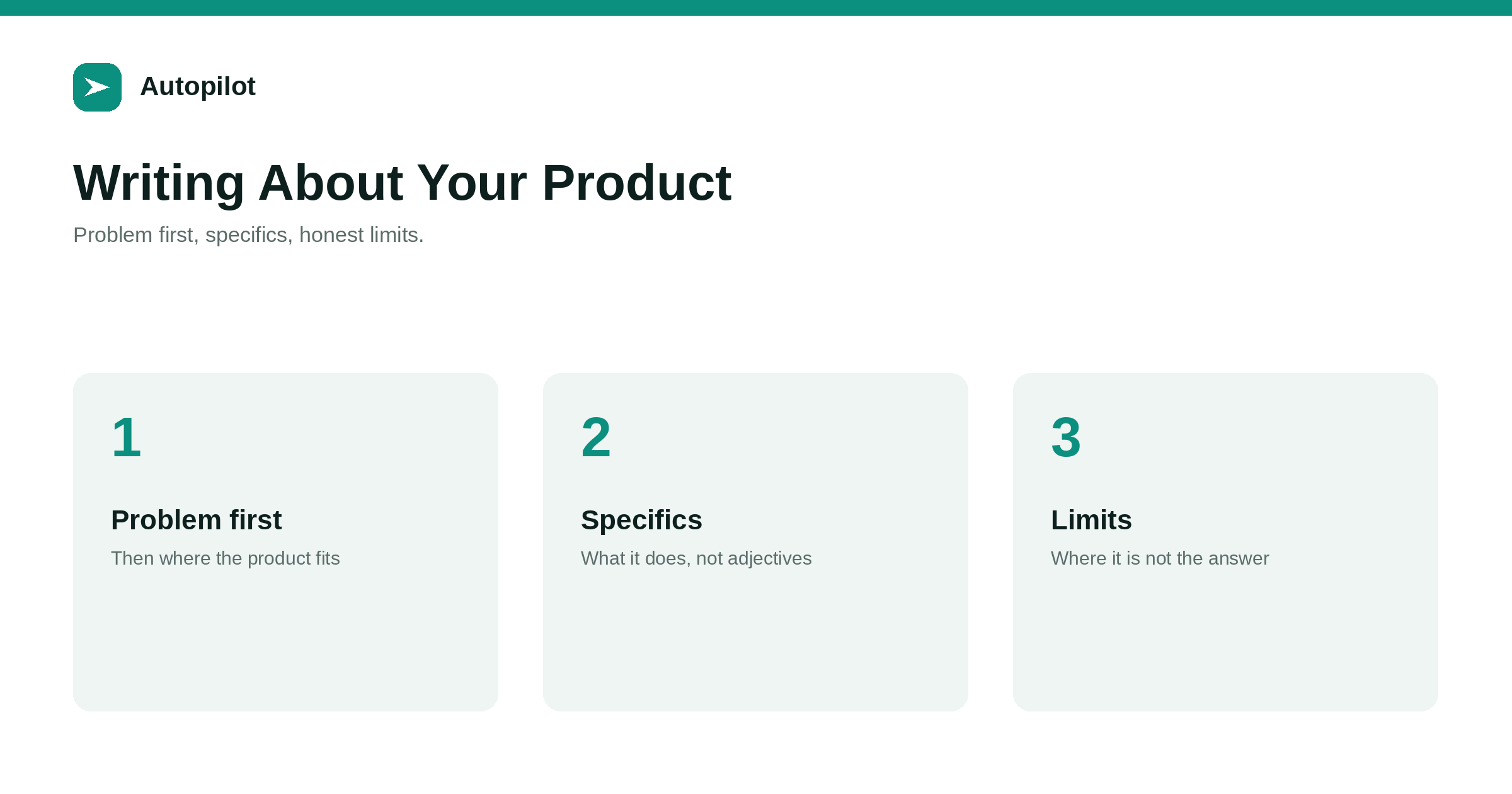
Short answer: start from the reader’s problem, explain it properly, and mention the product where it genuinely fits as one way to solve it. Describe what the product does in specific terms rather than superlatives, say who it suits and who it does not, and link to the product or pricing page rather than repeating sales copy in every article. Disclose that it is your product when comparing. Keep product mentions proportionate: an article that is mostly a pitch loses the trust that made the reader willing to listen.
A business blog exists partly to sell, and readers know it. They do not object to a business mentioning its product. They object to articles that promise help and deliver a pitch.
The difference lies in order, specificity and honesty.
Problem first
Start with the reader’s problem and explain it genuinely: why it happens, what the options are, what to consider. Only then mention where the product fits.
A reader who has been helped is open to a suggestion. A reader who is pitched in the first paragraph leaves.
Specifics over superlatives
Describe what the product does, concretely.
| Superlative | Specific |
|---|---|
| The most powerful solution | Publishes to WordPress and shares to social networks |
| Effortless automation | Drafts articles you review before or after publishing |
| Unmatched quality | Articles include a short answer, sections, FAQ and structured data |
| Grows your traffic | Publishes on a steady schedule; results depend on many factors |
Specific statements are more persuasive because readers can check them.
Say who it suits
Every product suits some people better than others. Saying so — this works well for small teams publishing regularly; if you need two hand-crafted articles a month, a freelancer may suit you better — makes the recommendation believable.
freelancer, agency or automation is an example of comparing approaches honestly, including where automation is not the best choice.
Honest limits
Mention what the product does not do, where relevant. Readers find out anyway, and discovering a limit the article hid is worse than being told.
the honest limits of AI blogging is an example of stating limits plainly.
Proportion
In most articles, the product should be a small part: a paragraph where it fits, and a next step at the end. An article that is mostly product description belongs on a product page, not the blog — landing page or blog post.
Link rather than repeat
Link to product and pricing pages rather than repeating details in every article. Details change; repeated copy goes out of date in many places at once and creates contradictions.
This blog links to the pricing page rather than stating prices, for exactly that reason.
Disclose in comparisons
When an article compares your product with alternatives, say it is yours near the start. Readers discount comparisons that hide the author’s interest — writing a fair comparison.
No invented results
Do not claim customer results you cannot evidence, and do not promise outcomes such as rankings or revenue that depend on factors outside your control. Such claims undermine trust and may breach advertising rules — fact-checking before you publish.
An example
Consider an article on why small businesses struggle to publish consistently. A pitch-first version opens with the product and lists its features. A useful version explains the real causes — writing takes longer than expected, review gets skipped, distribution is forgotten, nobody owns the schedule — and what helps with each.
In the section on writing time, it mentions that automated drafting with review is one option, what that involves, and who it suits. At the end, it offers a link to try it. The reader learns something whether or not they are interested in the product, and the ones who are interested arrive at the product page already understanding what it is for.
Writing product-led articles
Some articles are legitimately about the product: how to use a feature, what a plan includes, how to set it up. These are closer to documentation and support content, and readers who find them are usually already customers or evaluating closely.
Write them plainly and accurately, keep them current as the product changes, and do not dress them up as general advice. Support articles covers the format.
Checking the balance
Read an article and mark every sentence that promotes the product. If they make up more than a small share of an article meant to help, cut or move them. If the article would lose nothing useful to a reader who never buys, it may be an advert rather than an article.
Across the blog, most articles should help any reader in the subject, with the product appearing where it genuinely fits.
Tone
Write about the product in the same voice as the rest of the blog: plain, direct, honest. A sudden shift into marketing language when the product appears is noticeable and undermines the paragraphs around it.
Reviewing product mentions
Product details in articles go out of date as features change. Keep a list of articles that describe specific features, and review them whenever the product changes. Linking to documentation rather than describing interface details reduces how often this is needed.
Letting others speak for it
Customer quotes and case studies often describe a product more persuasively than the business can, because they come from someone with no reason to exaggerate. Where you have genuine, approved customer experience, use it in place of your own claims — customer contributions covers gathering it.
Headlines
Keep product names out of most article headlines. Readers search for their problem, not your product; a headline naming the problem finds them, and the article can introduce the product once it has helped.
The next step
End with a clear, relevant next step: try it, see pricing, read a related guide. Match it to the reader’s stage — calls to action that fit the article. A good article earns the right to suggest one.
Related reading
If this was useful, these cover the questions that usually come next.
- Calls to action that fit the article — the next step after the article
- Writing a fair comparison — comparing your product honestly
- Landing page or blog post — where selling belongs
The bottom line
Explain the reader’s problem properly before mentioning the product, describe what it does in specific terms, say who it suits and what it does not do, keep mentions proportionate, link to product and pricing pages instead of repeating them, disclose your interest in comparisons, and never claim results you cannot evidence.
DUK
How much should a blog article mention the product?
Usually a paragraph where it genuinely fits, and a next step at the end. Mostly-product articles belong on product pages.
How do I describe my product without sounding like an advert?
Use specific statements about what it does, say who it suits, and mention its limits.
Should I mention what my product cannot do?
Where relevant, yes. Readers trust businesses that are honest about limits.
Should prices appear in blog articles?
Better to link to the live pricing page, since prices change and repeated figures go out of date.
Do I need to disclose that a compared product is mine?
Yes, near the start of the comparison.
Can I include customer results?
Only results you can evidence, presented as individual experience rather than guaranteed outcomes.