ENEnglish
 LTLietuviškai
 DEDeutsch
 FRFrançais
 RUРусский
 ESEspañol
 PLPolski
 ITItaliano
 UKУкраїнська
 CSČeština
 PTPortuguês
 JA日本語
JA日本語 LVLatviešu valoda
 ETEesti
 HUMagyar
 IDBahasa Indonesia
 TRTürkçe
 HIहिन्दी
 ELΕλληνικά
 ARالعربية
 THไทย
THไทย VITiếng Việt
 RORomână
 MSBahasa Melayu
 BNবাংলা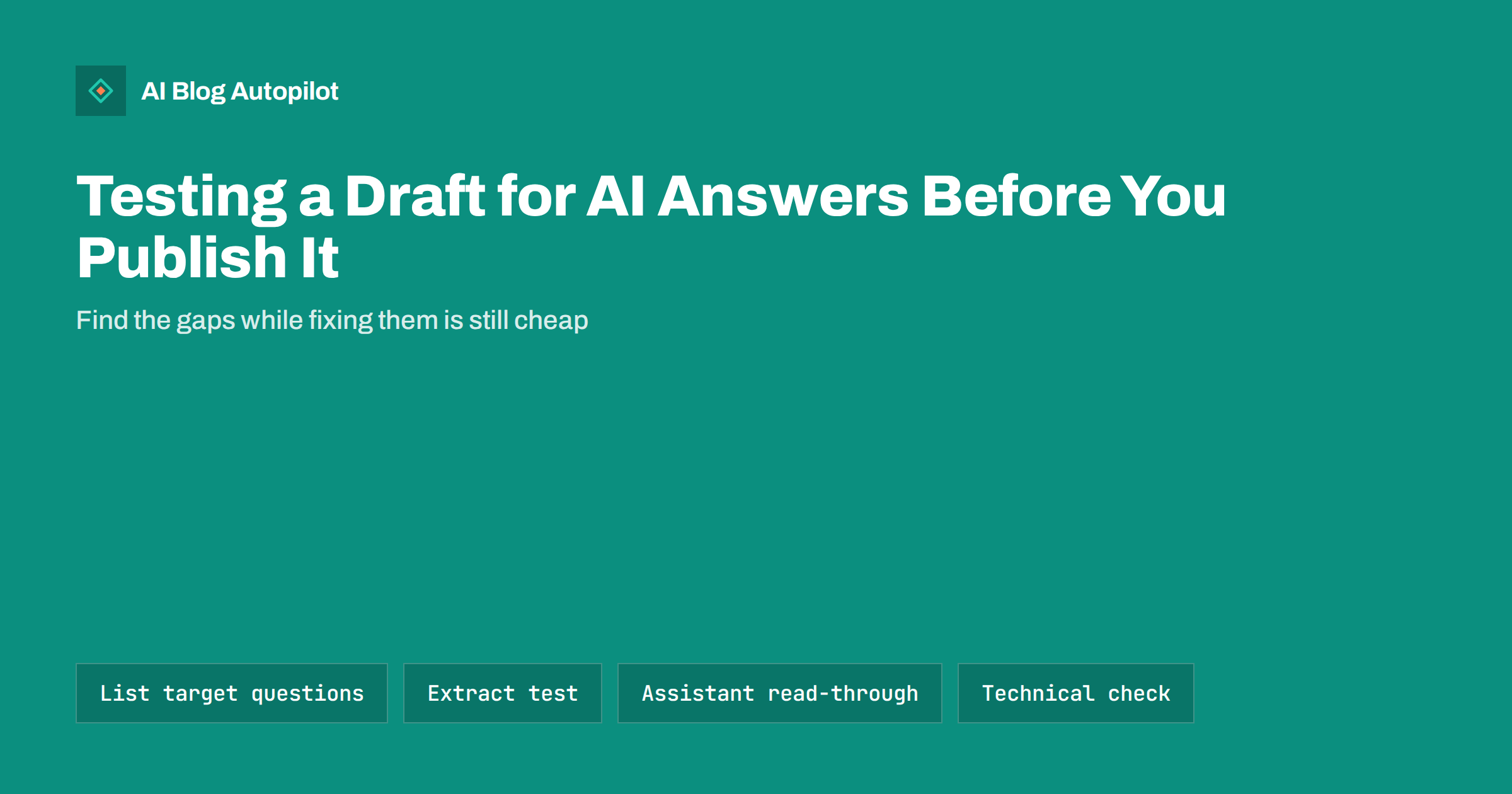
Short answer: you can test a draft for AI answers before publishing by listing the questions it should answer, checking that each is answered clearly near the start of a section, and asking an AI assistant to answer those questions using only the draft’s text. Where the assistant cannot find an answer, hedges, or gets it wrong, the draft is unclear. Finish with a technical check that the key content is in plain HTML text, indexable and allowed in snippets. The test cannot predict citations, but it reliably finds gaps readers would notice too.
Most advice about AI search is about what to do after publishing: track visibility, check whether assistants mention you, update old posts. It is cheaper to catch problems before an article goes live. A short routine at the editing stage shows whether the draft actually delivers the answers it promises, in a form that both readers and AI systems can use. This guide describes that routine, what it can and cannot tell you, and how to fit it into a normal workflow.
Why test before publishing
AI answers are built from passages that answer specific questions clearly. A draft can read well from top to bottom and still fail that test: the answer might be spread across three paragraphs, implied rather than stated, or buried after a long introduction. Those problems are easy to fix in a draft and tedious to fix across a published archive.
There is also a quality benefit that has nothing to do with AI. The same checks show where a busy reader skimming headings would fail to find what they came for. Treat the test as an editing tool first and an AI-search tactic second.
Testing before publishing also protects your reputation. Once an article is live, an unclear or wrong sentence can be quoted in an AI answer, shared on social media or copied by other sites, and corrections do not always travel as far as the original. A few minutes of checking at the draft stage is the cheapest point at which to prevent that, and it builds a habit of writing answers that can stand on their own.
Step 1: write down the target questions
Before testing, decide what the article should answer. For most blog posts, five to ten questions are enough:
- The main question behind the title, such as “how often should a small blog publish”.
- The natural follow-ups a reader would ask next: costs, steps, comparisons, exceptions, risks.
- One or two definitional questions if the topic uses terms a beginner might not know.
- The questions from the FAQ, which should already be in the draft.
Write the questions the way a person would ask them in a search box or an AI assistant, in full sentences. If you cannot list the questions, the article’s purpose is probably not clear enough yet, which is worth knowing before anything else.
Step 2: the extract test
The extract test is a manual check that takes a few minutes. For each target question:
- Find the section that should answer it. If there is no obvious section, that is the first finding.
- Read only the heading and the first two sentences of that section.
- Ask yourself whether those sentences answer the question on their own, without the rest of the article.
Common failures are sentences that depend on context (“As mentioned above, this is the main factor”), pronouns without a clear subject (“It usually takes longer”), and sections that start with background instead of the answer. Rewrite the opening sentences so they name the subject and state the answer directly. The article on writing clear definitions shows the pattern for definitional questions.
A before-and-after example makes the difference clear. A section headed “Timing” that begins “There are a lot of opinions about this, and it depends on many things” fails the test. The same section rewritten as “How often should a small blog publish?” and opening with “A small business blog should publish at a pace it can sustain every month, because consistency matters more than volume” passes. The rest of the section can then explain the exceptions. Nothing about the article’s depth has changed, only the order and precision of the first sentences.
Step 3: the assistant read-through
An AI assistant is a useful second reader for this test, as long as you use it carefully. Paste the draft and ask it to answer your target questions using only the text provided, quoting the sentences it relied on and saying clearly when the text does not answer a question. Then look at the results:
- “Not answered in the text” means the draft has a real gap, or the answer is too implicit to find.
- A hedged or vague answer usually means the draft itself hedges, or spreads the answer over several places.
- A wrong answer means a sentence is ambiguous or a claim is easily misread. That is worth fixing even if a human reader might have understood it.
- Quoted sentences from odd places, such as the FAQ instead of the main section, suggest the main section is weaker than the FAQ answer.
Keep the prompt the same for every article you test, so results are comparable over time. A fixed prompt also makes it easier to share the routine with a writer or editor, and to notice when a change in your templates improves or worsens the results.
A second useful prompt is to ask for a three-sentence summary of the article. If the summary misses your main point, readers skimming the page may miss it too.
Two cautions. First, check your tool’s data settings before pasting unpublished or confidential drafts, and do not paste client material without permission. Second, an assistant reading pasted text is not the same as an AI search system retrieving and ranking pages across the web. The test shows whether your text is clear, not whether it will be chosen.
Step 4: check claims and sources
AI answers favour content that is specific and verifiable, and readers do too. While testing, mark every claim that includes a number, a rule or a comparison, and check that:
- The claim is correct and current, with a date or jurisdiction where it could change.
- Important facts link to a primary source rather than to another blog.
- Opinions are presented as opinions, not as facts.
- No statistic has been invented or rounded into something more precise than the source says.
The process in fact-checking content before you publish covers this step in more detail.
Step 5: the technical check
A perfectly written answer is useless if systems cannot read it. Before publishing, or immediately after on a preview, confirm that:
- Key content is in HTML text, not only in images, embedded PDFs or interactive widgets. A comparison shown only as a picture cannot be quoted.
- The content does not depend on JavaScript to appear, or, if it does, that it renders correctly for crawlers.
- The page will be indexable: no stray noindex from a draft or staging setting.
- Snippets are allowed. Controls such as nosnippet or a very short max-snippet limit how much of the page can be shown in Google’s AI features, as described in Google’s page on AI features and your website.
- Headings are real headings (H2, H3) rather than bold paragraphs, so the structure is machine-readable.
- The FAQ markup, if any, matches the visible FAQ word for word.
Fitting the test into a workflow
The full routine takes around fifteen to thirty minutes per article once it is familiar. You do not need to run all of it on everything:
| Article type | Suggested test |
|---|---|
| Key guides and high-value pages | All five steps |
| Regular articles | Target questions, extract test, technical check |
| High-stakes topics (health, money, legal) | All steps, plus expert review of every claim |
| Short news or updates | Technical check only |
If you publish at volume, test a sample of articles each week rather than none. Patterns in the failures, such as introductions that never answer, point to changes in your briefs or templates that fix many future articles at once.
What the test cannot tell you
- Whether any AI system will cite the page. That depends on competition, authority, the exact question and factors nobody outside the providers can see.
- How the page will rank in traditional search.
- Whether the information is correct, unless you check it separately. An assistant can confidently repeat an error in your draft.
Keep the test in proportion: it removes avoidable weaknesses, and that is its whole value.
How AI Blog Autopilot fits in
AI Blog Autopilot writes articles with an answer-first opening, descriptive headings and an FAQ, and runs an automatic quality check before anything goes live. If you want to run your own tests on selected articles, you can switch on approval so drafts wait for you before publication. See how Autopilot works.
Related reading
- The Pre-Publication Checklist for Every Article
- Key Takeaways Boxes: Do Summaries Help AI Answers?
- How to Edit an AI Draft: The Four Passes That Matter
The bottom line
Before publishing, list the questions an article should answer, check that each is answered clearly at the start of a section, let an assistant try to answer them from the text alone, verify the claims and confirm the page is technically readable. It will not guarantee citations, but it catches gaps while they are cheap to fix and makes the article better for every reader.
DUK
Can I test whether AI answers will cite my article before publishing?
No test can predict citations, because they depend on competition and factors outside your control. You can test whether the draft answers its target questions clearly, which removes avoidable reasons for it to be passed over.
How do I use an AI assistant to check a draft?
Paste the draft and ask the assistant to answer your target questions using only the text, quoting the sentences it used and saying when the text does not answer. Gaps, hedged answers and wrong answers show where the draft needs work.
Is it safe to paste unpublished drafts into AI tools?
Check the tool’s data and privacy settings first, and do not paste confidential or client material without permission. Some tools let you turn off the use of your conversations for training.
What is the extract test?
For each target question, read only the relevant heading and the first two sentences of that section. If those sentences do not answer the question on their own, rewrite them so they name the subject and state the answer directly.
How long does the test take?
Usually fifteen to thirty minutes per article once the routine is familiar. For regular articles, a shorter version with target questions, the extract test and a technical check is often enough.
Should I rewrite a draft to please an AI assistant?
No. Use the assistant’s answers as signals of unclear writing, then fix the text for human readers. If a change would make the article worse to read, it is not worth making for an AI system.