ENEnglish
 LTLietuviškai
 DEDeutsch
 FRFrançais
 RUРусский
 ESEspañol
 PLPolski
 ITItaliano
 UKУкраїнська
 CSČeština
 PTPortuguês
 JA日本語
JA日本語 LVLatviešu valoda
 ETEesti
 HUMagyar
 IDBahasa Indonesia
 TRTürkçe
 HIहिन्दी
 ELΕλληνικά
 ARالعربية
 THไทย
THไทย VITiếng Việt
 RORomână
 MSBahasa Melayu
 BNবাংলা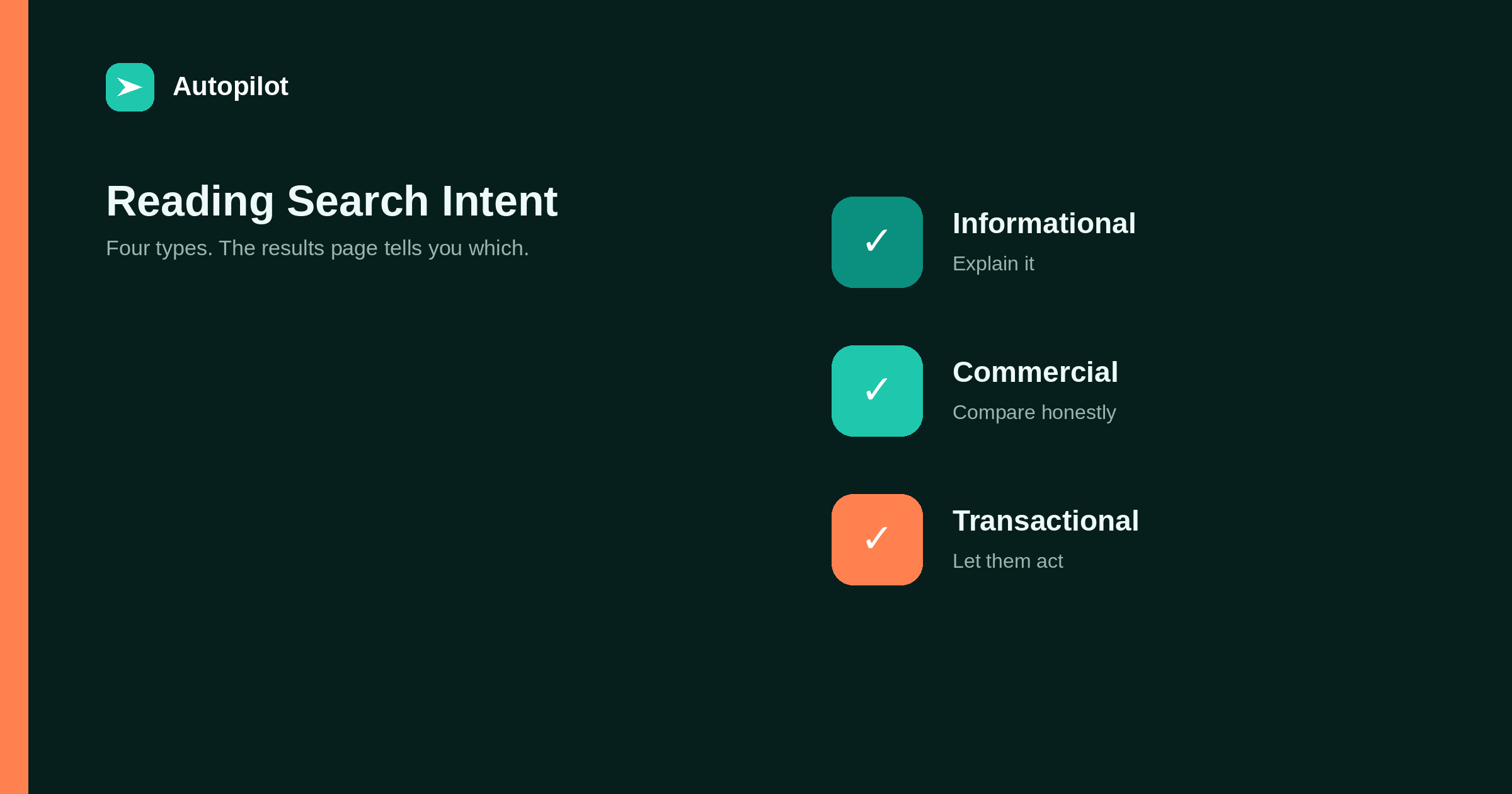
Short answer: intent is what somebody wants from a query, and there are four broad kinds: informational (explain something), commercial (help me choose), transactional (let me do it) and navigational (take me to a specific place). You do not have to guess: open the query and look at what is already ranking, because that is the clearest available statement of what the results are meant to serve. A page that answers the wrong intent can be excellent and still fail, and that mismatch is the usual explanation for impressions without clicks.
Two people typing similar words can want entirely different things. One wants to understand how something works; the other has decided and wants to do it. The same page cannot serve both.
Intent is the name for that difference, and reading it correctly is the cheapest way to stop writing good articles that nobody clicks.
The four types
The categories are broad and that is fine — they are a decision aid, not a taxonomy.
| Intent | Typical query | What the page must do |
|---|---|---|
| Informational | what is an rss feed | Explain clearly, answer early |
| Commercial | best blog automation tool | Compare honestly, including trade-offs |
| Transactional | blog automation pricing | Show the information and let them act |
| Navigational | autopilot login | Get them there in one click |
Most blog content serves the first two. Transactional queries want a product or pricing page rather than an article, and navigational queries want you out of the way.
Read it from the results, not from the words
The most reliable method takes two minutes and requires no tool: search the query and look at what is there.
If the first page is all guides, the intent is informational and a product page will not rank. If it is all comparison articles and listicles, it is commercial. If it is product and pricing pages, writing a 2,000-word explainer is unlikely to work.
Note the format too, because it is part of the signal: if everything ranking is a step-by-step with numbered instructions, that is what the query wants, and an essay on the same subject is answering a different question.
The words that give it away
Some markers are reliable enough to shortcut the check.
Informational: what, why, how, guide, explained, examples, meaning.
Commercial: best, top, versus, alternatives, review, comparison, for small business.
Transactional: pricing, cost, buy, sign up, free trial, demo.
Two cautions. How to can be commercial in disguise — how to automate a blog is often somebody choosing a tool, and the ranking pages will tell you. And a query can be genuinely mixed, in which case the results show two formats and a page that leads with the explanation and includes a fair comparison can serve both.
What a mismatch looks like in your data
Intent problems have a recognisable signature in Search Console.
Impressions with almost no clicks, at a decent position: you appear, and the title tells people you are not what they wanted.
A position stuck around 11 to 20 on a query you cover thoroughly: often the page is the wrong type for the query rather than not good enough.
Clicks with no engagement on a commercial query: your explainer ranks, people arrive wanting a comparison, and they leave. The fix is rarely more words; it is a different page, or a rewritten title that matches what you actually offer — see titles and descriptions.
Writing for each type
The format follows from the intent.
Informational wants the answer early, plain language, and structure a skimmer can follow — which is exactly the shape in how to structure an article.
Commercial wants a real comparison. That means naming trade-offs, saying who each option suits, and being honest about where yours is the wrong choice. A comparison that concludes you are best on every axis is read as an advertisement and performs like one.
Transactional wants the specifics without a preamble: what it does, what it costs, how to start. Point at the pricing page rather than paraphrasing prices that will change.
When intent shifts
Intent is not permanent. A query can move as a market matures: a term that was informational two years ago becomes commercial once products exist for it, and the results change accordingly.
This is one of the quieter reasons pages decline. Nothing about your article got worse; the question behind the query changed, and your page now answers the old version of it.
It is worth rechecking the results for your most important queries once or twice a year. If the ranking pages have changed type, the fix is usually a different page rather than an edit — though refreshing old posts covers the cases where an edit is enough.
Intent and planning
Deciding intent before writing prevents most of this, and it costs one line per article in a plan.
Record the question, the intent, and the format the ranking pages use. Three fields, filled in during planning rather than argued about after publication, and planning a month of articles is where they belong.
It also stops a specific waste: writing a comparison for a query whose results are all explanations, publishing it, and concluding that the subject does not work when what failed was the match between page and question.
Related reading
If this was useful, these cover the questions that usually come next.
- How many keywords one article should target — intent decides when two phrases are one page
- Long-tail keywords — specific queries have the clearest intent
- Titles and descriptions — fixing the mismatch that costs you clicks
The bottom line
Four intents: explain, compare, act, navigate. Read which one applies from the pages already ranking rather than from the words, and note the format they use as well. Impressions without clicks and a position stuck in the teens are usually mismatch rather than quality, and recheck your main queries yearly because intent moves.
DUK
What are the four types of search intent?
Informational (explain something), commercial (help me choose), transactional (let me act) and navigational (take me to a specific place). Most blog content serves the first two.
How do I work out the intent of a query?
Search it and look at what ranks. If the results are guides, the intent is informational; if they are comparisons, it is commercial; if they are product and pricing pages, an article is unlikely to work. Note the format as well as the type.
Why does my page get impressions but no clicks?
Usually an intent mismatch: you appear for the query, and the title tells searchers you are not what they wanted. Either rewrite the title to match what the page offers, or write the page the query actually wants.
Can one page serve two intents?
Sometimes, when the results themselves are mixed. A page that answers the question clearly and then includes a fair comparison can work. Forcing it when the results are uniform does not.
Does intent change over time?
Yes. A query can move from informational to commercial as products appear in a market, and pages that answered the old version quietly decline. Recheck the results for your main queries once or twice a year.
Should comparison articles admit weaknesses?
Yes. A comparison concluding that you win on every axis reads as an advertisement and performs like one. Saying who each option suits, including where yours is the wrong choice, is what makes the page useful.