ENEnglish
 LTLietuviškai
 DEDeutsch
 FRFrançais
 RUРусский
 ESEspañol
 PLPolski
 ITItaliano
 UKУкраїнська
 CSČeština
 PTPortuguês
 JA日本語
 LVLatviešu valoda
 ETEesti
 HUMagyar
 IDBahasa Indonesia
 TRTürkçe
 HIहिन्दी
 ELΕλληνικά
 ARالعربية
 THไทย
 VITiếng Việt
 RORomână
 MSBahasa Melayu
 BNবাংলা
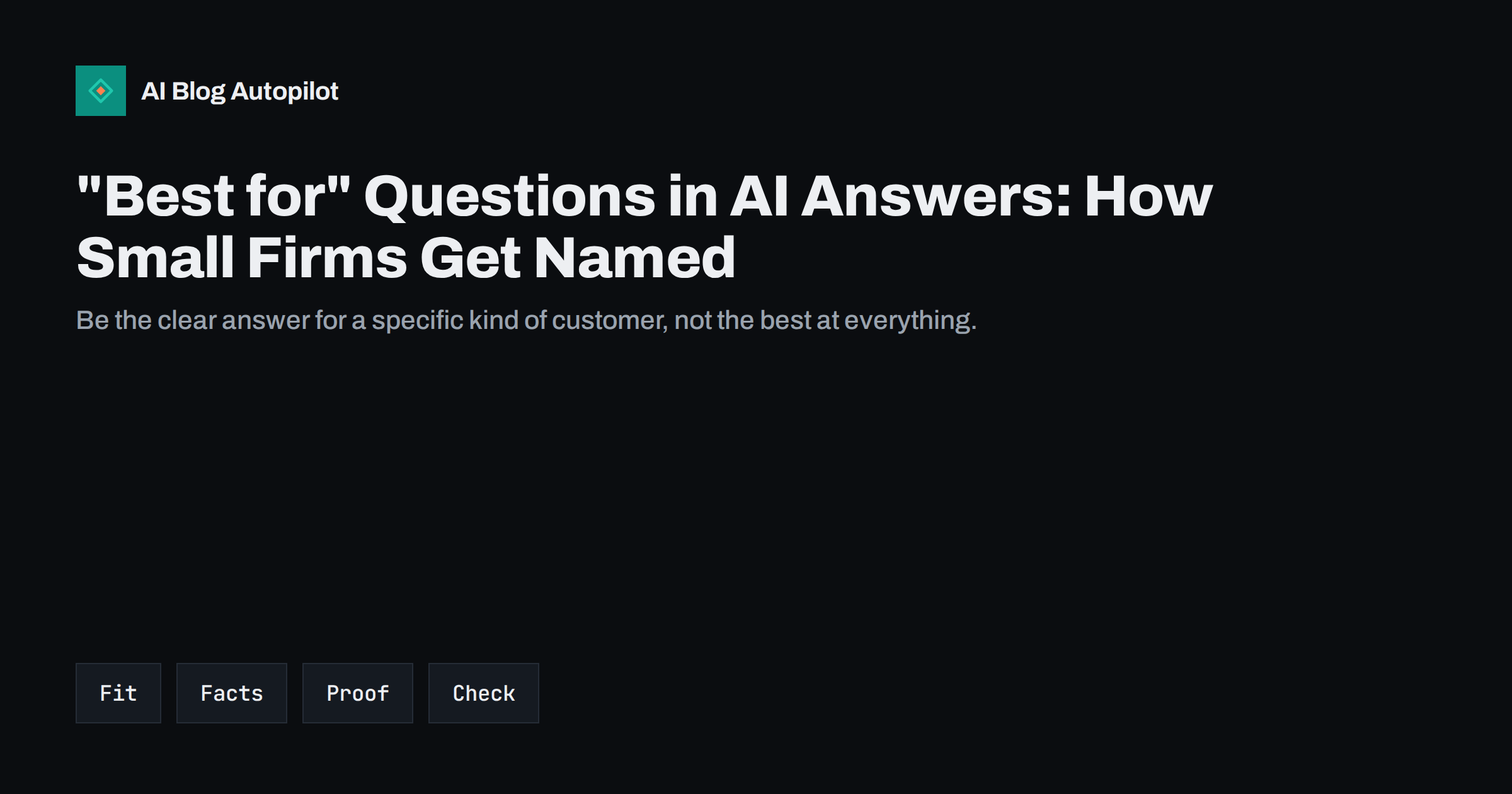
Short answer: when people ask an AI assistant “which is best for a small team” or “who should I hire near me”, the answer draws on pages that state clearly who a product or business suits, on reviews and independent mentions, and on facts that are easy to quote. A small business earns a mention by being specific about its ideal customer, publishing accurate details, collecting honest reviews and being described fairly elsewhere. No page can guarantee a mention.
Recommendation questions are some of the most valuable searches that people now put to assistants. The asker is close to a decision and wants a short list, not ten blue links. Being on that list is not a matter of tricks. It depends on whether the web already contains a clear, consistent and trustworthy description of what you do and who you do it for. This article looks at how to build that description.
How these questions are asked
People phrase them in many ways: “what is the best option for a small bakery”, “which tool is easiest for a beginner”, “what would you choose if I have a small budget”, “is there something better for someone who needs X”. Often they add constraints such as price, size, location, skill level or a particular need. The more specific the question, the more the answer depends on pages that mention that specific situation.
Follow-up questions are common too. After a first answer, the person narrows the choice: cheaper, closer, easier, with a certain feature. That is why a page that describes only a broad strength is less useful than one that names a clear fit. See conversational queries and content for how conversations develop.
The answers differ between assistants and over time, and the same question can produce a different list on a different day. Treat any single result as a sample, not a ranking, as explained in why AI assistants’ answers differ.
What the answers draw on
Assistants that search the web gather pages and summarise them, and they tend to rely on a mix of sources: the websites of the businesses themselves, independent comparison and review pages, forum and community discussions, directories and encyclopedic pages. Which of these carries the most weight varies by topic. For software, reviews and comparison pages are common. For local services, profiles, directories and reviews matter more. For expert services, articles and credentials count.
The details are not public, and they change, so no one outside the companies can promise how a particular answer is made. What can be said is that clear, consistent, widely corroborated facts are easier to use than vague claims. A business whose own pages, profiles and third-party mentions all say the same things is easier to describe correctly. Read how AI search picks sources for the general picture.
This also means that you are not only competing with other businesses. You are competing with the quality of the information that exists about you. If it is thin, outdated or contradictory, a competitor with a clearer record may be named instead, even if you are better.
Say who you are best for
The most useful change for most small businesses is to stop claiming to be best for everyone. A statement such as “we help independent cafes plan their seasonal menus” is easier to match to a question than “we offer solutions for businesses”. Put the statement on the home page, in the “about” page and on the service pages, in the same words, and support it with examples.
Write pages that answer “who is this for” and “who is it not for”. The second half may feel risky, but it increases trust and makes your description more accurate. Our guide to who-it-is-not-for statements shows how to write them without sounding negative.
Use definition sentences that can stand alone, for example “X is a service that does Y for Z.” These short statements are easy for assistants to quote, as discussed in definition sentences for AI. Place them near the top of the page, not hidden in the middle.
An example makes the point. A small accountancy for freelancers might describe itself on three pages as a general business adviser, a tax specialist and a bookkeeping service, with different prices in each place. An assistant asked for help for a freelancer who needs tax returns has no clear match. If the firm instead says on every page that it prepares tax returns and bookkeeping for freelancers and sole traders, lists the starting price and the process, and links to a short guide for first-year freelancers, the description becomes easy to use and easy to check.
Make the facts easy to use
People who ask for recommendations often care about price, location, size, speed, languages and support. If those facts are missing or hidden behind forms, an assistant cannot use them, and may use an older or wrong source. Publish what you can: a price range or starting price where you can state one, the areas you serve, opening hours, the main features and the steps to start. See a pricing page for search and AI and product facts for AI answers.
Keep the facts consistent across your site, profiles and listings. Contradictions between pages are a common cause of wrong answers, and the fix is dull but effective: make one master list and update everywhere at once. The problem is described in conflicting facts across pages.
Add comparison content that is honest. A page that explains how to choose between types of solution, including the cases where a competitor suits better, can be quoted in answers and earns trust from readers. Avoid attack pages. See how to write a product comparison.
Case studies deserve a place here. A short, factual page that describes a customer’s situation, what you did and what changed, with permission and without invented numbers, gives assistants and readers a concrete example of your fit. Keep each one specific to a kind of customer, so that it matches the questions that people really ask. Our guide to how to write a case study shows a simple structure.
Proof from other people
Recommendations lean on what others say. Reviews on trusted platforms, mentions in articles, community discussions and case studies all contribute. Ask customers for honest reviews and give them an easy way to write them, and do not offer rewards that break platform rules. A modest number of detailed reviews that mention what the customer needed is worth more than many empty ones. See reviews in AI answers.
Earn mentions by being useful in public: answer questions in communities where it is allowed, contribute data or a quote to a local publication, speak at an event and publish something that others want to cite. The routes are covered in digital PR for small blogs and brand mentions in AI answers.
Never fake it. Invented reviews, undisclosed paid placements and sock-puppet posts risk penalties from platforms and damage trust when discovered. The long game in this area is simply to deserve the recommendation.
Keep a simple log of your checks: the date, the assistant, the question, whether you were named and what was said. After three months you will see which questions you appear in and which you miss, and that shows where to put effort. It also protects you from overreacting to a single odd answer, which is a common trap with tools that change often.
Check what assistants say
Write down ten questions that your ideal customer might ask, from broad to specific, and ask them in two or three assistants. Record whether you are named, how you are described, which sources are cited and what is wrong. Repeat the check each month with the same questions, and treat the results as trends. The method is described in how to check visibility in AI answers.
When a description is wrong, trace it to a source. It may be an old page of yours, an outdated listing or a third-party article. Correct what you control, ask the owners of other pages to update theirs and add a clear page that states the right facts. Our guide to AI answers that are wrong about a business has a step-by-step approach.
Keep your expectations realistic. Even with strong pages, you may not be named for every question, and for some questions a different type of business is the better answer. The aim is to be present and accurate where you really fit.
Mistakes to avoid
Do not claim to be “the best” without proof. Superlatives without evidence are easy for readers and for systems to discount. Do not write dozens of “best X in town” lists that put yourself first; they rarely persuade anyone, and they may be treated as low-quality pages.
Do not hide behind a page that is only a sales form. Give enough information that a person, or an assistant describing you, can understand the offer without a call. Do not neglect your own name: make sure that a search for your business name leads to a clear, correct page and profile.
Finally, do not drop the basics for the new channel. Pages that are fast, clear and trustworthy serve people and machines alike, and the effort carries over when the way that people ask questions changes again.
How AI Blog Autopilot helps
AI Blog Autopilot writes full SEO articles for your WordPress blog from the topics, keywords, audience and tone you set, with FAQ sections, tags and SEO meta included, and it shares each one to your social networks. Describing your ideal customer in the audience setting helps every article speak to a specific reader, and approval mode lets you read each one first to check the facts. See the pricing page for plans.
Related reading
- How AI Search Picks Its Sources
- How to Check Your Visibility in AI Answers
- Product Facts for AI Answers
The bottom line
Be specific about who you serve, publish accurate and consistent facts, earn honest reviews and mentions, and check regularly what assistants say instead of hoping to be named.
DUK
Can I pay to be recommended by an AI assistant?
Not through your website. Answers draw on what exists about you, so the reliable route is clear pages and honest proof.
Why is a competitor named instead of me?
They may have clearer pages, more consistent facts or more independent mentions. Compare how each of you is described.
Should I say I am the best?
Only with evidence. Saying who you are best for is more useful and more credible.
How often should I check the answers?
Monthly with the same list of questions is enough. Treat results as trends, since they vary between assistants and days.
Do reviews matter for AI recommendations?
They are one of several sources that help describe you. Honest, detailed reviews are the most useful kind.