ENEnglish
 LTLietuviškai
 DEDeutsch
 FRFrançais
 RUРусский
 ESEspañol
 PLPolski
 ITItaliano
 UKУкраїнська
 CSČeština
 PTPortuguês
 JA日本語
JA日本語 LVLatviešu valoda
 ETEesti
 HUMagyar
 IDBahasa Indonesia
 TRTürkçe
 HIहिन्दी
 ELΕλληνικά
 ARالعربية
 THไทย
THไทย VITiếng Việt
 RORomână
 MSBahasa Melayu
 BNবাংলা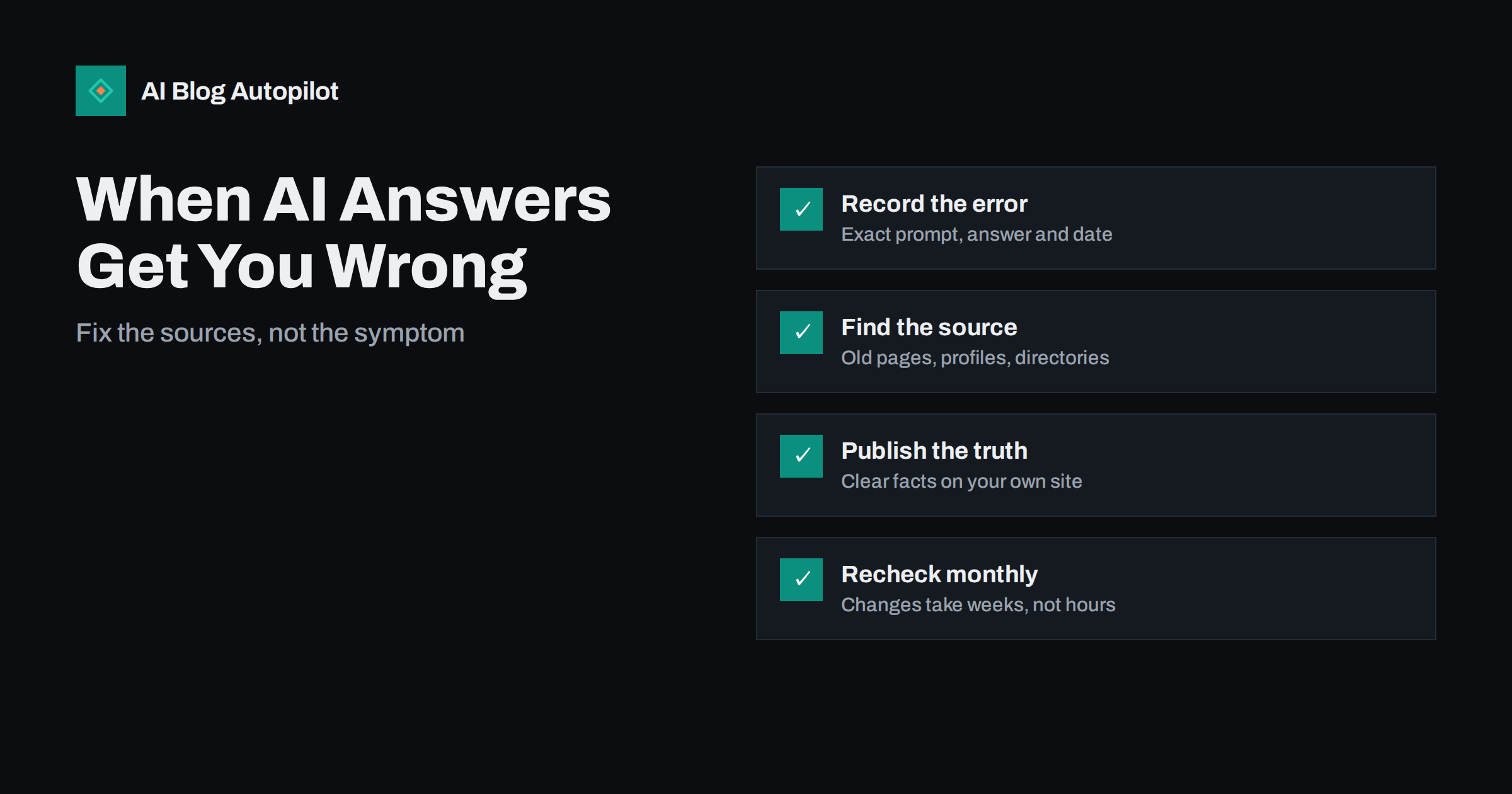
Short answer: when an AI assistant or AI search answer states something wrong about your business, the fix is usually to correct the information it learned from rather than the answer itself. Record the error, find where the wrong fact appears (old pages on your site, outdated directory listings, third-party articles), publish the correct facts clearly on your own site, and make your details consistent everywhere. Use the feedback option in the tool as well, then recheck over the following weeks. You cannot edit an AI answer directly, and changes are rarely immediate.
It is an unsettling experience. A customer mentions that “the AI said you close at five” when you have been open until eight for two years. Or you ask an assistant about your own company and it confidently lists a service you stopped offering, a price from an old brochure or a founder who left long ago. Sometimes it mixes you up with a business with a similar name.
This article explains why these errors happen, what you can realistically do about them, and how to reduce the chance of them in the first place. It is written for small businesses, bloggers and agencies, not for companies with large PR departments.
Why AI answers get business facts wrong
AI assistants and AI search features produce answers from a mix of information: what a model learned during training, and in many products, pages retrieved from the web at the time of the question. Errors usually come from one of a few places.
- Outdated information. Training data can be months or years old. If your prices, hours or services changed, older descriptions may still dominate.
- Old pages that still exist. An archived event page, a forgotten “services” page, a 2019 press release: if they are still live and indexed, they are still evidence.
- Inconsistent details across the web. Different phone numbers, addresses or descriptions in directories, social profiles and review sites make it harder for any system to know which one is right.
- Missing information. If your own site never states a fact clearly, systems fill the gap from other sources or from guesswork.
- Name confusion. Businesses with similar names, especially in different countries, can be blended together.
- Generation errors. Language models can produce plausible but incorrect statements even when the sources are fine. This is less controllable, but clear sources still reduce it.
Most of these causes point back to information you can influence. That is the good news.
Step 1: document the error properly
Before changing anything, write down exactly what you saw. You will need it to check progress and, if necessary, to report it.
- The tool and feature used (an AI assistant, an AI answer in a search engine, a chatbot inside another app).
- The exact question or prompt.
- The full answer, with a screenshot and the date.
- Any sources or links the answer cited.
- Whether the error repeats when you ask again, or ask in a different way.
AI answers vary between sessions and users. An error you see once may not be what most people see. Ask the same question several times and with small variations to understand how consistent the problem is.
Step 2: trace where the wrong fact comes from
If the answer cites sources, start there: the wrong fact often appears word for word on one of them. If it does not cite anything, search the web for the incorrect detail itself, such as the old price, the old address or the wrong service name, in quotes. You are looking for pages that state the wrong fact as current.
Typical culprits include:
- Old pages on your own site, including PDFs and image-heavy pages whose text is still indexed.
- Business directories and map listings that were never updated.
- Your own social media profiles with outdated bios.
- Articles, reviews or roundups written by others some time ago.
- Pages about a different business with a similar name.
Make a simple list: URL, what it says, who controls it, and what should change.
Step 3: fix the sources you control
Your own website should be the clearest, most current statement of facts about your business. That means:
- A thorough about page that states who you are, what you do, where you operate and since when, in plain sentences.
- Accurate contact, location and opening-hours details, the same on every page where they appear.
- A clear list of current services or products. If you discontinued something, say so, or redirect the old page to the relevant current one.
- Updated or removed outdated pages. Old announcements can stay for the record, but mark them clearly as historical or add a note pointing to the current information.
- An FAQ that answers the questions people actually ask about you, such as “Do you ship abroad?” or “Do you work with small businesses?”, in direct language.
- Organization or LocalBusiness structured data with your official name, logo, address and profiles, matching what the page says.
Write the key facts as simple declarative sentences. “We are open Monday to Saturday, 9:00 to 20:00” is easier for any system to extract than a stylised graphic with the same information.
Then update the profiles you control: map and business listings, social media bios, marketplace pages, industry directories. Consistency matters as much as accuracy. The same name, address, phone number and description everywhere removes ambiguity.
One more place worth checking is your own older blog posts. An article from several years ago that says “our prices start at” or “we currently offer” reads as a statement of current fact to anyone, human or machine, who lands on it without noticing the date. Add a short dated note at the top of such posts, update the figures, or link to the page that holds the current details.
Step 4: ask others to correct what you do not control
For third-party pages with wrong information:
- Directories and listing sites usually have a claim or correction process. Use it.
- Publishers and bloggers are often happy to update an old article if you contact them politely with the correct facts and a link to your source.
- Review sites may let you respond publicly with a correction even if they will not edit the review.
- Name confusion is best addressed by making your own identity unmistakable: full legal or trading name, location, founding year, and links between your site and your official profiles.
If a statement is seriously damaging or defamatory, speak to a legal professional about your options. That is outside what content changes can solve.
Step 5: use the feedback tools
Most AI assistants and AI search features have a way to flag an answer, usually a thumbs-down or “report” option with a text field. Use it, describe the error briefly and state the correct fact with a link to your official page. Some search engines also offer feedback on specific result features.
Be realistic. Feedback is one input among many, and you will rarely hear back. It is worth doing because it takes a minute, but the source fixes in steps 3 and 4 are what change the evidence the systems draw on.
Step 6: recheck over time
Corrections take time to flow through. Search engines have to recrawl the changed pages; AI features that retrieve from the web may reflect changes sooner, while knowledge learned during training can persist until a model is updated. There is no fixed timeline.
Set a reminder to repeat your documented questions every few weeks. Keep the screenshots in the same folder so you can see whether the answer is changing. If the error persists and the wrong fact still appears somewhere on the web, go back to step 2: there is usually a source you have not found yet.
Preventing errors in the first place
The same work that fixes errors also prevents them. A few habits help a lot:
- Review your key facts twice a year. Check your about, contact, services and pricing pages, and your main external profiles, in one sitting.
- Update rather than abandon. When something changes, update the old page or redirect it. Do not leave outdated pages live and unlinked.
- Publish regularly about what you actually do. A steady stream of accurate, current articles about your services and field gives search engines and AI systems plenty of recent, correct material.
- Ask AI assistants about your business occasionally. Treat it like checking your own search results: a quick way to spot problems before customers do.
How AI Blog Autopilot can help
AI Blog Autopilot writes and publishes articles about the topics you define for your business, on your own WordPress blog, and shares them to your social networks. Regular, accurate articles about what you do add up to a body of current information about your business on your own domain. The writer is instructed never to invent statistics, quotes or sources. Keeping your about, contact and service pages correct remains your job. See what Autopilot writes and publishes.
Related reading
- The About Page a Business Blog Needs
- How to Handle Corrections on a Blog
- How to Get Your Blog Cited by AI Search
- Citing Sources in Blog Posts: Why It Helps in AI Answers
The bottom line
AI answers get business facts wrong mostly because the information they draw on is outdated, inconsistent or missing. Record the error, find the source, publish clear and current facts on your own site, make your profiles consistent, ask third parties to correct their pages and send feedback to the tool. Then recheck over weeks, not hours. The more clearly and consistently your business is described across the web, the less room there is for mistakes.
DUK
Can I ask an AI company to change what its assistant says about my business?
Most tools offer a feedback or report option on answers, and you should use it with the correct facts and a link. There is usually no direct way to edit an answer, so correcting the sources the answer is based on is the more reliable route.
How long does it take for a corrected fact to appear in AI answers?
There is no fixed timeline. Features that retrieve web pages can reflect changes after the pages are recrawled, which may take days or weeks. Information learned during model training can persist until the model is updated.
Why does the AI mix my business up with another one?
Similar names, especially without clear location or founding details, can be blended together. Make your identity unmistakable on your site and profiles with your full name, location, what you do and links between your official accounts.
Does structured data help AI answers get my details right?
It can help by stating your name, address, logo and profiles in a machine-readable form, but only if it matches the visible page. It works best alongside clear written facts and consistent external listings, not as a replacement for them.
Should I delete old pages with outdated information?
Update them, redirect them to the current equivalent, or clearly mark them as historical. Leaving outdated pages live and unmarked is one of the most common causes of wrong answers.