ENEnglish
 LTLietuviškai
 DEDeutsch
 FRFrançais
 RUРусский
 ESEspañol
 PLPolski
 ITItaliano
 UKУкраїнська
 CSČeština
 PTPortuguês
 JA日本語
 LVLatviešu valoda
 ETEesti
 HUMagyar
 IDBahasa Indonesia
 TRTürkçe
 HIहिन्दी
 ELΕλληνικά
 ARالعربية
 THไทย
 VITiếng Việt
 RORomână
 MSBahasa Melayu
 BNবাংলা
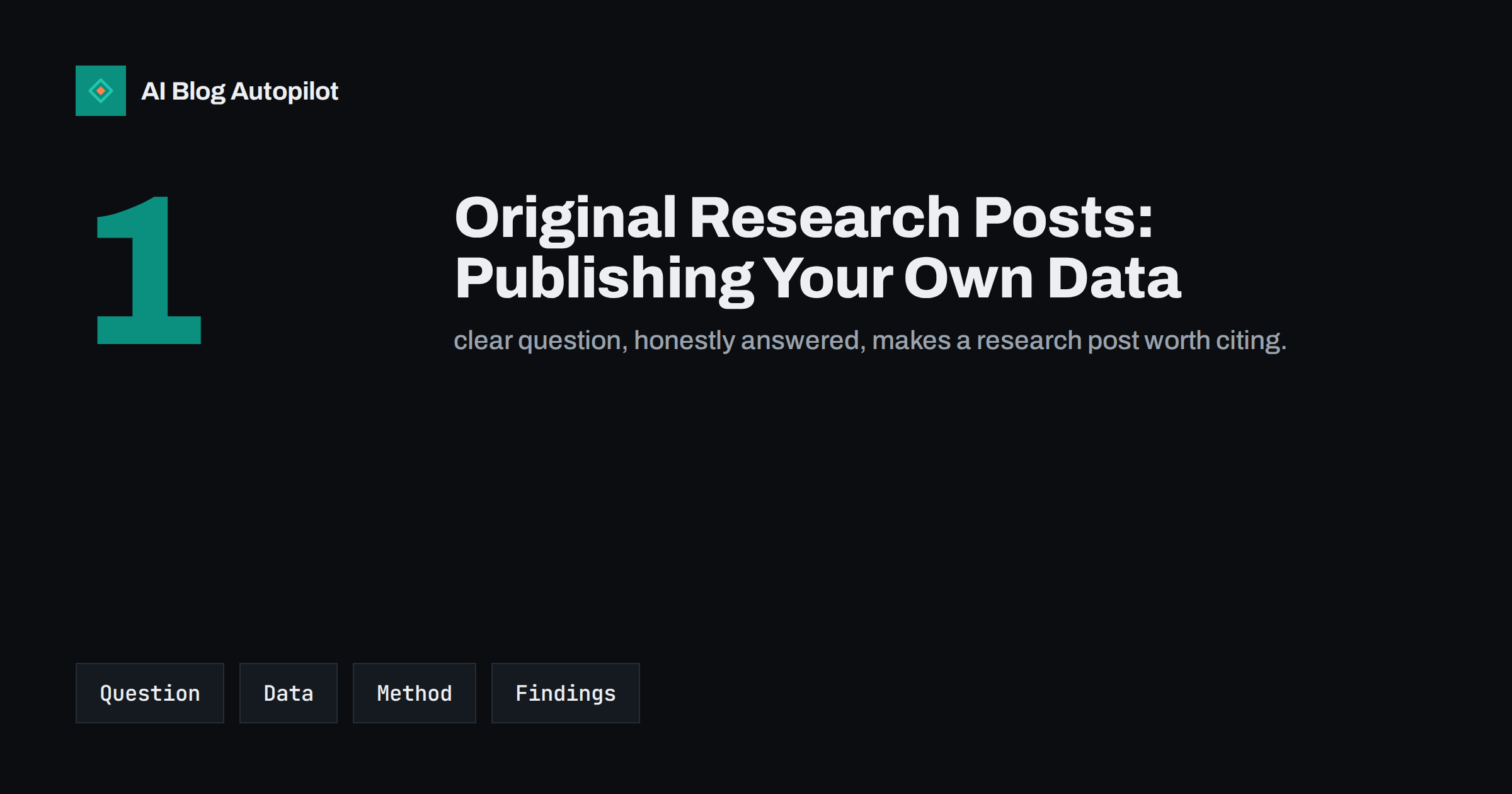
Short answer: an original research post publishes data that you collected yourself, such as a survey of customers, an analysis of your own records or a test you ran, together with a plain description of how the data was gathered and what it does and does not show. It earns links and citations because other writers, and AI assistants, need a source for the numbers they quote, and only you can be that source. A small business does not need a large sample to do this well. It needs a specific question, an honest method, a clear presentation and the discipline to say where the data is weak.
Most business blogs repeat statistics that someone else produced. That is fine for background, but it means every competitor can cite the same figures and nothing in the article is yours. Research that comes from your own work is different. It is original by definition, it shows that you have real experience in the field and it gives people a reason to reference your page rather than the ten others that say similar things. This article explains how to choose a question, collect data without fooling yourself, write the post and promote it responsibly.
What counts as original research for a small blog
The word “research” sounds expensive, but several kinds of data are within reach of an ordinary business.
- A survey of customers, newsletter subscribers or members of a community you belong to, asking a small number of well-chosen questions.
- An analysis of your own records, such as support tickets, orders, bookings or enquiries, summarised without exposing any individual.
- A test or experiment: comparing two approaches on your own site or process and reporting what happened.
- A structured review of public information, for example reading fifty public pricing pages and counting how many list a price, with the method described so others could repeat it.
- A benchmark built from several participants who agree to share anonymised figures.
All of these produce something that did not exist before you published it. That is the test: could a reader find the same figures elsewhere? If so, it is a summary, not research. Our article on statistics round-up posts covers the summary case, and our guide to adding original data to a post covers lighter ways of using your own numbers inside a normal article.
Start with a question people actually ask
Good research starts from a question that readers, journalists or colleagues in your field would like answered and cannot easily answer today. Look at what customers ask you repeatedly, at the questions in your sales conversations and at the topics where articles online contradict each other. A useful question is specific (“how long do small customers wait for a reply from suppliers in our sector?”), answerable with data you can realistically gather and interesting even if the answer is unexciting. Avoid questions whose answer you already know and only want to prove, because readers sense a marketing exercise dressed up as research, and so do editors.
Write the question down before you collect anything, together with what you will do with each possible answer. If you would publish the result whichever way it turns out, the question is honest. If you would hide an inconvenient result, change the question.
Collect the data without fooling yourself
The method matters more than the size. A small, carefully described sample is more credible than a large, vague one.
- Decide who you are asking, and be honest that your sample is people you can reach, not “the market”.
- Keep the questions short and neutral, with answer options that do not lead respondents to the answer you hope for.
- Record the dates, the number of responses and the number of people asked, so you can state a response rate.
- Protect people. Collect only what you need, tell respondents how the answers will be used and publish aggregates, never individual answers that could identify someone. If personal data is involved, check your privacy obligations first.
- Look at the raw data before summarising it, and note anything odd, such as duplicate entries or answers that were clearly not serious.
- Keep the raw file, even if you do not publish it. You will need it when someone asks a question about your numbers.
Be careful with percentages from small groups. “Sixty per cent of respondents” means very little when there were ten of them. State the actual counts (“six of ten”) when the group is small, and avoid language that suggests precision you do not have.
Write the post so the finding comes first
The structure of a research post differs from an ordinary article. Readers who cite it want the finding quickly and the method clearly, and an AI assistant looking for a quotable fact needs both in a form it can lift.
- Lead with the result in one or two sentences: what you found, from how many responses, in which period.
- Follow with the key findings as a short list, one finding per line, each with its number and its context.
- Describe the method in a short section: who was asked, how, when, how many answered and what the limits are.
- Present the data in tables or simple charts with clear titles, labelled axes and a sentence below each stating what it shows.
- Interpret carefully. Separate what the data shows from what you think it means, and say which is which.
- Say what the study cannot tell you. A limitations paragraph is a sign of quality, not weakness.
Give the post a title that states the subject and the type of evidence, such as “What 120 small business owners told us about publishing frequency”, rather than a vague promise. Put the date and period of the data on the page, since statistics age quickly.
Make the data easy to cite and reuse
Citations come when a number is easy to quote correctly. Write the headline figures as full sentences that can stand alone, such as “In our survey of 120 customers in March, 42 said they had never read a returns policy.” Include the sample size and date in the same sentence. Offer charts as images with descriptive alt text and a text caption, and place the underlying figures in an ordinary table so the numbers are readable by software as well as by people. Where it is appropriate and you are comfortable with it, offer a downloadable summary file and state the terms of reuse, for example that people may quote and chart the figures with a link back to the page.
Keep the page at a stable address and update it, rather than creating a new page each year. If you repeat the research annually, publish each wave as a section of the same page or as clearly linked pages, so that trends are visible and links accumulate in one place.
Promote it without overselling
A good research post still needs introductions. Send it to people who have written about the topic recently, to newsletters and communities in your field and to customers who took part, with a short, factual note saying what you found and where the method is described. Share it on your social profiles with one striking finding per post rather than the whole report in one go. Offer a journalist or blogger a specific angle: the number that surprised you, the difference between two groups or the trend over time. Our article on digital PR on a small budget describes approaches that fit this kind of content, and our guide to earning backlinks honestly explains why a citation is worth more than a bought link.
Common mistakes
- Claiming more than the data supports, such as presenting a customer survey as a market-wide study.
- Burying the method, which makes the figures impossible to judge and therefore less likely to be cited.
- Cherry-picking the flattering findings and omitting the rest.
- Using leading questions that guarantee a convenient answer.
- Publishing and forgetting. If the numbers are three years old and still presented as current, the page loses trust.
- Exposing individuals, through free-text answers or small groups that make people identifiable.
One careful piece of research a year is worth more than a dozen thin “studies”. It also feeds the rest of your content: every article you write afterwards can cite your own findings with a link, which strengthens the internal structure of the site.
How AI Blog Autopilot helps
AI Blog Autopilot writes full SEO articles for your WordPress blog from the topics, keywords, audience and tone you set, with FAQ sections, tags and SEO meta included, and it shares each one to your social networks. It cannot collect your data for you, and it should not invent any. What it can do is take care of the steady flow of ordinary articles around your research, so that you can spend your own time on the one piece only you can produce. Approval mode lets you read every article before it goes live, which is a good moment to add a link to your own findings. See the pricing page for plans.
Related reading
- Statistics Round-Up Posts: Doing Them Honestly
- How to Put Something Original in an Article You Automated
- Earning Backlinks Honestly: What Works for a Small Site
- Digital PR on a Small Budget
The bottom line
Original research does not require a research department. It requires a specific question, a fair method, honest limits and a clear page that puts the finding first. Collect your data carefully, protect the people in it, publish the method with the result and keep the page up to date. Done once a year, it gives your blog a source of numbers that others cite, that AI assistants can quote correctly and that no competitor can copy.
DUK
How big does a sample need to be for a blog research post?
There is no fixed number. A small sample is acceptable if you describe it honestly, show the actual counts and avoid claiming the result represents a whole market.
Do I need to be a statistician to publish research?
No. You need a clear question, neutral wording, careful records and the habit of stating limits. For anything with legal, medical or financial consequences, ask a qualified person to review it.
Can I use data from my own customers?
Yes, if you tell them how the answers will be used, collect only what you need and publish aggregates that do not identify anyone. Check your privacy obligations before you start.
How often should I repeat the research?
Once a year is enough for most blogs. Keep the same questions so the results can be compared, and update the same page where possible.
Will a research post get backlinks automatically?
No. It gives people a reason to link, but you still need to tell the right readers about it with a short, factual note and a clear angle.