ENEnglish
 LTLietuviškai
 DEDeutsch
 FRFrançais
 RUРусский
 ESEspañol
 PLPolski
 ITItaliano
 UKУкраїнська
 CSČeština
 PTPortuguês
 JA日本語
JA日本語 LVLatviešu valoda
 ETEesti
 HUMagyar
 IDBahasa Indonesia
 TRTürkçe
 HIहिन्दी
 ELΕλληνικά
 ARالعربية
 THไทย
THไทย VITiếng Việt
 RORomână
 MSBahasa Melayu
 BNবাংলা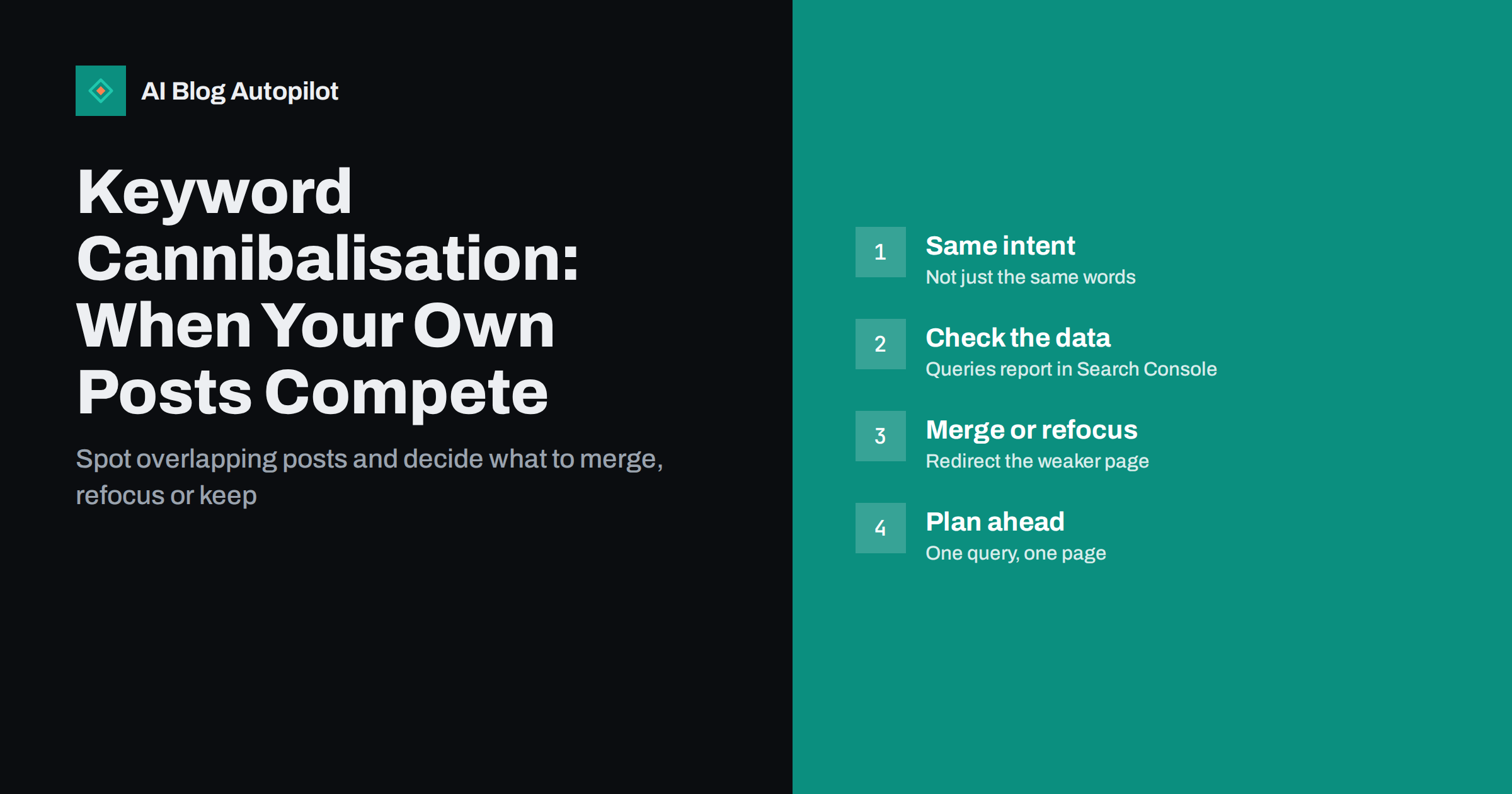
Short answer: keyword cannibalisation happens when two or more pages on your site target the same search intent, so search engines keep switching between them and neither ranks as well as one strong page would. It is a real problem only when the pages answer the same question for the same reader. Confirm it in Search Console by checking whether several URLs share impressions for one query over time. The usual fixes are to merge the pages and redirect the weaker one, or to refocus one page on a clearly different intent.
Once a blog passes a few dozen posts, overlap becomes almost inevitable. You write about a topic, come back to it a year later from a slightly different angle, and end up with two articles that look very similar to a search engine.
Sometimes that is fine. Sometimes it quietly holds both pages back. The trick is telling the two situations apart without panicking every time two titles share a word.
What keyword cannibalisation actually means
The term describes a site competing with itself. For a given search, a search engine usually shows one page from a site, occasionally two. If you have several pages that could satisfy the same query, the engine has to pick, and the pick may change from week to week.
The symptoms are familiar to anyone who has watched their rankings closely:
- Rankings for a query jump around more than you would expect.
- The URL shown for a query keeps changing between two of your posts.
- Neither post reaches the position you think the site deserves, while a single page on a competitor sits steadily above both.
- Links, both internal and external, are split between the pages instead of strengthening one.
The damage comes from dilution. Signals that would make one page convincing are spread thinly across two, and search engines have less reason to trust either as the definitive answer.
When overlap is not a problem
A lot of advice treats any shared keyword as cannibalisation. That leads to needless merging and deleting of perfectly good content.
Overlap is usually fine when:
- The intent differs. “What is a canonical tag” and “how to fix canonical errors in WordPress” share words but serve different readers at different moments.
- One page is broad and one is specific. A pillar page on content planning and a detailed post on seasonal content planning support each other when they link together.
- The search results show both types. If the first page of results mixes guides, definitions and tool pages, search engines are happy to show different formats for the same query.
- Both pages rank well. If your two pages hold positions two and four, you are taking more of the page, not less. Leave them alone.
The test is always the reader: would the same person, with the same question, be equally happy with either page? If yes, you have a cannibalisation problem. If no, you have two useful pages.
How to find cannibalisation on your blog
You do not need a paid tool to find the cases that matter. Three simple checks cover most blogs.
1. Search Console queries
In the performance report, filter by a query you care about and switch to the Pages tab. If several of your URLs collect impressions for that one query, note them. Then change the date range and compare: if the leading URL swaps between periods, the engine is undecided.
2. A site search
Search for site:yourdomain.com topic in a search engine. It is not a precise tool, but it quickly shows how many pages you have on a subject and whether their titles are nearly identical.
3. Your own content inventory
List your posts with their target query and main intent in a spreadsheet. Sort by query. Duplicates jump out immediately, and the list becomes the basis for a keyword map that prevents new overlaps.
Start with queries that matter commercially or bring meaningful traffic. Cannibalisation on a query that gets a handful of impressions a month is not worth an afternoon.
Confirming it before you act
Before merging anything, compare the two pages side by side. Answer these questions honestly:
- Do both pages answer the same main question?
- Would a reader who landed on one page still need the other?
- Does each page bring its own traffic from different queries, or do they share the same ones?
- Does either page have external links pointing at it?
- Which page is more complete, more current and better written?
If both pages answer the same question and share the same queries, act. If each page brings its own distinct traffic, the overlap is probably smaller than it looks, and a clearer focus on one of them may be enough.
Four ways to fix it
There is no single fix. Choose based on what the pages are and what they earn.
| Situation | Best fix | What happens to the weaker page |
|---|---|---|
| Two posts answer the same question | Merge into the stronger post | 301 redirect to the merged post |
| Posts overlap but could serve different intents | Refocus one on a distinct angle | Stays live with a new title and scope |
| A thin post adds nothing the main post lacks | Remove and redirect | 301 redirect to the main post |
| Both pages must stay for other reasons | Canonical to the preferred page | Stays reachable, not preferred in search |
Merging
Merging is the most common and usually the most effective fix. Pick the page with the better URL, stronger links and more complete content as the survivor. Move anything useful from the weaker page into it: a section, a better example, an FAQ. Update the date only if the content genuinely changed. Then redirect the old URL permanently to the survivor and update internal links so they point straight at the new page.
Refocusing
When two posts overlap but one could reasonably serve a different need, rewrite its title, introduction and headings around that need. A general post and a beginner’s checklist, or a concept explainer and a step-by-step guide, can coexist once each clearly owns its angle.
Removing
Some old posts are short, outdated and add nothing. Redirect them to the page that does the job properly. Removing without redirecting throws away any links the page earned.
Canonicalising
A canonical tag is the least common fix for blog cannibalisation. It suits true duplicates that must remain reachable, not two different articles on the same subject. For two genuinely different articles, search engines may ignore the canonical.
A simple illustration
Imagine a bike shop blog with two posts: “How to Store an E-Bike Battery in Winter” from two years ago and “E-Bike Battery Care: Winter Tips” from last month. Both explain temperature, charge level and storage location. In Search Console, the query “store e-bike battery winter” shows impressions for both URLs, and the leading page changes from month to month.
The older post has a few links from cycling forums; the newer one has better photos and a fresher checklist. The sensible fix is to keep the older URL, move the new photos and checklist into it, redirect the newer post to it, and point every internal link about winter battery care at the surviving page. One complete article replaces two half-answers, and the links the older page earned keep working for it.
Internal links: the quiet cause
Internal links often create or worsen the problem. If half your posts link to article A with the anchor “content calendar” and the other half link to article B with the same anchor, you are telling search engines that both pages are about the same thing.
After deciding which page owns a topic, make your links agree:
- Point descriptive anchors for that topic at the owning page.
- Link from the secondary page to the owning page where it makes sense.
- Update menus, category descriptions and related-post blocks that point at the weaker page.
This alone sometimes settles which page ranks, without merging anything.
Preventing it as the blog grows
Cannibalisation is much cheaper to prevent than to fix. A few habits keep it under control:
- Keep a keyword map. One row per page, with its main query and intent. Check it before every new article.
- Update instead of duplicating. If a topic you already cover needs fresh information, improve the existing post.
- Plan clusters on purpose. A pillar page covers the broad topic; each supporting post takes a narrower question and links back.
- Review twice a year. Run the Search Console check on your main queries and deal with new overlaps while they are small.
How AI Blog Autopilot helps avoid overlap
When articles are produced on a schedule, duplication is a real risk, so the planning step matters. AI Blog Autopilot plans each month’s articles from the topics, keywords and audience you give it, with each article built around a real search query, and it adds tags, FAQ and SEO meta before publishing. Keeping your topic list distinct and reviewing the content map from time to time is still the best way to spot two articles drifting towards the same question. More on how it plans and publishes is on the AI Blog Autopilot home page.
Related reading
- How Many Keywords Should One Article Target?
- Content Pruning: When to Delete, Merge or Redirect a Blog Post
- Search Intent: The Four Types and What Each Needs
- Content Clusters and Pillar Pages, Explained Simply
The bottom line
Keyword cannibalisation is real, but narrower than it is often made out to be. Two pages only compete when they serve the same reader with the same question. Confirm it with Search Console data, fix it by merging or refocusing, make your internal links agree, and keep a simple keyword map so the next article does not start the problem again.
DUK
Is keyword cannibalisation a Google penalty?
No. There is no penalty for having several pages on one topic. The cost is indirect: search engines struggle to choose between the pages, and links and relevance signals are split, so neither page ranks as well as a single strong page could.
How do I check for keyword cannibalisation for free?
Use the performance report in Google Search Console. Filter by a query, open the Pages tab and see whether several of your URLs get impressions for it. If the leading URL changes between date ranges, the pages are likely competing.
Should I delete one of the competing posts?
Usually merge rather than delete. Move the useful parts of the weaker post into the stronger one, then add a permanent 301 redirect from the old URL. Deleting without a redirect discards any links and traffic the page had.
Can two posts target similar keywords safely?
Yes, if they serve different intents. A definition article and a step-by-step guide can both rank when the results page shows both formats. Make each page’s angle clear in its title and headings, and link between them.
How often should I check for cannibalisation?
For most blogs, a review every six months is enough, plus a quick check of the keyword map before each new article. Larger sites publishing many posts a month benefit from a quarterly review of their most important queries.