ENEnglish
 LTLietuviškai
 DEDeutsch
 FRFrançais
 RUРусский
 ESEspañol
 PLPolski
 ITItaliano
 UKУкраїнська
 CSČeština
 PTPortuguês
 JA日本語
 LVLatviešu valoda
 ETEesti
 HUMagyar
 IDBahasa Indonesia
 TRTürkçe
 HIहिन्दी
 ELΕλληνικά
 ARالعربية
 THไทย
 VITiếng Việt
 RORomână
 MSBahasa Melayu
 BNবাংলা
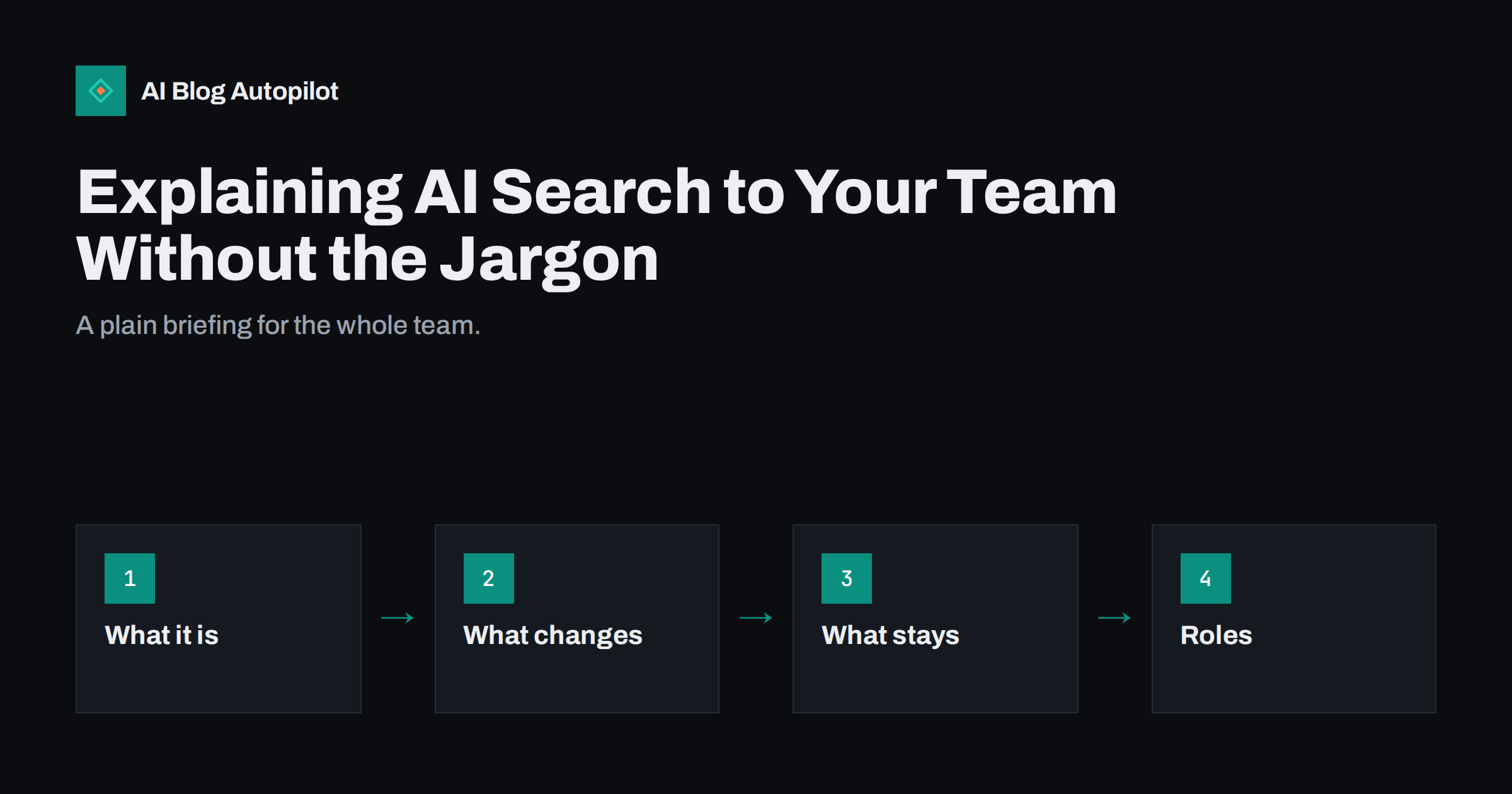
Short answer: explain AI search to your team in three sentences: people now ask assistants questions and get a written answer with a few sources, those answers are built from pages like ours, and our job is to keep clear, accurate, up-to-date pages that are worth citing. Then give each person one small task, such as checking facts, answering questions or updating old pages, so the topic becomes part of normal work instead of a special project.
Most teams hear about AI search from headlines, conference talks and worried posts on social networks. Some colleagues expect a disaster, others expect a shortcut, and many simply do not know what to do on Monday morning. When nobody has a shared picture, the blog gets conflicting requests: write for robots, stop writing, add a special file, change every title. A short, honest briefing prevents that.
This article gives you a plain-language script, a few examples that anyone can try in five minutes, a list of what changes and what does not, and a simple way to share the work. You do not need a technical background to present it.
Start with what people already do
Begin with a habit your colleagues recognise. Ask who has used an assistant to compare products, plan a trip, understand a form or find a recipe in the last month. Most hands go up. Then explain that the same thing happens with questions about your business: what does it do, who is it for, how much does it cost, is it any good.
Describe the result in everyday terms. Instead of ten blue links, the person gets a written answer, often with a few links beneath it. Sometimes the answer names a business, sometimes it describes a category, and sometimes it is wrong. The reader may click a source, or may simply act on the answer. That is the whole shift, and it is easier to accept when it is described without buzzwords.
Avoid the alphabet soup in the first meeting. Terms such as GEO, AEO and LLMO describe overlapping ideas, and the article on what the AI search terms mean can serve as a reference for those who want it. For everyone else, one phrase is enough: people ask, assistants answer, and the answers draw on pages.
Invite stories as well. Someone on the team has probably asked an assistant about a holiday, a tool or a medical form and been surprised by the answer, good or bad. Those stories show that answers can be helpful and wrong in the same breath, which is exactly why careful pages matter. They also keep the conversation human, and a colleague who has told a story is more likely to take part in the work that follows.
Keep the first session short, and promise a follow-up with results. People accept a new topic more readily when they see that it will not take over their calendar, and when they know when they will hear more.
Show it live in five minutes
A live demonstration persuades more than a slide. Pick three questions that a customer would really ask, for example what your business does, how it compares with an alternative and what a typical customer should know before buying. Type each into two or three assistants and read the answers aloud. Note which pages are mentioned, which facts are right and which are missing or wrong.
Write the findings on one page: the question, the tool, the date, what was said and what you would change. Expect surprises. A fact that is clear to the team may be absent from the answer, and a competitor may be described more accurately than you are. This is not an emergency; it is a to-do list. The guide on checking whether assistants mention your blog explains how to repeat the test without fooling yourself, for example by using several wordings and noting that answers vary from one session to the next.
Keep the tone calm. The point of the demonstration is to show that the topic is concrete and that the team can influence it through ordinary content work, not to scare anyone.
Say what changes and what does not
Teams relax when they hear that most of their craft still matters. Clear writing, accurate facts, honest claims, helpful structure and current pages were important before assistants and remain important now. What changes is the way people reach those pages and how much of the answer they take without visiting.
Be specific about the changes. Some questions will be answered without a click, so a page must be useful even when it is only quoted. Pages should state key facts plainly, in sentences that can be lifted out. Old pages that contradict newer ones become more risky, because an assistant may repeat the outdated version. The articles on how AI search picks sources and how assistants know a business give the background if someone asks for detail.
Be equally specific about what does not change: nobody can buy a guaranteed mention, no single file or trick controls the answers, and anyone who promises a fixed position is guessing. A short list of claims to ignore is worth pinning in the team channel, because it saves hours of discussion.
Give every role one small task
A topic becomes real when it has owners. Offer each role a task that fits what they already do. Writers can lead each article with a direct answer and keep claims specific. Editors can check that numbers, names and dates match the rest of the site. Support staff can pass on the questions customers ask, which are the best topic source. Sales staff can report what prospects say they heard from an assistant. A manager can decide how often the test questions are repeated and who sees the results.
Keep the tasks light. If the work adds an hour a day, it will be dropped within a month. If it adds ten minutes to a review step that already exists, it will survive. Write the tasks in a short table in your editorial document and review them once a quarter.
Name one person as the contact for questions. Colleagues will keep forwarding articles, screenshots and rumours, and someone needs to answer calmly and add useful items to the list. That person does not need to be technical; they need to be curious and consistent.
Agree on rules for wording and claims
Because assistants quote pages, careless wording travels further. Agree a few rules. Describe what the business does in one sentence and use it everywhere. Use the same names for products and services across pages. State prices, limits and conditions in one place and link to it. Mark the date of important guides. Do not claim results you cannot show, and do not hide limits in small print.
These rules also reduce internal friction. When two people disagree about how to describe a service, the agreed sentence settles it. When a page needs to change, the person responsible knows where else the fact appears. The guide on conflicting facts across pages shows how small differences confuse both readers and assistants.
Finally, agree that nobody writes for an assistant at the expense of a person. If a sentence is clear for a reader, it is usually clear for a tool. Texts stuffed with questions, repeated keywords or invisible blocks help nobody and carry a risk of being treated as spam.
Answer the questions you will be asked
Expect the same questions in every meeting, and prepare short, honest answers. Will assistants replace our website? No, but some visitors will read a summary first and arrive later or not at all, so the site must work as both a source and a destination. Should we block assistants from reading our pages? That is a business decision with trade-offs, and the right answer depends on whether you want to be mentioned; make it deliberately and write it down.
Someone will ask whether the content can simply be produced faster to cover more ground. Volume alone does not help if pages repeat each other or contain thin claims. A smaller set of accurate, well-maintained pages usually does more than a large pile of similar ones. Someone else will ask about tracking. Be frank that measurement is imperfect: some visits can be recognised, many mentions cannot, and the best approach is to combine regular test questions with your usual analytics and the questions customers report.
Finally, expect worry about jobs. Say clearly that the work moves toward checking, updating and judging rather than disappearing. People who know the customers, the facts and the tone are the ones who keep answers accurate, and that knowledge becomes more valuable, not less.
Plan a small routine and a first month
End the briefing with a plan that fits on one slide. Week one: run the test questions and record the answers. Week two: fix the most obvious factual gaps on key pages. Week three: update or merge old pages that contradict newer ones. Week four: repeat the test questions and compare. After that, repeat the routine monthly, and share a one-page summary with the team.
The summary can follow the structure in a monthly AI visibility report: what was tested, what changed, what was fixed and what comes next. Do not overreact to small movements, since answers vary naturally. Look for repeated patterns across weeks, and celebrate corrections that make an answer more accurate, even if traffic does not change immediately.
If the team wants to experiment with a tool, set a time limit and a success measure first. The article on piloting an AI blog tool offers a thirty-day structure that keeps such trials honest.
How AI Blog Autopilot helps
AI Blog Autopilot can write and publish articles on your chosen topics, with FAQ sections, tags and SEO meta, and share them to your social networks. Give it your fact sheet and the questions your customers ask, and check names, dates and figures before each article goes live. See the pricing page for plans and monthly credits.
Related reading
- GEO, AEO and LLMO Explained: What the AI Search Terms Mean
- AI Search Optimisation Myths: Seven Claims to Ignore
- Checking Whether AI Assistants Mention Your Blog
The bottom line
Explain AI search with a live demonstration, say what changes and what does not, give each role one small task and repeat a simple test every month.
DUK
How long should an AI search briefing for a team take?
Twenty to thirty minutes is enough: a short explanation, a live demonstration with three questions and an agreed list of tasks.
Do we need a technical person to explain it?
No. A curious editor or marketer can lead it, since the work is mostly clear writing, accurate facts and regular checks.
Should we stop writing for search engines?
No. Clear, accurate and current pages serve both search engines and assistants, so the core work stays the same.
How often should we repeat the test questions?
Monthly is a sensible rhythm, with the same questions and several wordings, because answers vary between sessions.
What if a colleague wants a special trick or file?
Ask for evidence and test it on a small scale first. Nobody can guarantee a mention, so treat such promises with care.