ENEnglish
 LTLietuviškai
 DEDeutsch
 FRFrançais
 RUРусский
 ESEspañol
 PLPolski
 ITItaliano
 UKУкраїнська
 CSČeština
 PTPortuguês
 JA日本語
JA日本語 LVLatviešu valoda
 ETEesti
 HUMagyar
 IDBahasa Indonesia
 TRTürkçe
 HIहिन्दी
 ELΕλληνικά
 ARالعربية
 THไทย
THไทย VITiếng Việt
 RORomână
 MSBahasa Melayu
 BNবাংলা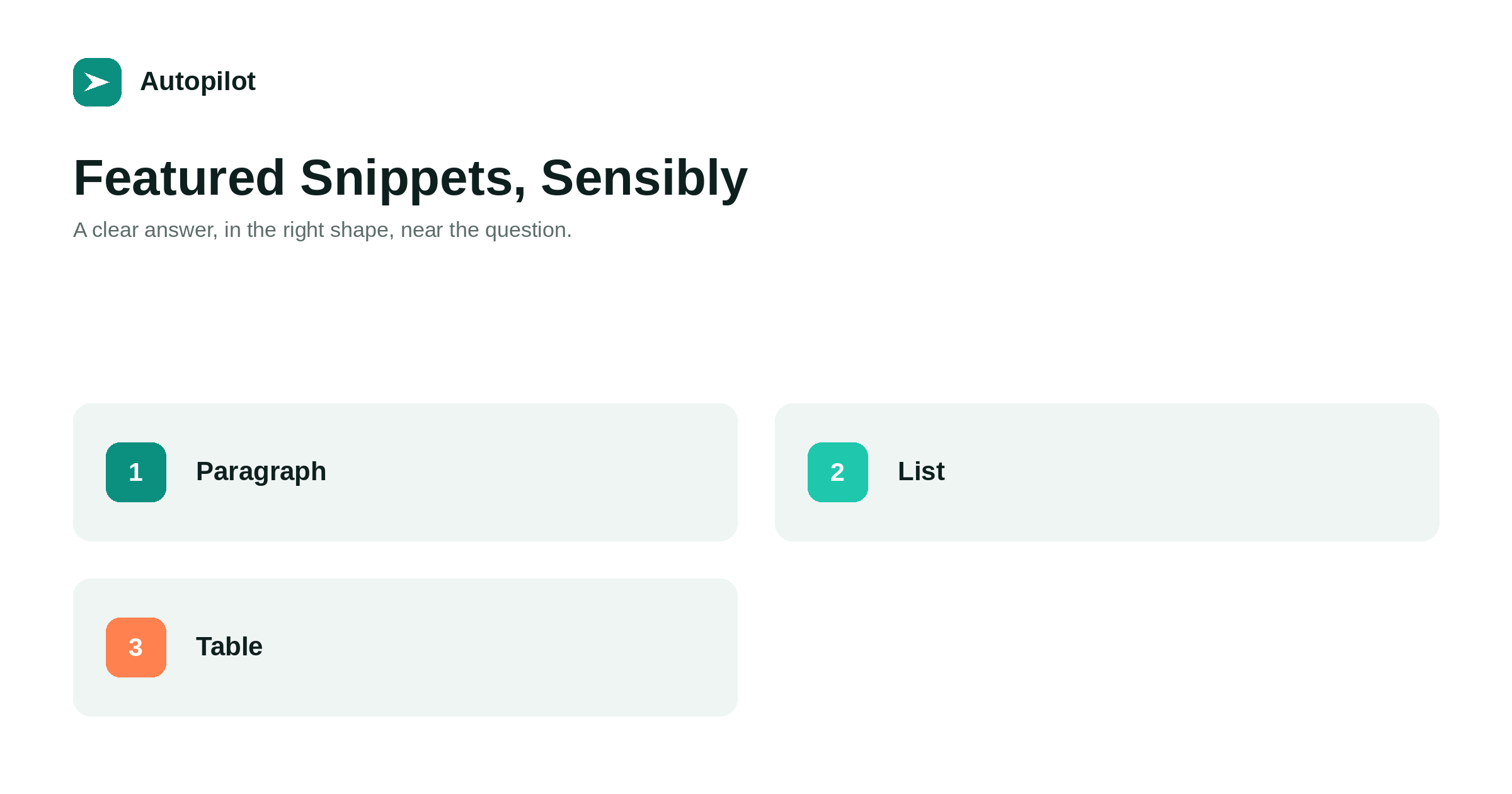
Short answer: a featured snippet is a short passage from a page shown at the top of search results as a direct answer. Pages that get them usually answer the question clearly, close to a heading that asks it, in a format that suits the question: a direct paragraph of roughly 40 to 60 words for what and why questions, a numbered list for steps, a table for comparisons. Write that way because it helps readers; the snippet is a possible side effect. Nobody can guarantee one, and a snippet can reduce clicks as well as increase them.
Featured snippets — the boxed answers above ordinary results — are chosen from pages that already rank well for a query. They quote a passage that answers the question directly, usually with a link to the source.
You cannot request one. You can write in a way that makes a passage easy to quote, which also happens to make the page easier to read.
Match the format to the question
Snippets tend to take the shape that suits the question.
| Question type | Snippet shape | How to write for it |
|---|---|---|
| What is, why does | Paragraph | A direct 40–60 word answer under a heading |
| How to | Numbered list | Steps as a real ordered list, one action each |
| Best, types of, examples | Bulleted list | Items as a real list with short labels |
| Compare, versus, cost | Table | A real HTML table with clear headers |
Using real HTML lists and tables, not styled paragraphs, matters, because search engines read the structure. when a table beats three paragraphs covers choosing between them.
Put the question near the answer
A heading that states the question, followed immediately by the answer, is the clearest possible signal of what a passage answers.
How long should a blog post be? as an H2, followed by a two-sentence direct answer, then the detail. The answer should make sense on its own, without the paragraphs before it — the same principle as sections that stand alone in how to structure an article.
Write the answer to stand alone
A snippet is lifted out of context. The passage must make sense by itself.
- Name the subject rather than using it or this.
- Give the answer before the caveats.
- Keep it to what fits in a short passage; put detail after.
- Avoid phrases like as mentioned above.
The short answer block at the top of an article is a natural candidate, which is one reason to write it carefully — see introductions that do not waste time.
Snippets and clicks
A snippet puts your page at the top, and it also answers the question on the results page. For some queries that means more clicks; for simple factual questions it can mean fewer, because the reader already has the answer.
Pages whose answer invites more reading — a process, a decision, a comparison with nuance — tend to benefit more than pages answering a one-line fact. zero-click searches looks at this in more detail.
You need to rank first
Snippets are usually drawn from pages already ranking on the first page for the query. Formatting cannot lift a page that does not rank into the snippet.
So the order of work is: answer the question well enough to rank, then make sure the answer is formatted clearly. For a page already ranking in the top few positions, improving the answer passage is a reasonable, small change to try.
Snippets and answer engines
The same qualities that make a passage suitable for a snippet — a clear, self-contained, specific answer near a descriptive heading — also make it more likely to be quoted by AI answer engines.
being cited by AI search covers answer engines specifically. The practical advice is the same, and it is also what makes an article easier for a human to skim.
What not to do
Some snippet advice makes pages worse.
Repeating the question in every paragraph to look relevant reads badly.
Truncating the useful answer to force a click frustrates readers and tends to backfire.
Adding a Q&A block of trivial questions purely to target snippets adds clutter. An FAQ is useful when the questions are real — writing FAQ sections covers that.
A worked example
Take the question how often should a small business publish blog posts. A page that answers it well for a snippet might have an H2 asking exactly that, followed by: Most small businesses do best publishing one to two articles a week, at a pace they can keep for a year. Consistency matters more than volume: a steady schedule beats bursts followed by silence. The right number depends on how much time you have to review each article.
That passage names the subject, gives the answer first, includes the key caveat, and makes sense on its own. The detail — how to decide, what happens when a blog stops — follows below for readers who want it.
Compare an opening that begins There is no one-size-fits-all answer to this question. It may be true, but it answers nothing and is unlikely to be quoted.
Checking what you have
Search Console does not label snippets directly, but a page with a high position and an unusual click-through rate for a question query may be appearing in one. Searching the query yourself shows what is displayed, though results vary by location and device.
Treat snippets as a possible bonus of clear writing, not a target to measure yourself against. They come and go, and no technique guarantees one.
Related reading
If this was useful, these cover the questions that usually come next.
- Being cited by AI search — the same principles for answer engines
- Introductions that do not waste time — the short answer at the top
- Zero-click searches — what a snippet does to clicks
The bottom line
Match the answer’s shape to the question — a direct paragraph, a real list or a real table — put it right under a heading that asks the question, and make it understandable on its own. Rank first, format second, and treat the snippet as a possible side effect of clear writing rather than a goal.
FAQ
What is a featured snippet?
A short passage from a web page shown at the top of search results as a direct answer to a query, with a link to the source.
How do I get a featured snippet?
You cannot request one. Pages that get them usually rank well already and answer the question clearly, in a suitable format, right under a heading that asks it.
How long should a snippet answer be?
For paragraph answers, roughly 40 to 60 words is a common guide: enough to answer, short enough to quote.
Do featured snippets increase clicks?
Sometimes. For simple facts they can reduce clicks because the answer is shown directly. Answers that invite further reading tend to benefit more.
Do I need structured data for snippets?
No. Snippets are drawn from the visible content. Clear HTML headings, lists and tables help search engines read the structure.
Can I lose a featured snippet?
Yes. Snippets change frequently as results and pages change. Nobody can guarantee keeping one.