ENEnglish
 LTLietuviškai
 DEDeutsch
 FRFrançais
 RUРусский
 ESEspañol
 PLPolski
 ITItaliano
 UKУкраїнська
 CSČeština
 PTPortuguês
 JA日本語
JA日本語 LVLatviešu valoda
 ETEesti
 HUMagyar
 IDBahasa Indonesia
 TRTürkçe
 HIहिन्दी
 ELΕλληνικά
 ARالعربية
 THไทย
THไทย VITiếng Việt
 RORomână
 MSBahasa Melayu
 BNবাংলা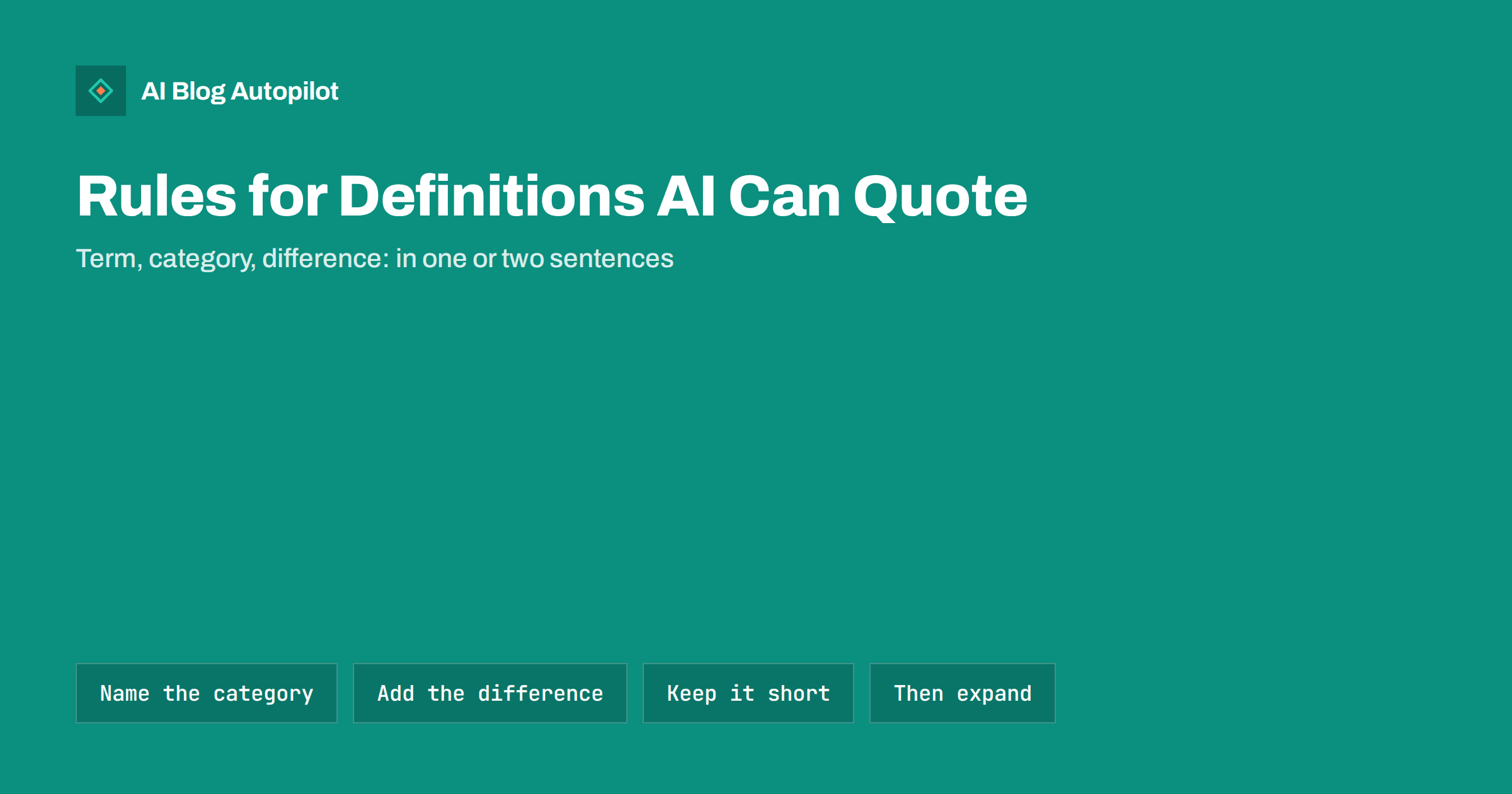
Short answer: a definition that AI answers and search features can reuse is short, self-contained and precise: it names the term, says what kind of thing it is, and states what makes it different, usually in one or two sentences. Put it directly under the heading that asks the question, avoid circular wording and filler, and follow it with an example and any important limits. The same qualities make the definition useful to a human reader who just wants the answer.
A large share of searches start with “what is”. People want a quick, reliable explanation of a term before they read further. Search engines have long shown definitions in featured snippets, and AI answers now often open with a one- or two-sentence definition drawn from web pages. Whether your page is the source depends on many factors outside your control, but one factor is entirely in your hands: whether your page contains a clear definition worth quoting.
Surprisingly many articles do not. They introduce a term with a paragraph of context, a history lesson or a vague statement about how important it is, and never actually say what it is. This article shows how to fix that.
Why definitions matter for AI answers
AI answer engines assemble responses from passages they consider relevant and reliable. For definitional questions, the ideal passage is a compact statement that answers the question without needing the surrounding text. If your definition is buried in the third sentence of a rambling paragraph, it is harder to identify and harder to lift intact.
A clear definition also helps in other places:
- Featured snippets and “People also ask” answers favour short, direct explanations.
- Readers who skim find the answer immediately and are more likely to continue reading.
- Internal consistency improves when every article on your blog uses the same wording for the same concept.
No formatting trick guarantees a citation. But an article without a clean definition gives any system less to work with.
The anatomy of a good definition
A classic, reliable pattern has three parts:
- The term being defined.
- The category it belongs to: what kind of thing it is.
- The distinguishing feature: what separates it from other things in that category.
For example: “A canonical tag is an HTML element that tells search engines which URL is the main version of a page when several URLs show the same content.” The term is “canonical tag”, the category is “an HTML element”, and the distinguishing feature is what it tells search engines.
That single sentence can stand on its own. A reader who sees only this sentence, in an AI answer or a snippet, still learns what the thing is. That is the test for every definition you write.
Rules for writing definitions that can be quoted
- Start with the term, not with context. “Keyword cannibalisation is…” is better than “When you have been blogging for a while, you might notice…”
- Keep it to one or two sentences. Roughly 20 to 50 words is a useful range. Longer definitions tend to mix in explanation that belongs in the next paragraph.
- Avoid circular definitions. “Link building is the process of building links” tells the reader nothing new. Use different, simpler words than the term itself.
- Use plain language. If the definition needs another definition to be understood, simplify it or define the second term right after.
- Make it self-contained. Avoid “this”, “it” or “as mentioned above” in the definition sentence. The sentence may be read without anything around it.
- Be accurate and neutral. A definition is not the place for opinions or marketing. Save “why it matters” for the following sentence.
- Expand acronyms. Write “Core Web Vitals (CWV)” or “E-E-A-T, which stands for experience, expertise, authoritativeness and trustworthiness”, at least once.
Good and weak definitions compared
| Weak | Why it fails | Stronger |
|---|---|---|
| “Crawl budget is a very important concept that every SEO should understand.” | Says it matters, never says what it is | “Crawl budget is the number of URLs a search engine is willing and able to crawl on a site in a given period.” |
| “An XML sitemap is a sitemap in XML.” | Circular | “An XML sitemap is a file that lists the URLs on a site you want search engines to know about, often with the date each was last changed.” |
| “It helps you with duplicate pages.” | Depends on context; unclear subject | “A canonical tag tells search engines which URL is the main version when several pages show the same content.” |
| “Search intent is basically what people want, kind of the reason behind searches in general.” | Vague and padded | “Search intent is the goal behind a search: what the person wants to know, do or buy.” |
Adjusting definitions for your audience
The right definition depends on who is reading. The same term can need different wording for a beginner and for a specialist, and a definition that is technically perfect but pitched at the wrong level fails just as badly as a vague one.
- For beginners, choose a familiar category and describe the effect rather than the mechanism. “A redirect is an instruction that automatically sends visitors and search engines from one web address to another” works for almost anyone.
- For practitioners, you can be more precise and use the field’s vocabulary. “A 301 redirect is an HTTP status code that signals a permanent move and asks clients to use the new URL” is right for a technical audience.
- For mixed audiences, start with the plain version and add the precise detail in the next sentence. Beginners get what they need first, and experts can see you know the specifics.
Whatever the level, avoid defining a term by listing everything it can involve. A definition that tries to cover every edge case becomes a paragraph, and the core meaning gets lost. Keep the definition sentence tight and move exceptions, variations and history into the explanation that follows.
A quick way to check a definition is to read it aloud to someone outside your field. If they can repeat the idea back to you in their own words, the definition works. If they ask “but what is it?”, the category or the distinguishing feature is missing.
Where to put the definition
Placement matters as much as wording.
- Directly under a question heading. If the section is titled “What is crawl budget?”, the first sentence under it should be the definition.
- Early in articles about a single concept. In an explainer, the definition belongs in the opening answer, not halfway down the page.
- Inline in longer guides. When an article uses a technical term for the first time, give a short definition in the same sentence or the next one, then continue.
- In the FAQ. A “What is…” question in the FAQ, with a two-sentence answer, is another natural home, especially if the main article assumes some knowledge.
Avoid putting definitions only in images, tooltips or collapsible elements that require interaction. Plain text in the main content is the most reliable format for every kind of reader and crawler.
After the definition: expand usefully
A definition answers “what is it?”. The next few sentences should answer what the reader needs next. A good sequence is:
- An example. Make the abstract concrete: “For example, if the same article is reachable with and without a tracking parameter, the canonical tag points both to the clean address.”
- A contrast. Say what it is not, or how it differs from a commonly confused term: “Unlike a redirect, a canonical tag does not send visitors anywhere.”
- Why it matters. One or two sentences on the practical consequence for the reader.
- Limits or conditions. Any important “but”: “Search engines treat it as a strong hint, not a command.”
This structure makes the section genuinely useful, and each sentence can also stand as a small, quotable fact.
Consistency across a blog
When a blog publishes many articles in the same field, the same terms appear again and again. If each article defines them slightly differently, readers get confused and so, potentially, do systems trying to understand what your site says.
- Keep a short internal list of your key terms and their approved definitions.
- Reuse the core wording, adapted to the context, rather than inventing a new definition each time.
- Link the term to your main explainer or glossary entry on first mention in other articles.
- When a definition changes, for example because a standard is updated, update it everywhere.
For sites with many specialist terms, a glossary page can hold the canonical definitions, with individual articles linking to it.
Markup: helpful, but secondary
HTML has a <dfn> element for marking the defining instance of a term, and schema.org includes a DefinedTerm type for glossary-style content. These can make your intent clearer to machines, but there is no evidence that they are required for definitions to be used in search features or AI answers. The written sentence is what matters. Add markup if it fits your setup; never treat it as a substitute for a clear definition.
How AI Blog Autopilot helps
AI Blog Autopilot plans each article around a real search query and writes long-form articles with clear structure and an FAQ section, which gives definitions natural places to live: under question headings and in the FAQ. You can describe your preferred tone and audience so explanations fit your readers. If you keep an approved list of definitions, switch on approval to check articles against it before they go live. See how Autopilot plans and writes articles.
Related reading
- Glossary Pages and Definitions: When They Help
- Writing for Featured Snippets Without Chasing Them
- Readability: Writing So People Finish the Article
- Citing Sources in Blog Posts: Why It Helps in AI Answers
The bottom line
A definition worth quoting names the term, its category and what sets it apart, in one or two plain, self-contained sentences. Put it right under the question it answers, follow it with an example, a contrast and the practical consequence, and keep definitions consistent across your blog. It is a small habit that makes every explainer clearer for readers and easier for search features and AI answers to use.
FAQ
How long should a definition be for AI answers?
Usually one or two sentences, roughly 20 to 50 words. That is long enough to name the category and the distinguishing feature, and short enough to be lifted without surrounding context.
Where should a definition go in a blog post?
Directly under a heading that asks the question, such as “What is crawl budget?”, or in the opening answer of an explainer. The definition should be the first sentence of that section, not buried after background information.
What makes a definition circular?
A definition is circular when it explains a term using the term itself, such as “link building is building links”. It gives the reader no new information. Use different, simpler words that describe what the thing is and does.
Do I need DefinedTerm schema for my definitions to be used?
No. Markup such as DefinedTerm or the dfn element can clarify intent, but the clear written sentence is what readers, search features and AI answers rely on. Add markup only as a supplement.
Should every article on my blog define the same term again?
Briefly, yes, when the term is central to the article, but use consistent wording and link to your main explainer or glossary entry. Consistent definitions help readers and avoid mixed signals about what your site says.