ENEnglish
 LTLietuviškai
 DEDeutsch
 FRFrançais
 RUРусский
 ESEspañol
 PLPolski
 ITItaliano
 UKУкраїнська
 CSČeština
 PTPortuguês
 JA日本語
JA日本語 LVLatviešu valoda
 ETEesti
 HUMagyar
 IDBahasa Indonesia
 TRTürkçe
 HIहिन्दी
 ELΕλληνικά
 ARالعربية
 THไทย
THไทย VITiếng Việt
 RORomână
 MSBahasa Melayu
 BNবাংলা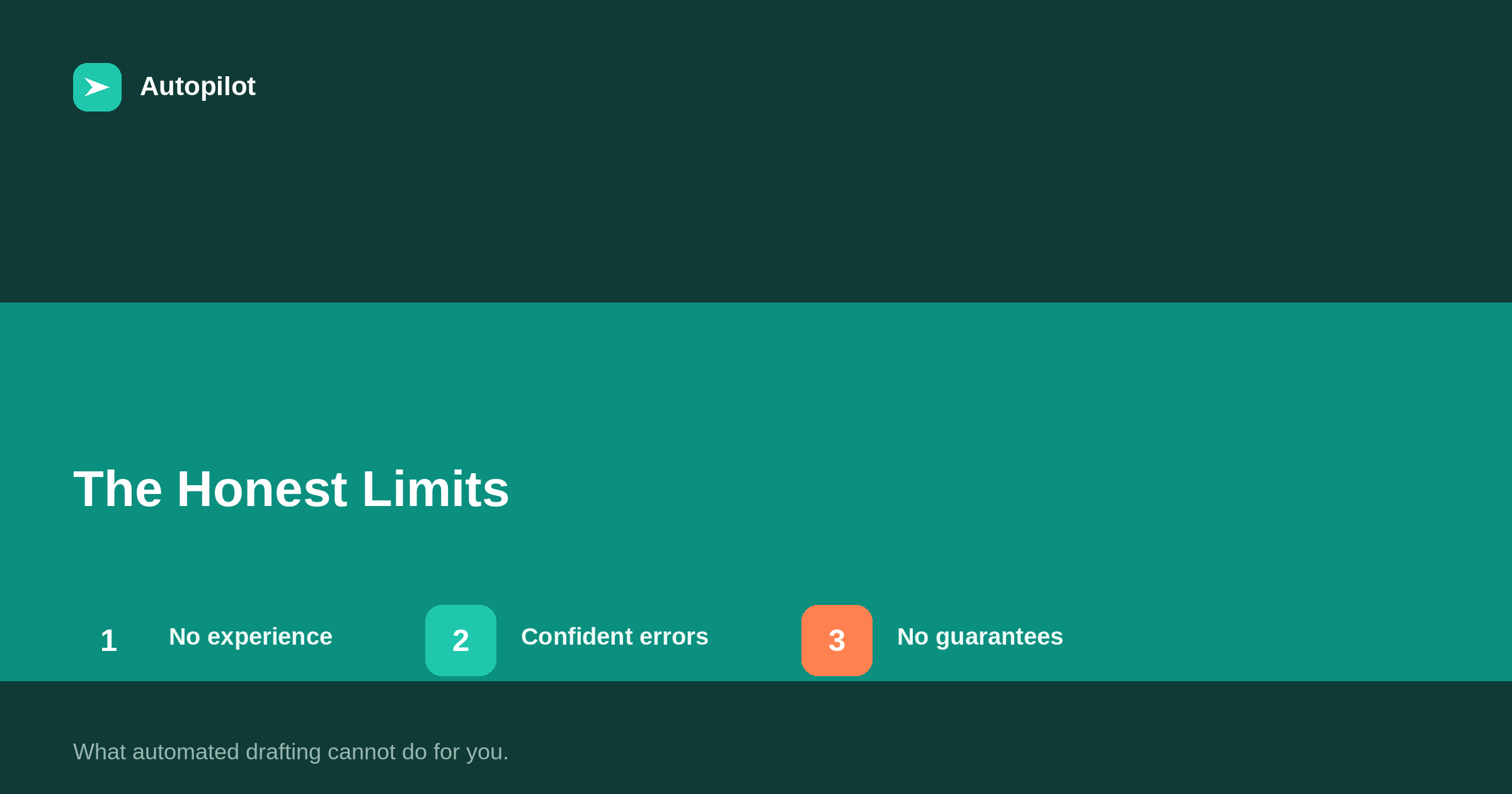
Short answer: automated drafting is fast and fluent, and it has real limits. It has no first-hand experience, so articles contain none unless someone adds it. It can state wrong facts confidently. It tends towards the common view, so articles resemble each other and what is already published. It cannot be accountable; a person or organisation must be. It does not know your business unless told. And it cannot guarantee traffic, rankings or customers. Review, additions and clear instructions address most limits; none remove them entirely.
A business that sells blog automation has an obvious interest in describing it favourably. That is exactly why it is worth being plain about what automated drafting cannot do.
Knowing the limits is what makes automation useful. Every limit below has a practical response, and most of the advice on this blog exists because of one of them.
No first-hand experience
A drafting tool has not run your business, served your customers, or made your mistakes. Its articles contain research and general knowledge, not experience.
The response is adding experience during review: your numbers, customer situations, screenshots, views. adding something original covers how. Without it, articles are competent summaries.
Confident errors
Automated drafts are fluent, and fluent text sounds right whether or not it is. Wrong prices, outdated features, invented statistics and misremembered rules appear in the same confident tone as correct statements.
The response is checking every verifiable claim — fact-checking before you publish. This is the one review step that should never be skipped.
Sameness
Drafting tools tend towards the most common way of saying things. Articles can resemble each other and resemble what is already published on the subject.
The responses are a distinct voice guide, a never list of phrases, original material, and a clear point of view where appropriate — writing down your brand voice.
No accountability
A tool cannot stand behind an article. If it is wrong, a person or organisation is responsible.
The response is a real byline and a review process that makes someone responsible for each article — bylines and author pages.
No knowledge of your business
Unless told, a tool does not know what you sell, what you charge, what you never claim, or who your customers are.
The response is standing instructions: reader, subjects, offer, forbidden claims, voice. writing a brief an AI can use covers them.
No guaranteed results
No tool can guarantee rankings, traffic, citations in AI answers or customers. Those depend on competition, search changes, your market and your offer, as well as on the content.
Be sceptical of any provider promising them, including in this category. What automation reliably changes is the cost and consistency of publishing.
Limits and responses
Put together, the limits and their responses look like this.
| Limit | Response |
|---|---|
| No experience | Add your own material in review |
| Confident errors | Check every verifiable claim |
| Sameness | Voice guide, never list, original material |
| No accountability | Real byline, named reviewer |
| No business knowledge | Standing instructions |
| No guaranteed results | Measure outcomes, adjust honestly |
None of the responses is complicated. All of them require someone in the business to take part.
What search guidance says
Published guidance judges content by whether it is helpful and reliable, not by how it was produced. Automation used mainly to manipulate rankings is spam; automation used to produce useful pages is not.
The limits above are exactly the ways automated content can fail to be helpful, which is why addressing them matters — what search engines actually say about AI content.
Limits that change over time
Drafting tools improve, and some limits narrow. Factual accuracy, handling of long documents and following detailed instructions have all improved over time. Others are structural: a tool will never have your experience, and it cannot be accountable for your business.
Revisit your process periodically. Review steps that were essential a year ago may need less time now; the structural limits will still need a person.
What automation is genuinely good at
For balance, it is worth stating the strengths plainly too. Automated drafting is fast, consistent in structure, tireless, able to work in many languages, and good at producing a clear first version of an explanatory article from a good brief.
Combined with automated images, publishing and distribution, it removes most of the mechanical work of running a blog. That leaves people free for the work that needs them — which, as this article argues, is the work that makes a blog worth reading.
Questions to ask any provider
When evaluating any automation tool, ask how it handles facts it cannot verify, how you give it instructions, whether you can review before publishing, and what it claims about results. Honest answers acknowledge the limits above. Choosing an AI blog creator lists more questions.
A realistic picture
A realistic picture of automated blogging is neither the hype of effortless growth nor the dismissal of it as spam. It is a way to publish consistently, at a lower cost, with people spending their time on direction, review and the material only they have.
Businesses that approach it that way tend to keep going long enough for results to arrive. Those expecting effortless growth tend to stop within months, which is usually just before anything would have happened.
The role of the reviewer
Most of the limits come back to one role: the reviewer who checks facts, adds experience and takes responsibility. A blog with a good reviewer and automated drafting is usually stronger than one with no review and hand-written drafts, because the reviewer is where judgement enters.
Why be honest about this
Businesses that understand these limits get more from automation: they review the right things, add the right material, and set realistic expectations. Businesses that do not tend to publish a lot, discover the problems later, and conclude that automation does not work.
It does work, for the parts it is good at, with people doing the parts it is not.
Related reading
If this was useful, these cover the questions that usually come next.
- When not to automate — the practical consequence
- Editing a draft — how review addresses the limits
- What search engines actually say about AI content — the guidance
The bottom line
Automated drafting has no experience, can be confidently wrong, tends towards sameness, cannot be accountable, does not know your business unless told, and cannot guarantee results. Add experience, check facts, use a distinct voice, put a real name behind each article, write clear instructions, and measure outcomes honestly.
GYIK
What are the limits of AI blog writing?
No first-hand experience, confident errors, a tendency towards sameness, no accountability, no knowledge of your business unless told, and no guaranteed results.
Can AI-written articles contain mistakes?
Yes, stated as confidently as correct information. Every verifiable claim should be checked.
Why do AI articles sound similar?
Drafting tools tend towards common phrasing. A voice guide, a never list and original material counter it.
Can AI blogging guarantee rankings?
No. Rankings depend on competition, search changes and much else. Be sceptical of guarantees.
Who is responsible for AI-drafted articles?
The person or organisation that publishes them. A real byline and review process make that clear.
Is AI blogging still worth it?
For the explanatory middle of a blog, with review and additions, it saves substantial time. People still need to do the parts it cannot.