ENEnglish
 LTLietuviškai
 DEDeutsch
 FRFrançais
 RUРусский
 ESEspañol
 PLPolski
 ITItaliano
 UKУкраїнська
 CSČeština
 PTPortuguês
 JA日本語
JA日本語 LVLatviešu valoda
 ETEesti
 HUMagyar
 IDBahasa Indonesia
 TRTürkçe
 HIहिन्दी
 ELΕλληνικά
 ARالعربية
 THไทย
THไทย VITiếng Việt
 RORomână
 MSBahasa Melayu
 BNবাংলা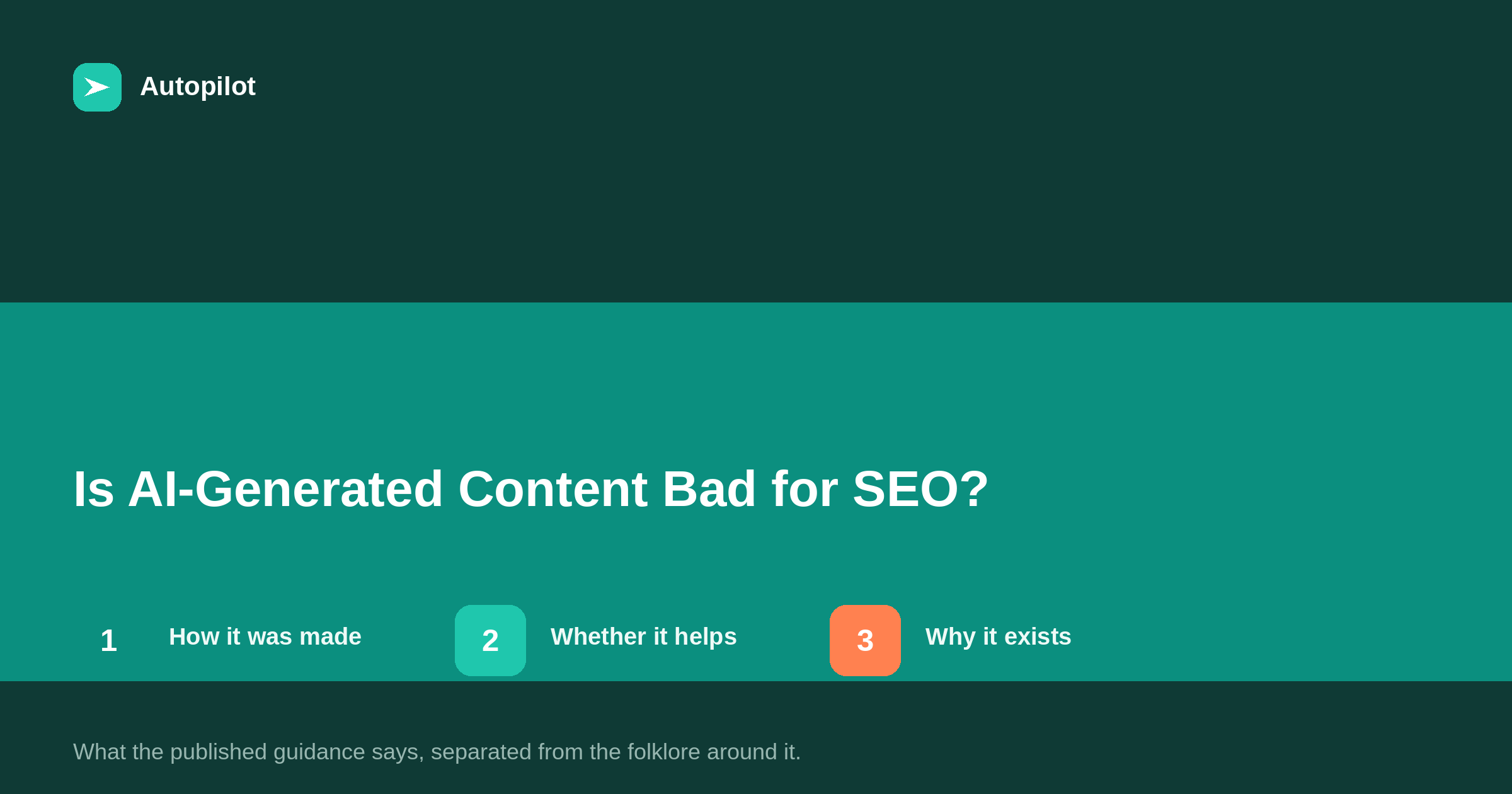
Short answer: no, not because it was generated. Google’s published position is that it rewards high-quality content however it is produced, and that what breaks the rules is using automation to manipulate rankings rather than to help readers. The practical difference is purpose: an article written to answer a question is fine, and a page generated to occupy a keyword is spam whoever or whatever typed it. That distinction, not the technology, is what the guidelines are built on.
This question has an unusually clear answer, which gets muddied because so much advice about it was written before the guidance was published and never updated.
So: what the documentation actually says, what it does not say, and what that means for anyone publishing automated articles on purpose.
What the guidance says
Google’s stated position is that it rewards high-quality content regardless of how it is produced. Automation is not treated as a category of violation; using it to generate content primarily to manipulate search rankings is, and that has been in the spam policies for a long time under the heading of scaled content abuse.
The distinction is purpose, not process. The same tool can produce a genuinely useful guide and a page that exists only to hold a keyword, and the guidelines separate those two cases rather than separating human from machine.
Alongside that sits the helpful content guidance, which asks whether a page was made for people or for search engines, and the quality rater concept usually written as E-E-A-T — experience, expertise, authoritativeness, trustworthiness. It is worth being precise here: E-E-A-T is a set of ideas raters use when assessing quality, not a score applied to a page. Treating it as a checkbox misreads it.
What actually gets penalised
The behaviours that cause problems are specific and recognisable, and none of them require automation — automation just makes them faster.
- Pages built around a keyword rather than a question. The classic scaled abuse: hundreds of near-identical pages, one per variation.
- Content with no added value. A restatement of what is already on the first page, adding nothing.
- Fabricated specifics. Invented statistics, studies or quotes. This is a trust problem as much as a ranking one.
- Site reputation abuse. Publishing unrelated third-party content on an established domain to borrow its authority.
- Nobody responsible. No author, no contact, no sign anyone stands behind the page.
Read that list and the pattern is plain: every item is about intent or care. A blog that publishes automated articles about questions its customers ask, with someone accountable for them, matches none of it.
The honest risks that remain
Saying "it is allowed" is not the same as saying "it is safe to switch off your brain". Three real risks survive.
Factual drift. Generated text states things confidently, including things that were true two years ago. Anything specific — a limit, a price, a rule — needs checking.
Sameness. If everyone generates an article on the same topic from the same public knowledge, the results converge, and a page indistinguishable from twenty others has no reason to be chosen.
Self-competition. Volume without planning produces overlapping pages, which is the most common self-inflicted ranking problem there is.
All three are manageable, and all three were possible before automation existed.
How to publish automated content safely
| Practice | Why it matters |
|---|---|
| Every article answers a real question | The line the spam policies actually draw |
| Someone is accountable for the page | Trust signals require a responsible party |
| Specifics are checked or removed | Fabricated detail is the biggest single risk |
| Add something not already on page one | Your data, your examples, your position |
| Plan topics so pages do not overlap | Self-competition is self-inflicted |
| Update what ages | Stale specifics are wrong specifics |
None of these are about hiding that a tool was involved. They are the same practices that made a hand-written blog good, applied at a speed that makes them easier to forget.
Why the argument keeps going anyway
If the guidance is this clear, why does the debate continue? Three reasons worth naming, because each produces different bad advice.
A lot of AI content genuinely is bad. People see the output of the keyword-per-page approach, conclude the technology is the problem, and generalise from the worst examples.
Older advice never expired. Articles written before the current guidance was published still rank well and still say automation is against the rules. They were describing a different policy era.
Detection tools sell certainty. Products that claim to identify AI writing have an interest in the question mattering, and their accuracy is far lower than their marketing implies. False positives on human writing are common.
None of that changes what the guidelines say. It does explain why you will keep meeting people who are confident they say something else.
Should you disclose it?
There is no search requirement to label content as AI-assisted, and adding a label does not improve or harm rankings. It is an editorial choice, and a reasonable one: a short note explaining how your content is produced and who reviews it costs nothing and answers a question some readers will have anyway.
What matters far more is that the article is right and that someone is responsible for it. Autopilot is built around that division — it writes and publishes, you decide the topics and the claims — and the first three articles are free precisely so you can judge the output before committing. Plans are on the pricing page, and automating a blog without losing quality covers the review step in more detail.
The bottom line
The rule that survives every update is simpler than the debate around it: publish pages that exist to help someone, make sure the specifics are right, and be findable as the party responsible for them. Automation changes how fast you can do that, and it changes how fast you can do the opposite. Which of the two you are doing is the whole question, and it was the whole question before any of this was automated.
GYIK
Does Google penalise AI-generated content?
Not for being AI-generated. Its published position is that quality matters regardless of how content is produced; what violates the spam policies is generating content primarily to manipulate rankings.
Can Google detect AI writing?
Detection is unreliable and, by Google’s own framing, beside the point. The policies are about whether a page is useful and why it exists, not about which tool produced the sentences.
Do I need a human author byline?
Not as a rule, but somebody should be accountable for the page. An organisation as author with a real contact route satisfies that; an anonymous site with no owner does not.
Is E-E-A-T a ranking factor?
No. It is a framework quality raters use when assessing search results, which informs how systems are evaluated. Treating it as a direct score leads to cargo-cult changes that do nothing.
What is scaled content abuse?
Producing many pages primarily to game search rankings rather than to help people. The scale is part of the definition, but the disqualifying element is the purpose.
Should I delete AI articles I already published?
Only the ones that answer nothing. Judge each page on whether it is useful and accurate; if it is, its origin is not the problem, and if it is not, its origin was never the problem either.