ENEnglish
 LTLietuviškai
 DEDeutsch
 FRFrançais
 RUРусский
 ESEspañol
 PLPolski
 ITItaliano
 UKУкраїнська
 CSČeština
 PTPortuguês
 JA日本語
JA日本語 LVLatviešu valoda
 ETEesti
 HUMagyar
 IDBahasa Indonesia
 TRTürkçe
 HIहिन्दी
 ELΕλληνικά
 ARالعربية
 THไทย
THไทย VITiếng Việt
 RORomână
 MSBahasa Melayu
 BNবাংলা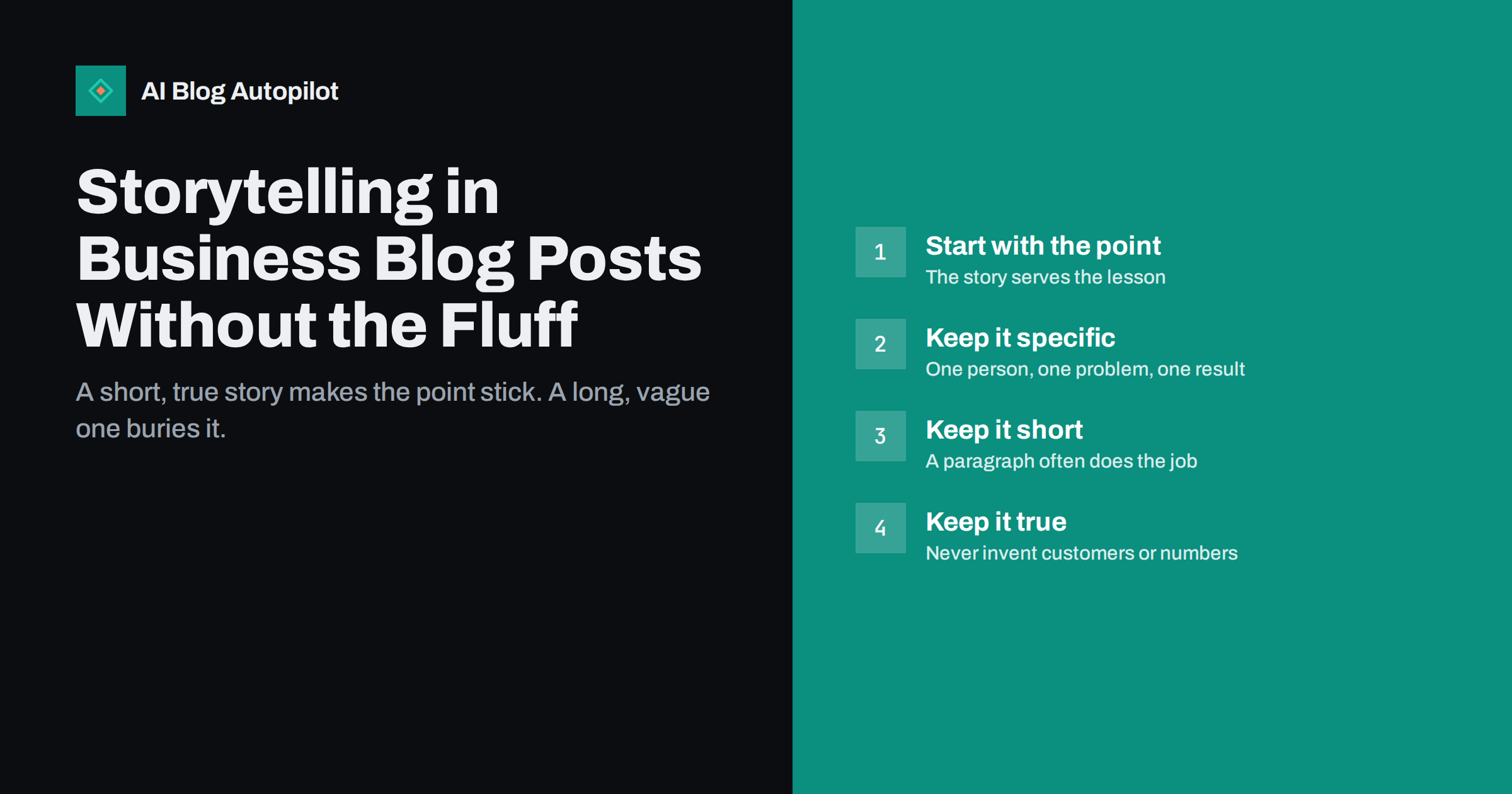
Short answer: storytelling in a business blog post means using a short, specific, true example to show a point instead of only stating it. A good story has one person or situation, one problem, what was done and what changed, and it sits right next to the advice it illustrates. It should usually be a few sentences to a paragraph, never invented, and never a long warm-up before the reader gets the answer they came for.
Most business articles are lists of advice: do this, avoid that, check the other. The advice may be right, but it is easy to forget because nothing anchors it. A brief story gives the reader a picture to remember: the bakery that lost its weekend orders because its contact form broke, the consultant who doubled enquiries by rewriting one page. This guide explains how to use stories in business blog posts in a way that helps readers and search, without padding the article.
What storytelling means in a business article
Storytelling in a blog post is not fiction and it is not a dramatic opening. It is the habit of showing advice in action. Instead of writing “check your forms regularly”, you show what happens when nobody checks them. Instead of “answer the question early”, you describe a reader who left because the answer was buried.
In practice, most useful stories in business writing fall into a few types:
- A customer situation: a real problem a client had and how it was solved, with permission or anonymised.
- Your own experience: a mistake you made, a test you ran or a decision you had to take.
- A before-and-after: the same page, process or plan before and after a change.
- A typical scenario: a clearly labelled composite example, such as “imagine a shop that sells bicycles”, used to walk through a method.
All four are stories in the sense that they have a situation, a problem and an outcome. The difference from a plain example is that something changes, and the reader sees why.
Why stories help readers and search
Stories help the reader first. People remember a concrete case better than an abstract rule, and they can judge whether advice applies to them when they see the situation it came from. A story also builds trust: it shows that the writer has met the problem in real life rather than collecting tips from other articles.
For search, the benefit is indirect but real. Search engines say they reward content that shows first-hand experience, and specific stories are one of the clearest ways to show it. A paragraph that describes what happened when you tried something carries information that a generic article does not have, which makes the page more original and harder to replace with any other result.
Stories can also help with AI answers in a narrow way: a short, self-contained case with clear numbers or a clear outcome is easy to quote. But do not write stories for machines. Write them because they make the advice clearer, and the other benefits follow.
Where a story belongs in a post
The most common mistake is putting the story first. Many writers learned to open with an anecdote, but a reader who searched for an answer does not want three paragraphs about a client meeting before the answer appears. In a business blog post, the answer comes first and the story supports it.
Good places for a story:
- Right after the main advice in a section, to show what it looks like in practice.
- Next to a warning, to show what goes wrong when the advice is ignored.
- In a short “example” sub-section inside a how-to article, walking through the steps with one case.
- Near the end, as a brief case that ties the article together before the summary.
A short opening example can work when it is one or two sentences and leads straight into the answer. “Last year a client asked why their blog had traffic but no enquiries. The answer was in how their articles ended.” That is a story, but it costs the reader five seconds, not a minute.
The shape of a short business story
You do not need a narrative framework with acts and arcs. For a blog post, four parts are enough:
- Situation: who, and what they were trying to do. “A small accounting firm publishing two articles a month.”
- Problem: what was not working, stated concretely. “Most visits came from one old post, and nobody from it contacted them.”
- Action: what was changed, ideally linked to the advice in the article. “They added a short, specific call to action matching that post’s topic.”
- Result: what changed, honestly stated. “Enquiries from that page started arriving within a few weeks.”
Each part can be one sentence. The whole story can fit into a paragraph of sixty to a hundred words. Longer stories are fine for case studies, but inside an advice article they should stay short so the advice remains the main thing.
Specific details do most of the work. “A bakery in a small town” is more vivid than “a local business”. “Weekend orders dropped” is more vivid than “they lost revenue”. Pick one or two details that make the situation real and leave out the rest.
Keeping stories true
A business blog loses trust quickly when stories sound invented. Readers notice suspiciously perfect outcomes, round numbers and customers who speak like marketing copy. Rules that keep stories honest:
- Never invent customers, quotes or results. If you need an illustration and have no real case, use a clearly labelled scenario: “Imagine a shop that…”
- Ask permission before naming a client, or remove identifying details.
- Report results modestly. “Enquiries rose noticeably” is better than an exact percentage you cannot support.
- Include what did not work. A story where the first attempt failed is more believable and often more useful.
- Do not stretch one case into a rule. One client’s result shows what can happen, not what will happen to everyone.
This matters even more when part of your content is produced with automation. Software can write a clearly labelled scenario, but real customer stories and your own experience have to come from you. Keep a simple list of real cases, short notes on what happened, and add them to articles during editing.
Common mistakes with stories in blog posts
Stories go wrong in predictable ways:
- The long warm-up: several paragraphs of scene-setting before any useful information. Move the answer up and cut the story to its core.
- The story with no point: an anecdote that is interesting but does not illustrate the advice next to it. If you cannot say which point it supports, remove it.
- The sales pitch in disguise: every story ends with “and then they bought our product”. Readers stop trusting the blog. Most stories should be about the method, not about you.
- Too many stories: a story in every paragraph slows the reader down. One to three per article is usually enough.
- Vague details: “a client had a problem with their website” teaches nothing. Name the kind of business, the problem and the change.
- Emotional exaggeration: words like “devastated” or “life-changing” in a business article sound false. Plain description is more convincing.
Finding stories when you think you have none
Most businesses have more stories than they realise. They are just not written down. Good sources:
- Customer questions: every repeated question has a situation behind it. Write down what the customer was trying to do.
- Support and sales notes: problems solved, objections answered, misunderstandings cleared up.
- Your own mistakes: a test that failed, a tool that did not fit, a decision you would make differently.
- Team experience: ask colleagues for one example of something that went wrong and how it was fixed.
- Before-and-after material: old versions of pages, old processes, old plans.
A shared document where anyone in the team can add a two-line note is enough. When you edit an article, look through the list and pick the case that best matches the main point.
Stories in different article types
How-to articles benefit from one worked example that follows the steps. Comparison articles benefit from short cases showing which option suited which situation. Opinion pieces need at least one real experience behind the opinion. Glossary and definition pages usually need no story at all; a clear example sentence is enough. Match the amount of storytelling to what the reader came for.
Formatting helps too. A story can sit in a normal paragraph, but a short label such as “Example:” or “In practice:” tells skimming readers that a concrete case follows, so they can read it or skip it. Keep the story visually close to the advice it supports, and avoid boxes or quotes that make it look like an advert.
How AI Blog Autopilot helps
AI Blog Autopilot writes complete articles with FAQ, tags and SEO meta, and the writer is instructed never to make up statistics, quotes or sources. Your topics, audience and tone guide each article. If you prefer to add your own customer stories before publishing, you can switch on approval and edit drafts; otherwise AUTO mode publishes on its own. See the pricing page for plans.
Related reading
- How to Put Something Original in an Article You Automated
- How to Write a Case Study That Persuades Without Exaggerating
- Writing Introductions That Don’t Waste the Reader’s Time
- E-E-A-T on a Blog That Publishes Automatically
The bottom line
Stories make business advice memorable and believable when they are short, specific and true. Put the answer first and the story right next to the point it supports. Use a simple shape of situation, problem, action and result, keep it to a paragraph, label invented scenarios clearly and never invent customers or numbers. Keep a running list of real cases so every article has something only you could write.
GYIK
Should a business blog post start with a story?
Usually not with a long one. Readers who searched for an answer want it first. A one or two sentence example that leads straight into the answer can work, but longer stories belong after the main advice.
How long should a story in a blog post be?
Inside an advice article, a few sentences to one paragraph is usually enough. Longer stories suit dedicated case studies, where the story is the main content.
Can I use made-up examples?
You can use clearly labelled scenarios, such as “imagine a shop that sells bicycles”, to explain a method. Never present invented customers, quotes or results as real.
Do stories help SEO?
Indirectly. Specific stories show first-hand experience and make a page more original, which search engines say they value. The main benefit is that readers understand and trust the advice more.
How many stories should one article have?
One to three is usually enough for a standard blog post. Too many slow the reader down and push the practical advice out of view.