ENEnglish
 LTLietuviškai
 DEDeutsch
 FRFrançais
 RUРусский
 ESEspañol
 PLPolski
 ITItaliano
 UKУкраїнська
 CSČeština
 PTPortuguês
 JA日本語
 LVLatviešu valoda
 ETEesti
 HUMagyar
 IDBahasa Indonesia
 TRTürkçe
 HIहिन्दी
 ELΕλληνικά
 ARالعربية
 THไทย
 VITiếng Việt
 RORomână
 MSBahasa Melayu
 BNবাংলা
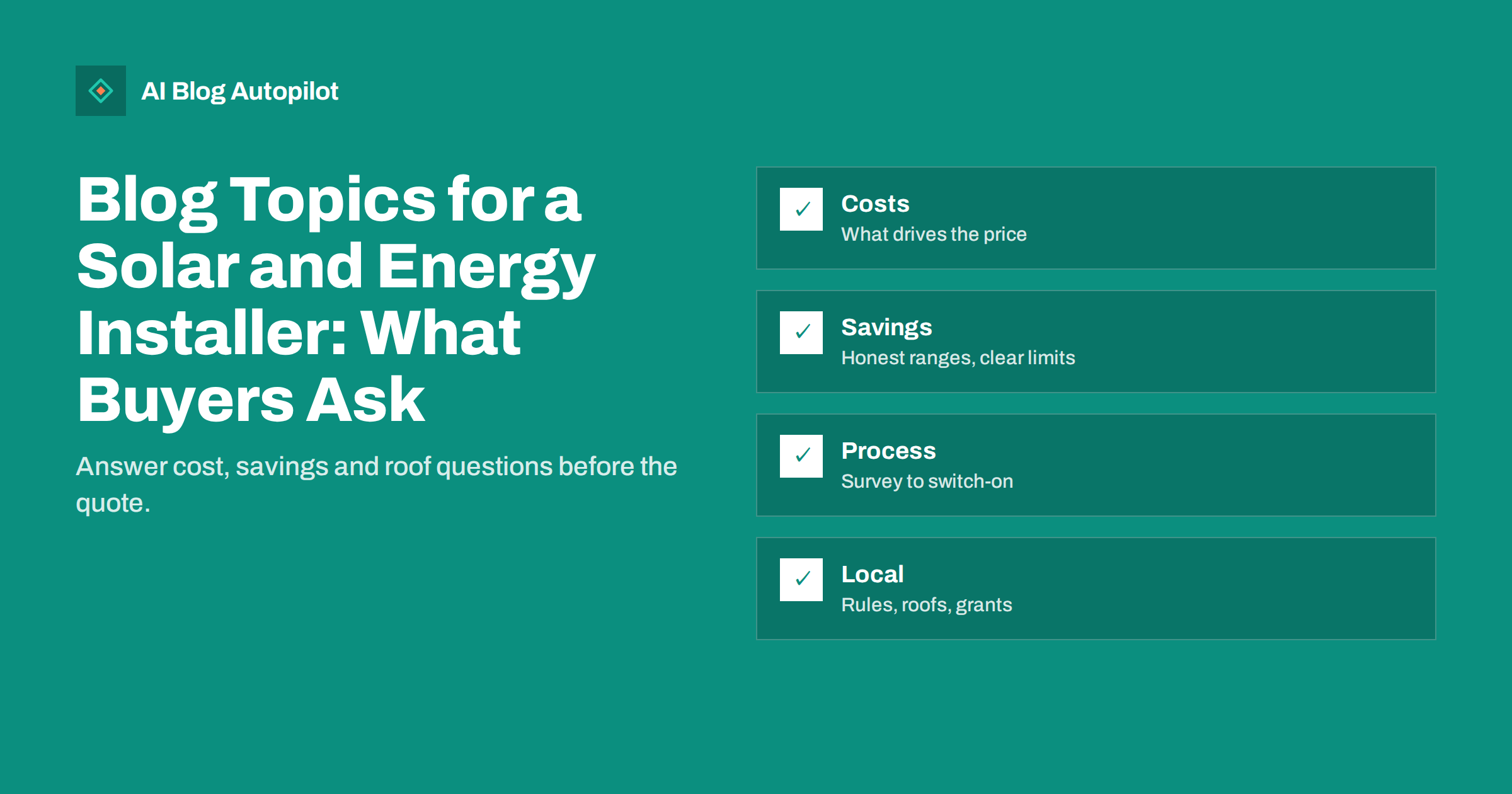
Short answer: a solar or energy installer should blog about what buyers ask before requesting a quote: how much a system costs and why, how savings are estimated, whether a roof is suitable, what the installation process looks like, how grants and rules work locally and what maintenance is needed. Use honest ranges, state assumptions, date every figure and avoid promises about returns. Link each guide to a survey or quote request.
A solar installation or a heat pump is a large purchase, and buyers usually take months to decide. They read, compare and ask friends before they call anyone. Installers who explain things well during that period are the ones who get the call, and those who hide behind vague promises are skipped.
This guide lists topic groups that suit an installer of solar panels, batteries, heat pumps or other energy equipment. It shows how to present costs and savings fairly, how to use local detail and how to handle regulated claims. Rules for incentives and advertising differ by country and change often, so check current local requirements before you publish.
Cost and price guides
Cost is the first question. A good price guide explains what is in a typical system: panels, inverter, mounting, cabling, installation, certification and any extras such as batteries or monitoring. It then shows what changes the price: size, roof type, access, panel quality, scaffolding, grid connection and local requirements.
Give ranges if you can, with the date and the assumptions, such as “for an average home with a south-facing roof”. Make it clear that prices change and that a survey is needed for a firm quote. If you cannot publish numbers, show how a quote is built so that buyers know what to expect.
Do not hide the costs that surprise people, such as scaffolding, upgrades to the electrical panel or the cost of replacing an inverter later. Buyers who find these themselves feel misled, and those who read about them on your site are more likely to trust you. The article on writing honest articles about what things cost shows a clear structure.
Savings, payback and honest numbers
Buyers want to know what they will save. This is where care is most needed. Savings depend on the system, the roof, shading, local sunshine, how much energy the household uses, when it uses it, energy prices and rules for selling surplus energy. Prices and rules change, so any estimate is only valid for a set of assumptions.
Explain the method rather than promising an outcome. Show a worked example with clear inputs and outputs, say which numbers are estimates and show how a change in one input alters the result. Avoid phrases such as “pays for itself in x years” unless the assumptions are stated next to it. Regulators in many places act against misleading savings claims.
Cover the limits too. A battery does not suit every home, and a system that is too big may not pay off. If you tell readers when a system is not a good idea, they will believe you when you say it is. The guide to evidence for marketing claims explains how to support a statement with proof.
Add short guides for special cases that people search for: flat roofs, slate or tile roofs, barns and outbuildings, small apartments with a shared roof and properties in conservation areas. Each page can explain what is usually possible, which approvals may be needed and what alternatives exist. Even if the answer is that a system is not practical, the honest explanation builds trust and sends a clear message about your standards.
Roofs, sites and suitability
Many people wonder if their property is suitable. Write guides on roof orientation, tilt, shade, roof materials, age and condition, flat roofs, listed buildings and ground-mounted systems. Explain what a surveyor checks and which photos or measurements a homeowner can send to speed up a quote.
Include a short suitability checklist that readers can complete in minutes and that leads to a request for a survey. Keep the questions simple: roof direction, rough area, shade from trees or buildings, type of roof covering and whether the property is rented or owned.
Explain limits without discouraging. Some roofs need repair first, some buildings have restrictions and some sites have grid limits. A page on these issues saves time for you and for the buyer, and it brings enquiries from people who are ready to proceed.
The installation process
People fear the unknown. A page that walks through the process from first contact to switch-on removes that fear: enquiry, survey, design, quote, contract, permissions, scheduling, installation, inspection, connection and handover. Give typical time frames, and say what the customer must do at each stage.
Describe what the day of installation is like: who arrives, how long it takes, whether the power is turned off, how the roof and garden are protected and how the site is cleaned. Photos from real jobs, with the owner’s permission and without revealing addresses, make this page convincing.
Explain after-sales care: warranties, monitoring, servicing, what to do if something fails and who to call. Describe warranties carefully and accurately, since they depend on the manufacturer and the contract. A clear aftercare page is a strong signal of reliability.
Grants, rules and local detail
Incentives and regulations are among the most searched topics, and among the most changeable. Write guides on the schemes that apply in your region, describing who is eligible, how to apply and what documents are needed. Put a date at the top, review often and remove or update any page that is out of date.
Link to official sources for the rules, and say clearly that readers should check the current conditions before they decide. If you help customers to apply, describe how, and be honest about what you cannot guarantee. Misleading claims about grants cause complaints and damage a company’s reputation quickly.
Local detail makes your content stand apart from large national sites. Write about local planning rules, typical house types, the sunshine and weather in your area, the local grid operator and examples of installations in nearby towns. The guide on blog strategy for a local business adds ideas for local relevance.
Write about the equipment that sits alongside the panels too. Questions about inverters, batteries, charging points, monitoring and smart tariffs are growing, and buyers like to see how these parts fit together. Give a simple diagram, define each part in a sentence and explain what the owner will notice day to day. Avoid brand claims that you cannot support, and say when a choice depends on the household’s habits.
Finally, keep the pages up to date. Equipment changes, prices move and rules are revised, so a guide that was correct two years ago may now mislead. Put a review date in your content plan for each important page and keep a short list of the facts that change most often, so that an update takes minutes and not hours.
Maintenance, performance and questions after the sale
Owners have many questions after installation: how to read the monitoring app, what to do in winter, how to clean panels, why the output has dropped, what happens in a power cut and how a battery behaves. Write short, practical guides for each. They serve existing customers and attract people who are comparing providers and want to know what ownership is like.
Explain normal performance variation. Output changes with season, weather and time of day, and a lower result in winter is expected. A guide that shows what normal looks like prevents worry and unnecessary calls, and shows that you are open.
Add safety guidance where relevant, and point readers to a qualified professional for anything that involves electricity or working at height. Do not encourage readers to do work that needs training. The article on support articles that actually reduce tickets shows how to write help pages that work.
Think about the moment when a visitor is ready to ask for help. A short page that lists what you need for a first conversation, such as a recent energy bill, roof photos and the address, helps them prepare and speeds up your reply. Add a clear promise of what happens next, without making commitments that you cannot keep, such as a call within a stated number of working days if that is true.
Reviews matter in a market where the sums are large. Ask satisfied customers to leave an honest review on the platforms that buyers use, and show a few on your site with permission. Respond politely to negative ones and explain how you put things right. A company that handles problems well often earns more trust than one with a perfect record that looks too good to be true.
Trust, proof and enquiries
Show the credentials that matter in your market: certifications, memberships, insurance, manufacturer approvals and years of experience. Only publish those you hold and can prove, and keep them up to date. Add profiles of the team who will do the work, since buyers like to know who will be at their home.
Case studies help, with the owner’s permission. Describe the property type, the system, the cost range, the time and what the owner says about it. Avoid unverifiable claims, and keep any figures consistent with your own price and savings pages. See how to write a case study that persuades without exaggerating.
Make the next step easy. Each article should offer a short form for a survey or a call, say how quickly you reply and what happens next. Track which guides lead to enquiries and improve those first.
How AI Blog Autopilot helps
AI Blog Autopilot can write and publish articles for your chosen topics, with FAQ sections, tags and SEO meta, and share them to your social networks. For a regulated topic such as savings and incentives, use the approval option and check every figure and rule before an article goes live. See the pricing page for plans and monthly credits.
Related reading
- Blog Strategy for a Local Business
- Writing Honest Articles About What Things Cost
- How to Write a Case Study That Persuades Without Exaggerating
The bottom line
Answer cost, savings, roof and process questions with honest ranges, dated figures and local detail. Make the next step a simple request for a survey.
GYIK
Should I publish system prices on my website?
If you can, publish dated ranges with assumptions. If not, explain how a quote is built and what affects it.
How do I write about savings without misleading readers?
Show a worked example with stated assumptions and say that results vary. Avoid fixed payback promises.
How often should grant pages be updated?
Check them at least monthly and put a date on the page. Remove or update anything that has changed.
Can I show photos of customers’ homes?
Only with the owner’s permission and without details such as the address or security features.
What is a good call to action?
A short survey request form that explains what happens next and how quickly you will reply.