ENEnglish
 LTLietuviškai
 DEDeutsch
 FRFrançais
 RUРусский
 ESEspañol
 PLPolski
 ITItaliano
 UKУкраїнська
 CSČeština
 PTPortuguês
 JA日本語
 LVLatviešu valoda
 ETEesti
 HUMagyar
 IDBahasa Indonesia
 TRTürkçe
 HIहिन्दी
 ELΕλληνικά
 ARالعربية
 THไทย
 VITiếng Việt
 RORomână
 MSBahasa Melayu
 BNবাংলা
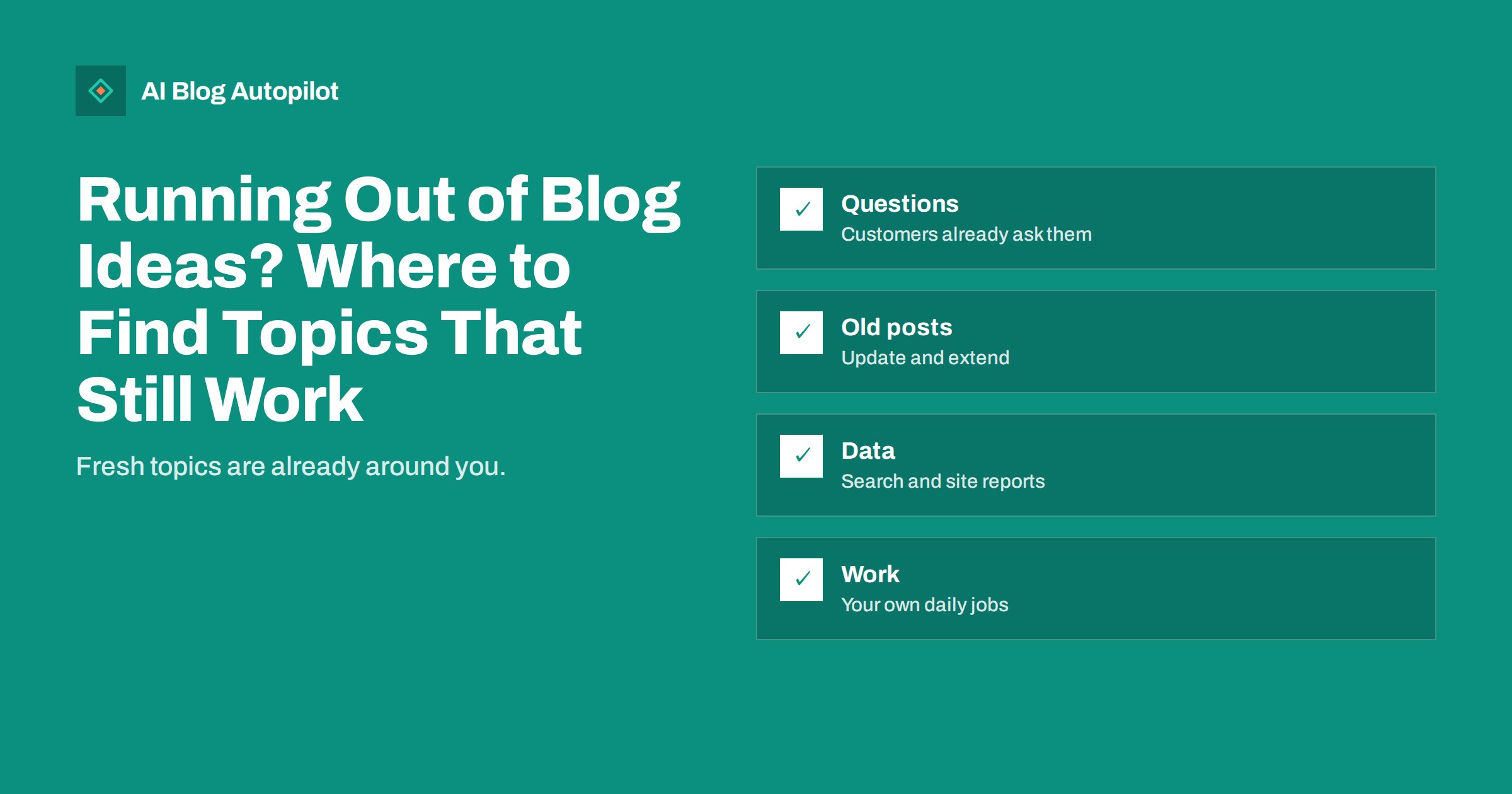
Short answer: when ideas run out, stop brainstorming and start collecting. The best topics come from questions customers already ask, gaps in your existing posts, search and site data, your yearly calendar and the work you do every day. Keep one running list, rate each idea quickly and write the ones that match a real reader need.
Nearly every blogger reaches a point where the obvious topics are written and the next one is hard to find. It feels like a creative problem, but it is usually a process problem. Ideas are not scarce; they are scattered across emails, calls, reports and notebooks, and nobody gathers them in one place.
This guide shows where to look, how to capture ideas before they disappear and how to choose among them. It suits small business blogs, agencies and solo writers who need to publish steadily for months or years, not just for the first few weeks.
Do not wait for questions to arrive. Create places for them: a short line under each article inviting readers to ask what we missed, a question box on the contact page or a regular post on social networks asking what people would like explained. Replies give you topics in the language of your audience, and people who ask tend to read what you write in response.
Start with the questions people ask you
Your customers, clients and colleagues ask questions every day, and each repeated question is a topic with proven demand. Check your inbox, the contact form, live chat, social messages and call notes. Note the exact words people use, since those are often the words they type into a search engine.
Ask the people who talk to customers for their top five questions. A sales colleague hears objections, a support colleague hears problems and a receptionist hears the basics. Ten minutes with each can produce a dozen article titles. Keep the original wording in your list, as it tells you what the reader wants.
Answer one question per article and answer it fully. A page that begins with a clear, direct answer works for readers, search engines and AI assistants alike. The guide to turning customer questions into topics goes through the process in detail.
Look at the structure of your archive as well. If you have many articles on one subtopic and none on its neighbour, you have a gap. Draw a quick map of your main subjects with the existing posts listed under each. Empty branches show where new articles belong, and the map also reveals where several weak posts could be merged into one strong one.
Do not forget to link new posts into the old ones. A new article that connects to three or four existing pages helps readers and search engines see the whole collection and gives older pages a small lift in visits.
Look at what you already published
Your archive is a rich source. Go through your best-performing posts and ask what readers might want next. A guide to choosing something may need a follow-up on using it, maintaining it or fixing common problems. A comparison may need a deeper article on one option. Each follow-up links naturally to the original and builds a cluster of related pages.
Check the comments, replies and questions beneath your posts. Readers often tell you what is missing: a step you skipped, a term you did not explain, a situation you did not cover. Each of those is a topic, and answering it shows you listen.
Look also for old posts that need updating. A refreshed article can bring more traffic than a new one, and the process often uncovers new sections or whole new articles. The guide to refreshing old blog posts explains when updating beats writing from scratch.
Use search and site data
Search data shows what people already look for in connection with your site. In Search Console, look at queries that bring impressions but few clicks, and at questions that appear in your query list. These often reveal topics where you are close to ranking but lack a page that addresses the question directly.
Use the suggestions that search engines show as you type, and the related questions shown in results. They display the real language of searchers. Collect a handful for each main topic and group them by intent, so that you can see which are about learning, comparing or buying. The guide to search intent helps with the grouping.
Check your site’s own search box if you have one. The terms visitors type there are requests that your content does not answer well. A short report each month can feed your list without extra research.
Add the events that your customers care about even when you do not sell anything related. A florist cares about school proms, a tax adviser cares about the end of the financial year and a travel agent cares about school holidays. Check public calendars, trade association sites and local council pages, and add dates to your list once a quarter.
Follow your calendar
Many topics follow the year: seasons, holidays, school terms, tax deadlines, sporting events, trade shows and local festivals. Mark the dates relevant to your readers and work backwards, so that articles go live a few weeks before interest rises. A calendar of recurring events produces a steady supply of timely topics with little effort.
Look at your own business calendar too: product launches, new staff, anniversaries, new services and changes in prices or opening hours. Each can justify an article, as long as it helps the reader and does not just announce your news.
Update recurring articles each year at the same address, instead of publishing a new one every time. That saves effort and builds authority on one page. The guide to seasonal content planning covers the method.
Try the habit of writing one short post each week from a real situation: a question answered, a job completed or a mistake avoided. Keep the post to a few hundred words and a clear lesson. These small posts rarely need research and, over a year, add up to a large body of honest, specific material that no competitor can copy.
Also save your best explanations. When you write a helpful email answer to a client, ask whether it could help others. Remove personal details, add a clear title and a short introduction, and you have an article that is already tested on a real reader.
Turn your own work into material
You know things that your readers do not, and you use them every day. Write about how you solve a typical problem, the mistakes you see and the tools you use. A step-by-step account of a real job, with permission and without identifying details, often makes a stronger article than a generic guide.
Keep a notebook or a note on your phone for ideas as they occur. A frustrating job, a surprising result or a question from a client is worth a line. At the end of the week, move the lines into your main list. Without capture, good ideas disappear within an hour.
Interview people. A colleague, a supplier or a customer can offer a view you lack, and a short conversation often provides most of an article. The guide to interviewing experts for your articles offers a simple method.
Look sideways at other fields
Look at what readers ask in neighbouring subjects. If you sell garden tools, readers may also ask about soil, weather or small-space planting. If you advise on tax, readers may ask about bookkeeping or pensions. Write about the edges of your subject, where your knowledge helps and where competitors are thin.
Study competitors without copying them. Look at the headings and questions on their best pages and note what they leave out. The gaps are your opportunity. The guide to competitor content analysis explains how to do this fairly.
Look at formats as well as topics. A subject you have covered as a guide might work as a checklist, a comparison, a glossary or a set of answers to common questions. A different format can reach a different reader and give you a new page from a familiar idea.
Set a minimum for the list, for example never fewer than twenty ideas waiting. When the number falls below it, schedule thirty minutes to refill it from the sources above. A small, regular top-up is far easier than a rescue session when the calendar is empty, and it keeps publishing steady through busy weeks.
Keep one list and score every idea
Keep all ideas in one place: a spreadsheet or a simple document. For each one, note the working title, the reader’s question, the source, a rough score for usefulness to readers and for fit with your business, and a status. A list of fifty scored ideas removes the fear of the blank page.
Score quickly and be willing to drop ideas. Ask three questions: would a real reader search for this, can we add something of our own, and does it connect to something we sell or do? Ideas that fail all three can go. Those that pass at least two are worth keeping.
Review the list monthly, and plan the next four to six weeks of articles from it. If you ever feel stuck, you will have a tested list in front of you, not an empty page. The guide to prioritising blog topics shows how to choose the order.
How AI Blog Autopilot helps
AI Blog Autopilot plans a month of articles from the topics, keywords, audience and tone you give it, so a clear list of topics is its starting point. Keep adding to your list from the sources above and update it in the product. See the pricing page for plans.
Related reading
The bottom line
Collect instead of brainstorming: gather questions, data, calendar dates and your own work in one scored list, and write what real readers need.
GYIK
Why do I keep running out of ideas?
Usually because ideas are scattered and never collected in one place, not because they are scarce.
What is the fastest source of topics?
Questions customers already ask by email, chat, phone and social messages.
How many ideas should I keep on the list?
Enough for several weeks, perhaps thirty to fifty, each with a note on the reader’s question and a score.
Is it better to update old posts or write new ones?
Both. Updating a post that already has traffic can pay off more than a new article, so review the archive regularly.
How can search data help?
Queries with many impressions and few clicks show topics where a more direct page could rank.