ENEnglish
 LTLietuviškai
 DEDeutsch
 FRFrançais
 RUРусский
 ESEspañol
 PLPolski
 ITItaliano
 UKУкраїнська
 CSČeština
 PTPortuguês
 JA日本語
 LVLatviešu valoda
 ETEesti
 HUMagyar
 IDBahasa Indonesia
 TRTürkçe
 HIहिन्दी
 ELΕλληνικά
 ARالعربية
 THไทย
 VITiếng Việt
 RORomână
 MSBahasa Melayu
 BNবাংলা
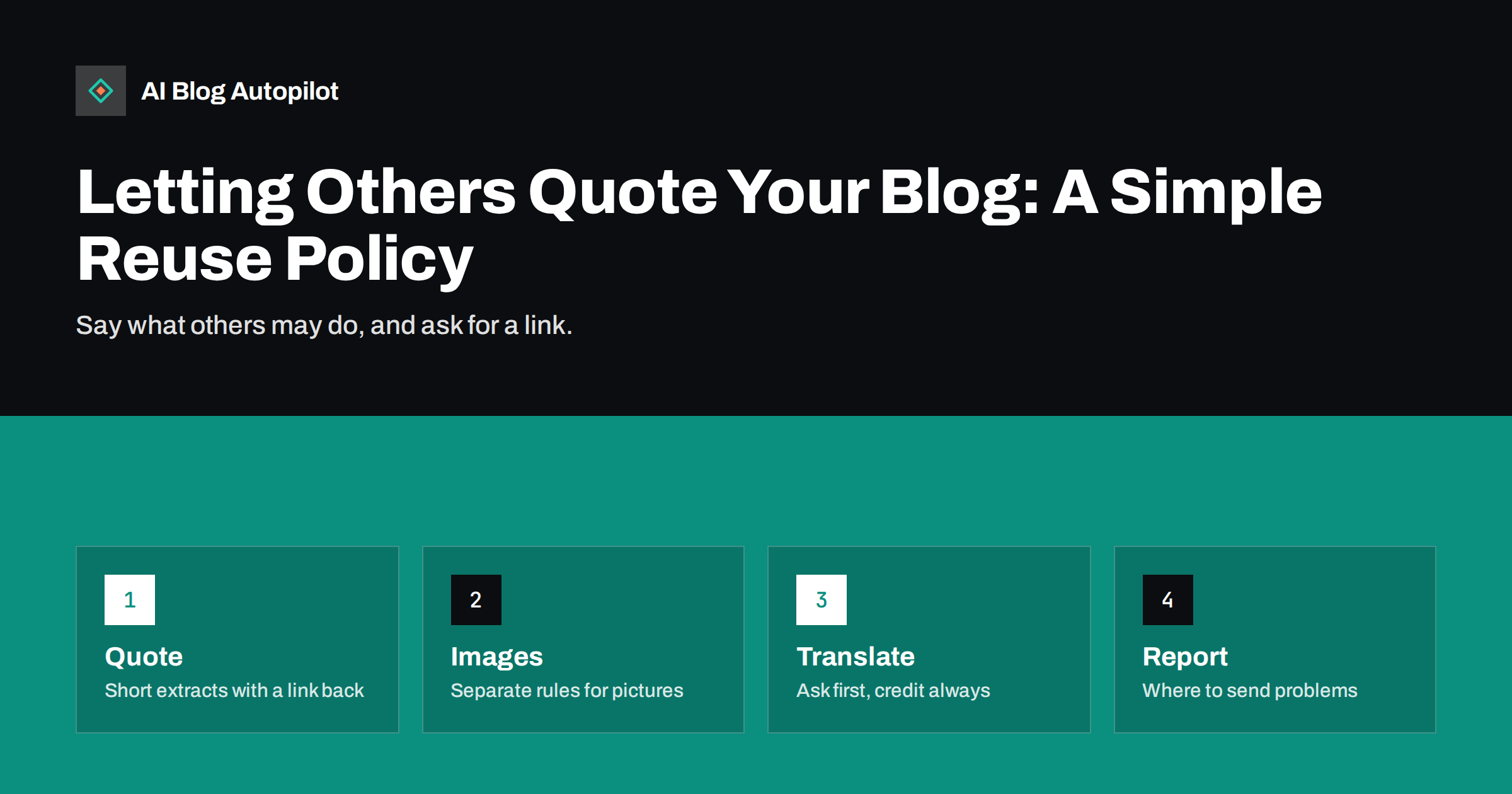
Short answer: a reuse policy is a short page on your blog that tells people what they may do with your content: quote a few sentences with a link, share an image with credit, translate an article only with permission, and never republish a whole post as their own. It reduces awkward emails, makes honest reuse easier, gives you a clear basis for asking a site to credit or remove copied material and shows readers that you take your own content seriously. It is not legal advice; for a policy with legal weight, ask a qualified adviser in your country.
Most bloggers never write one. They either say nothing and hope, or they print a stern copyright line in the footer that tells nobody what is actually allowed. Neither helps the writer who wants to quote you in an article, the teacher who would like to use a chart in class or the company that wants to translate your guide. A clear, friendly policy turns those requests from guesses into simple answers.
Why a policy helps you
Content that is easy to reuse correctly gets reused correctly. When you say “you may quote up to a short extract if you link to the original”, the people who would have asked, or worse, copied quietly, now know what to do. Quotes with links bring visitors and mentions, which support the work we describe in earning backlinks honestly. A policy also gives you something concrete to point to when someone goes too far, and it saves time because you can answer common requests with a single link.
It helps AI assistants and automated tools too, in a modest way. A page that states the terms plainly is easier to interpret than silence. Keep in mind that a written policy does not physically stop anyone; it sets expectations and records your wishes.
A policy also forces you to think about what your content is worth to you. Some articles are marketing assets you want to spread as widely as possible; others hold original research, templates or methods that give you a real advantage. Sorting your content into those groups, even loosely, tells you where to be generous and where to be careful. You might invite others to share your guides freely and still ask for permission before anyone reprints a downloadable template.
What most blogs want to allow
Decide your position before you write. For many business blogs the reasonable defaults are:
- Short quotations of a few sentences, with a visible link to the original article, are welcome in news, commentary, education and reviews.
- Linking to any page is always welcome, and you do not need permission.
- Summaries in the reader’s own words, with a link, are fine.
- Printing or sharing for personal or classroom use is fine, with the source shown.
- Republishing a whole article needs written permission, and a canonical link or clear credit if you grant it.
- Translating an article needs permission, because it creates a new version of your work.
- Using content to claim it as one’s own, or removing credit, is not allowed.
Your choices may differ. A nonprofit might be happy for others to reprint articles freely; a consultancy may want tighter control over its frameworks. What matters is that the page states a position and the position is workable.
Treat images and data separately
Do not assume that the rules for text cover pictures. Photographs, diagrams and charts are often made by a designer, licensed from a stock library or created with a tool whose terms limit reuse. State clearly which images may be shared and under what conditions. If you made a chart and are happy for others to use it, say so and give the credit line you prefer. If an image is licensed to you only for your own site, say that it may not be copied. Our article on image rights for blog posts explains how to check what you are allowed to pass on.
Data deserves the same thought. If you publish original figures, you may want others to cite them freely, because citations are the point. Say how to cite: the article title, your name and the link.
Handling translation and syndication
Requests to translate and to syndicate are the ones that need a process. For translation, decide whether you allow it at all and, if you do, ask for the translator’s name, the target language, the place of publication and a link back to the original. For syndication, where another site republishes your article, ask them to add a canonical link or a clear credit line, as covered in our guide to republishing posts without SEO harm. A short request form or an email address on the policy page is enough, and you should reply promptly.
What to do when someone copies you
Publish what you will do when content is copied without permission. A sensible sequence is to contact the site owner politely, give them a clear request (add credit and a link, or remove the copy), set a reasonable deadline and, if nothing happens, use the hosting company or search engine reporting tools. Our article on when other sites copy your posts walks through the practical steps. Keep dated records of your original publication, because they help establish who published first. Whenever possible, start with a friendly message; most copying is careless, not malicious.
Prepare a short template for the first contact so you do not have to write from scratch in the middle of an irritating day. State the URL of the copy, the URL of your original, the date you published, what you ask them to do and by when. Stay factual and courteous. Keep screenshots of the copied page with the date, in case it changes. If the site is clearly automated and unresponsive, move on to the hosting provider and the search engine’s reporting routes, and do not spend more time on it than the matter deserves.
Where to put the policy and how to word it
Create one page, called “Reuse policy” or “Using our content”, and link to it from the footer and from the about page. Use plain language, short paragraphs and a few headings, and put the most common answers first. Include a contact email for permission requests, the date of the last update and the name of the person or business responsible. Avoid legal jargon you do not understand, because wording that is unclear is worse than wording that is simple. If you need the policy to have legal effect, have a qualified person review it. The article on writing an editorial policy page shows how to keep these pages consistent with each other.
Reuse by your own team and partners
A policy is not only for strangers. Your colleagues, freelancers, agencies and partners also reuse your articles, graphics and data, and they need to know the rules. Decide whether a sales team may paste paragraphs into proposals, whether a partner may put your guide on their site with a logo, and whether a freelancer keeps any rights over what they wrote. Put these points in a short internal version of the policy, and make sure contracts say who owns the finished work.
Keep a simple register of what has been given to whom: the asset, the person or company, the date and the terms. When the same request arrives again, you can answer in a minute. Review the register once a year and withdraw permissions that are no longer needed. For content produced with the help of software, check the tool’s terms about ownership and reuse, so that what you grant to others is something you actually have the right to grant.
Finally, set a reminder to review the whole policy once a year. Laws, platforms and your own business change, and a policy that no longer matches reality does more harm than a short one that is up to date.
A short example of the wording
You do not need pages of text. A workable policy can fit in a handful of plain sentences. For example: “You are welcome to quote short extracts from our articles if you link to the original page. You may share our articles on social media and link to them freely. Please do not republish a complete article, translate it or use our images without asking us first. If you would like to, contact us at the address below and tell us where and how you plan to use the material. We usually reply within a few working days.”
Adapt this to your own wishes and add the details that matter to you: how you would like to be credited, whether commercial use is acceptable and whether charities or schools receive special treatment. Read it as a stranger would, and remove anything that could be understood in two ways. Test the contact address before you publish the page, and put the date at the bottom so that readers can see it is current.
How AI Blog Autopilot helps
AI Blog Autopilot writes full SEO articles for your WordPress blog from the topics, keywords, audience and tone you set, with FAQ sections, tags and SEO meta included, and it shares each one to your social networks. The policy itself is something you decide, because it states your wishes. Once it exists, you can link to it from your about page and footer, and every article the tool publishes sits under the same clear terms. Approval mode lets you read articles first. See the pricing page for plans.
Related reading
- Image Rights for Blog Posts: Stock, Screenshots and Generated Images
- Originality and Plagiarism on a Business Blog
- When Other Sites Copy Your Blog Posts: Scrapers and SEO
- Content Syndication: Republishing Posts Without SEO Harm
The bottom line
A reuse policy is a short, friendly page that says what people may quote, share, translate and republish, how to credit you and whom to ask. It makes honest reuse easy, turns quotations into links and gives you a calm starting point when content is copied. Write it in plain words, treat images and data separately, keep it current, and ask a qualified adviser if you need something legally binding.
GYIK
Do I need a reuse policy if I already have a copyright notice?
A copyright notice says the work is protected but not what you welcome. A reuse policy explains what is allowed, which helps honest readers and saves you replying to the same requests.
How much of an article may someone quote?
That is your decision, and the law in your country also applies. Many blogs allow a short extract of a few sentences with a visible link to the original.
Can I forbid AI tools from using my content?
You can state your wishes and use technical controls such as robots.txt, but a policy page alone does not stop automated access.
Should I allow translations?
Only if you are comfortable with it. Many blogs allow translation on request, with the translator named and a link to the original.
Is this legal advice?
No. It is general information. For a policy that must be legally binding, ask a qualified adviser in your country.