ENEnglish
 LTLietuviškai
 DEDeutsch
 FRFrançais
 RUРусский
 ESEspañol
 PLPolski
 ITItaliano
 UKУкраїнська
 CSČeština
 PTPortuguês
 JA日本語
JA日本語 LVLatviešu valoda
 ETEesti
 HUMagyar
 IDBahasa Indonesia
 TRTürkçe
 HIहिन्दी
 ELΕλληνικά
 ARالعربية
 THไทย
THไทย VITiếng Việt
 RORomână
 MSBahasa Melayu
 BNবাংলা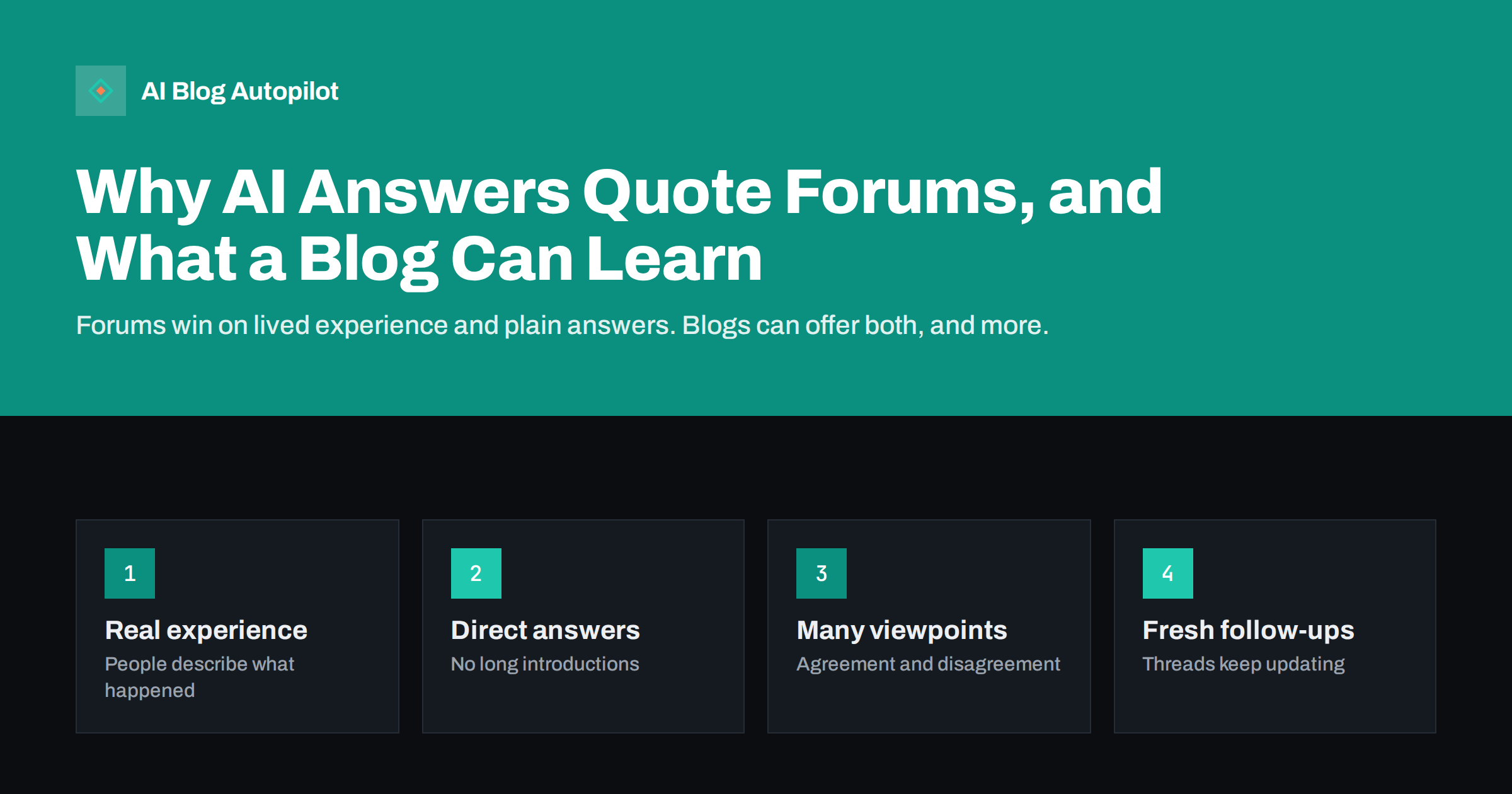
Short answer: AI answers and search results often cite forum threads and community discussions because they contain first-hand experience, direct answers to specific questions, several viewpoints and frequent updates, which many blog posts lack. A blog can compete by doing the same things on purpose: answering the exact question early, sharing real experience and specific details, covering the trade-offs and edge cases people argue about, and keeping articles up to date. Taking part honestly in relevant communities also helps your business be mentioned where those discussions happen.
Anyone who checks how AI assistants answer questions in their field soon notices that forum threads, community questions and discussion sites appear among the sources surprisingly often. Search results show a similar pattern, with discussion results prominent for many queries. For blog owners this can feel unfair: a thread with three replies outranks a carefully written guide. But the pattern makes sense once you look at what those threads offer. This article explains why discussions get cited and what a business blog can learn from them.
Why discussions show up so often
Search engines and AI assistants try to give people answers that match what they asked and that seem trustworthy. Discussions often meet both needs in ways that standard articles do not:
- They match the question exactly. A thread often starts with someone asking the very question another person later searches for, in the same everyday words.
- They contain first-hand experience. Replies describe what actually happened: “I tried this, and here is what went wrong.”
- They show several viewpoints. Different people suggest different solutions, disagree and correct each other.
- They cover edge cases. Follow-up questions bring out the unusual situations that general guides skip.
- They feel independent. Readers often trust other users more than a business writing about its own field.
Search engines have also said for years that they want to show more first-hand perspectives, and discussion content is one of the clearest sources of them. AI assistants that search the web before answering pick up the same pages.
What forum answers do well
Look at a highly cited thread in your own field and you will usually see the same patterns:
- The answer comes first. The best replies start with the solution, not with background.
- Details are specific. Exact settings, model names, steps, amounts of time and the result.
- Problems are admitted. People say what did not work, which makes the advice believable.
- The tone is plain. No marketing language, no padding, no keyword stuffing.
- The thread evolves. New replies add updates when something changes.
None of these require a forum. They are writing habits, and a blog can adopt every one of them.
What forums do badly
Discussions also have clear weaknesses, and these are where a blog can stand out:
- Answers conflict without resolution. Readers have to decide which of ten replies to trust.
- Information is scattered. The useful parts are spread across many replies and pages.
- Old threads go stale. A popular thread from years ago may describe settings or prices that no longer exist.
- Expertise is unclear. Readers often cannot tell whether a reply comes from an expert or a guess.
- Structure is missing. No headings, no summary, no clear steps.
A good blog post can combine the strengths of a discussion with the structure, accuracy and clear authorship that discussions lack.
That combination is also what makes a page easy for AI assistants to use. A clearly structured article with a direct answer, a short list of steps and a section on exceptions gives an assistant several self-contained passages it can quote, instead of forcing it to piece together an answer from scattered replies.
Writing blog posts that compete with threads
Practical ways to make your articles as useful as the best discussions:
- Use the question people actually ask. Look at how questions are phrased in communities in your field, and use the same wording in headings and the opening answer.
- Answer in the first paragraph. Put the direct answer at the top, then explain.
- Add real experience. Describe what you or your customers saw, with specific details and honest results.
- Cover the disagreements. If people argue about two approaches, explain both, say when each fits and give your view.
- Include the edge cases. The follow-up questions in threads are a list of sections your article is probably missing.
- Show who wrote it. A clear author with relevant experience helps readers and gives assistants a reason to trust the page.
- Keep it current. Update the article when things change and show the date of the last meaningful update.
An example of the difference
Imagine someone asks how to stop a home espresso machine from producing sour coffee. A typical blog post opens with the history of espresso, explains extraction in general terms and lists ten tips. A popular thread on the same question has a reply that says: grind finer first, because that fixes most sour shots; if the shot already runs slowly, raise the water temperature a little instead; and if the beans are very fresh or very light roasted, some sourness is normal. Two other replies disagree about temperature and explain why.
The thread is more useful, not because it is a forum, but because it answers first, gives a clear order of steps, names the conditions that change the advice and shows the disagreement. A blog post written with the same habits, plus a clear structure, a short checklist and an author who has actually made a lot of espresso, would serve the reader better than both.
Turning thread questions into sections
One useful exercise: read the five most active discussions about a topic you cover, and write down every distinct question and objection. Compare the list with your article. Each question that your article does not answer is a candidate for a new paragraph, an FAQ entry or a separate article. This is one of the quickest ways to make content more complete without padding it.
Taking part in communities honestly
Because discussions are cited so often, being part of them matters. AI assistants that recommend businesses or tools often draw on what people say in communities. That does not mean posting links everywhere. Communities dislike self-promotion, and many have strict rules against it.
Honest participation looks like this:
- Answer questions in your field with genuinely helpful replies, whether or not you mention your business.
- Disclose your connection when you mention your own product or service.
- Link to your article only when it adds something the reply cannot contain, such as a detailed guide or a checklist.
- Follow each community’s rules, which differ widely between forums, subreddits and groups.
- Never use fake accounts or ask others to post praise for you. It breaks community rules and, when discovered, damages trust far more than it ever helps.
Over time, genuine participation leads to your business being mentioned naturally, which is exactly the kind of signal that discussion-heavy answers draw on.
Customer discussions on your own site
You can also host useful discussion yourself. Moderated comments on articles, a community section or a public question-and-answer page can add first-hand experience to your own content, as long as they are kept free of spam and actually answered. Small sites rarely need a full forum; a well-maintained comment section or an FAQ built from real customer questions often achieves the same effect.
If you collect questions by email or support tickets, those are discussions too. Turning repeated questions into public answers on your blog brings the specificity of a thread onto a page you control.
Checking which discussions matter in your field
To see the pattern for your own topics, ask a few AI assistants and a search engine the questions your customers typically ask, and note which sources appear. If the same communities show up repeatedly, read the cited threads carefully:
- What exactly was the question?
- Which reply did the answer draw on, and why?
- What does your article on the same topic say, and what does it miss?
- Is your business mentioned in the discussion at all?
Repeat the check every few months. Sources change, and an improved article can start appearing alongside or instead of the threads. Results also vary between assistants and from one day to the next, so look for patterns across several checks rather than reacting to a single answer.
Keep notes of what you find in a simple table: the question, the sources cited, whether your site appeared and what you changed afterwards. After a few rounds you will see which kinds of improvements actually move your pages into the answers, and which topics are dominated by discussions so strongly that a different angle, such as a detailed checklist or a comparison, is a better use of your time.
How AI Blog Autopilot helps
AI Blog Autopilot writes full articles planned around real search queries, with a direct answer, FAQ, tags and SEO meta, and the writer is instructed never to make up statistics, quotes or sources. You set the topics, keywords, audience and tone. Taking part in community discussions is something you do yourself. See the pricing page for plans.
Related reading
- How AI Search Picks Which Pages to Cite
- Brand Mentions: Why AI Answers Recommend Some Businesses
- Sharing Blog Posts on Reddit Without Getting Banned
- Turning Customer Questions Into Blog Topics
The bottom line
Forum threads and community discussions are cited often because they match real questions, contain first-hand experience, show several viewpoints and cover edge cases. A blog can compete by answering the exact question first, adding real experience and specific details, explaining disagreements and edge cases, showing clear authorship and staying current. Take part in communities honestly and with disclosure, so your business is part of the discussions that answers draw on.
GYIK
Why do AI answers cite forum threads so often?
Threads often match the exact question people ask, contain first-hand experience and show several viewpoints and edge cases. Search engines and assistants look for those qualities when choosing sources.
Can a blog post outrank a forum thread?
Yes. A post that answers the question directly, includes real experience, covers disagreements and edge cases and stays current can be more useful than a scattered thread.
Should I post links to my blog in forums?
Only when the link genuinely adds something to a helpful reply and the community’s rules allow it. Disclose your connection, and focus on answering the question rather than promoting.
How do I find which discussions matter in my field?
Ask AI assistants and a search engine the questions your customers ask and note which threads and communities are cited. Read those threads to see what your articles are missing.
Is it worth adding comments or a forum to my own site?
Moderated comments or a question-and-answer page can add first-hand experience to your content, but only if you keep them free of spam and answer questions. Small sites rarely need a full forum.