ENEnglish
 LTLietuviškai
 DEDeutsch
 FRFrançais
 RUРусский
 ESEspañol
 PLPolski
 ITItaliano
 UKУкраїнська
 CSČeština
 PTPortuguês
 JA日本語
 LVLatviešu valoda
 ETEesti
 HUMagyar
 IDBahasa Indonesia
 TRTürkçe
 HIहिन्दी
 ELΕλληνικά
 ARالعربية
 THไทย
 VITiếng Việt
 RORomână
 MSBahasa Melayu
 BNবাংলা
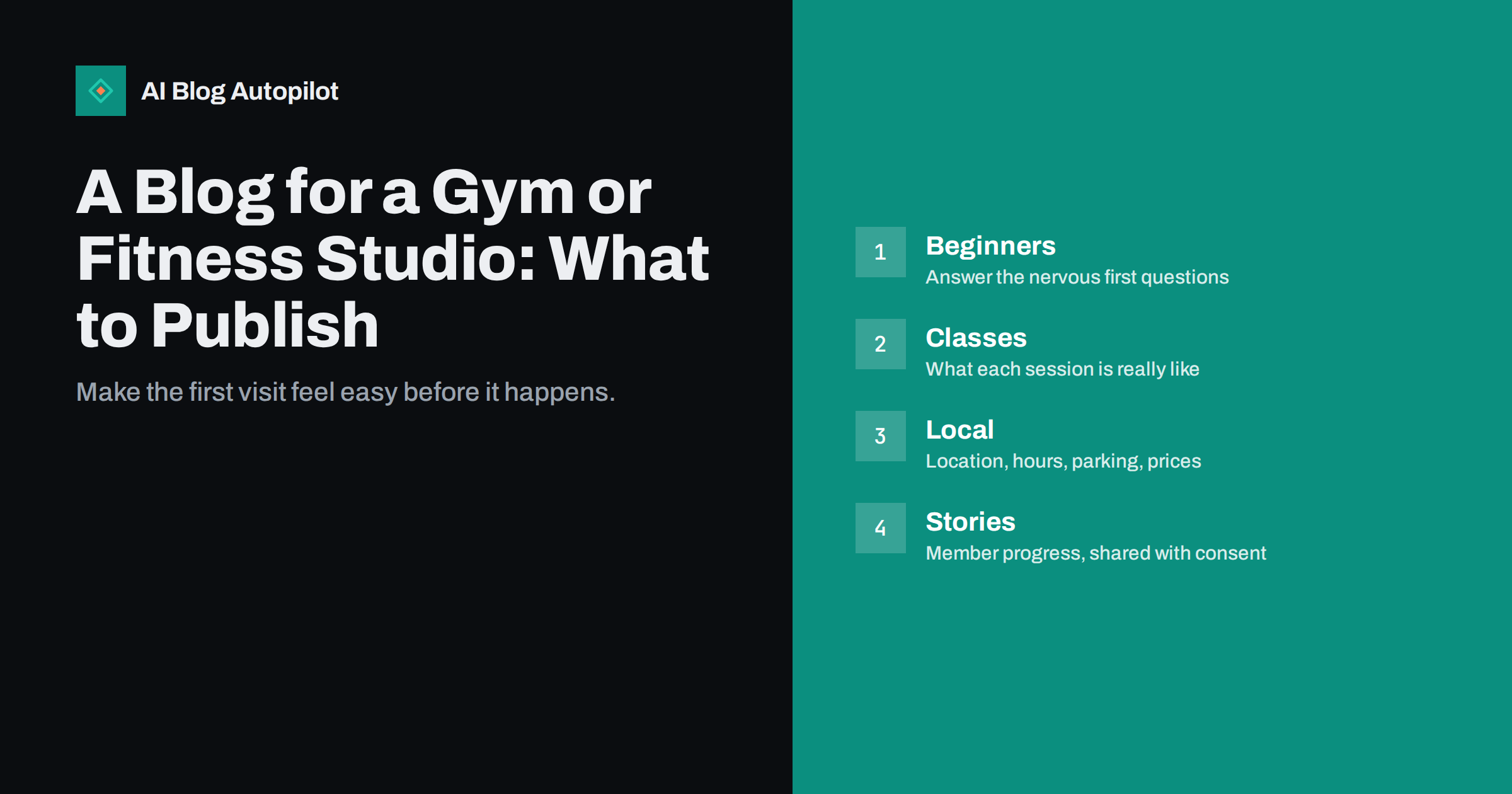
Short answer: a gym or fitness studio blog should lower the barrier to the first visit. The best content answers the nervous questions of beginners, explains what each class or programme is like, describes the practical details of the place and shares honest, general guidance on training. Because most members live or work nearby, local search matters more than national traffic, so every article should connect clearly to a real location, real timetable and a simple way to book a trial. Avoid medical claims and promises of results, which are risky and rarely believable.
People rarely join a studio on impulse. They hesitate: will I be the least fit person in the room, what do I wear, is it expensive, how crowded does it get, will the instructor shout? Those worries show up in searches long before anyone walks in. A blog that answers them with warmth and detail turns hesitation into a booking. This article sets out the topics, the structure and the habits that make a fitness blog useful.
Start with the nervous beginner
The most valuable readers are people who have not joined yet. Write for them first. Titles such as “What to expect at your first yoga class”, “How to use the gym floor without feeling lost” or “What to bring to a first personal training session” match real searches and speak directly to hesitation. Describe the room, the length of the session, the equipment you provide, the level of fitness needed and what happens if someone has to stop and rest. Use plain language and avoid jargon that makes a newcomer feel behind.
Our guide to search intent explains why these articles work: the reader wants reassurance and practical detail, not a lecture on training theory. A page that gives exactly that will usually outperform a longer, more general piece.
Consider also the people who used to train and want to return, and those coming back after an injury, a baby or a long break. They have a different worry: they remember what they used to be able to do. A “returning after a break” guide that stresses gentle progress, listening to the body and talking to a professional where needed will reach a group that many studios overlook. Include a plain statement of what your coaches do to adapt a session, such as offering lighter options, so the reader can picture being looked after.
Explain every class and programme
Give each class, course or membership type its own page and write it as an honest description. Cover who it suits, how intense it is, how long it lasts, what the instructor does, what equipment is needed and how it differs from the one next to it on the timetable. A comparison article such as “Pilates or yoga: which should you try first?” helps people choose and links naturally to both class pages. Be fair about alternatives, including the ones you do not offer. A reader who feels advised rather than sold to is far more likely to book.
Keep the timetable current, and avoid describing times in the article text that will go out of date. Link to the live schedule instead.
Practical and local details
Many bookings depend on logistics. Publish the address, how to find the entrance, parking and public transport, opening hours, changing rooms, lockers, accessibility, child-friendly options and how to cancel or freeze a membership. Write a short, clear page for each of these, and repeat the essentials in the footer and on your business profile so they match everywhere. The article on blog strategy for a local business shows how to connect articles to local pages, and the guide to reusing posts on a business profile explains how to share the same content where local searchers look.
Be open about prices where you can. People searching for a membership often want a range before they ask. If you cannot publish exact prices, explain what affects them, such as contract length, peak-time access or included classes. Our piece on writing honestly about cost covers the approach.
Add a short section for common objections, such as “I do not have time”, “I am not fit enough” or “I tried before and stopped”. Answer them with respect and with practical options: short sessions, flexible times, small groups and a first month without pressure. Readers who recognise their own doubt in the text feel understood, and an article that names the worry usually earns more trust than one that only describes the facilities.
General guidance without overreach
Training advice makes good content, but a blog cannot assess an individual. Write about habits and principles, such as how to build a routine, how to warm up, how to progress gradually or how to plan rest days, and be clear that it is general information. Recommend that readers with injuries, medical conditions, pregnancy or any health worries speak to a doctor or a qualified professional before changing their activity. Avoid claims about weight loss amounts, fixed timelines or “guaranteed” results. They are hard to support and can mislead.
Name the instructor or coach who wrote or reviewed each piece and show their qualifications. It helps readers decide whom to trust and gives the page the expertise signals that search engines look for.
Member stories and community
Stories from members make the place feel real. A short profile of someone who started as a beginner, a write-up of a charity event or a recap of a challenge gives prospective members a picture of who is in the room. Always ask for written consent, let the person see the text and photos, and avoid health details or before-and-after comparisons unless you are certain they are allowed where you operate. Our guide to customer stories and contributions covers consent and editing. Keep the tone encouraging and never use someone’s body as an advertisement.
Community content does not have to feature members at all. A page about the coaches, with their backgrounds, qualifications and teaching style, helps people pick a class. A short guide to studio etiquette, covering punctuality, equipment, shared spaces and respect for others, makes newcomers more comfortable. Behind-the-scenes posts about how a new programme was designed show care and expertise. Each of these gives prospects a sense of the atmosphere before they arrive, which is often the deciding factor.
A calendar of topics that follow the year
Fitness has a strong seasonal pattern. Plan content for the new-year rush, the spring and summer push, the back-to-school return and the quieter winter months. Publish beginner and trial content a few weeks before each peak, so articles are indexed and ready when searches rise. The article on planning seasonal content shows how to set this up without scrambling each year. Mix in evergreen pages that keep working all year, such as first-visit guides and class explainers.
Turning readers into trial visits
Every article should offer a next step that fits the reader’s stage. For a beginner guide, that might be “book a free introduction” or “ask a question before you visit”. For a class page, it might be “try this class”. Keep the form short and the promise specific, and only mention offers that are real and current. Review which articles bring bookings, not just visits, and write more like them. A measured, friendly call to action beats pressure, and the guide to calls to action that fit the article has examples.
Make the first step as small as possible. A free introduction, a drop-in class or a short call to ask questions all lower the barrier, provided you really offer them. Explain exactly what happens at the first visit and what the visitor needs to do, so there is nothing to fear. Follow up politely after a trial and ask how it went. Many people need a second nudge, and a friendly message a few days later turns interest into membership more reliably than any article.
Measuring what the blog actually does
Traffic is a weak measure for a local studio. What matters is how many readers book a trial, join a class or ask a question. Add a simple way to record where each new member first heard of you, such as a “how did you find us?” field on the booking form. Track which articles are visited just before a booking, and compare them with the ones that only attract visitors. Over a few months, you will see which topics produce members and which produce only clicks, and you can write more of the first kind.
Review search queries in your reporting tools, too. If people find you for “beginner classes near me” or for the name of a particular style, make sure a page exists that answers precisely that and gives a clear way to book. Small adjustments to titles and opening paragraphs, made after looking at real searches, often improve results more than writing new articles. Our guide to the Search Console reports that matter shows what to look at first.
How AI Blog Autopilot helps
AI Blog Autopilot writes full SEO articles for your WordPress blog from the topics, keywords, audience and tone you set, with FAQ sections, tags and SEO meta included, and it shares each one to your social networks. For a studio, that can mean a steady stream of beginner guides, class explainers and seasonal pieces while you teach. Approval mode lets you read each article before it goes live, which is the right moment to check class details and remove anything that sounds like a health claim. See the pricing page for plans.
Related reading
- Blog Strategy for a Local Business
- Planning Seasonal Content Without Scrambling Every Year
- Customer Stories and Contributions on a Business Blog
- Social Media Content Mix: What to Post Between Articles
The bottom line
A fitness blog succeeds when it makes the first visit feel easy. Answer the beginner’s worries, describe every class honestly, publish the practical and local details, keep advice general and careful, share member stories with consent and time your content to the seasons. Each article should lead to a simple next step, so the readers you attract turn into people who turn up.
GYIK
What should a new gym blog write about first?
Start with first-visit guides, a page for each class or membership and the practical details of the location, hours and prices. These match the searches people make before joining.
Can a fitness blog give workout advice?
General guidance is fine if it is clearly general and written or reviewed by a qualified coach. Readers with injuries or health conditions should be told to speak to a professional first.
Should I publish member before-and-after photos?
Only with clear written consent and after checking the rules where you operate. Many studios choose stories about habits and experience instead of body comparisons.
How often should a small studio post?
A steady rhythm you can keep matters more than volume. One or two useful articles a week is plenty, timed ahead of busy seasons.
Do I need a separate page for every class?
It is a good idea. A page per class lets you describe it honestly and match the specific searches people make about it.