ENEnglish
 LTLietuviškai
 DEDeutsch
 FRFrançais
 RUРусский
 ESEspañol
 PLPolski
 ITItaliano
 UKУкраїнська
 CSČeština
 PTPortuguês
 JA日本語
 LVLatviešu valoda
 ETEesti
 HUMagyar
 IDBahasa Indonesia
 TRTürkçe
 HIहिन्दी
 ELΕλληνικά
 ARالعربية
 THไทย
 VITiếng Việt
 RORomână
 MSBahasa Melayu
 BNবাংলা
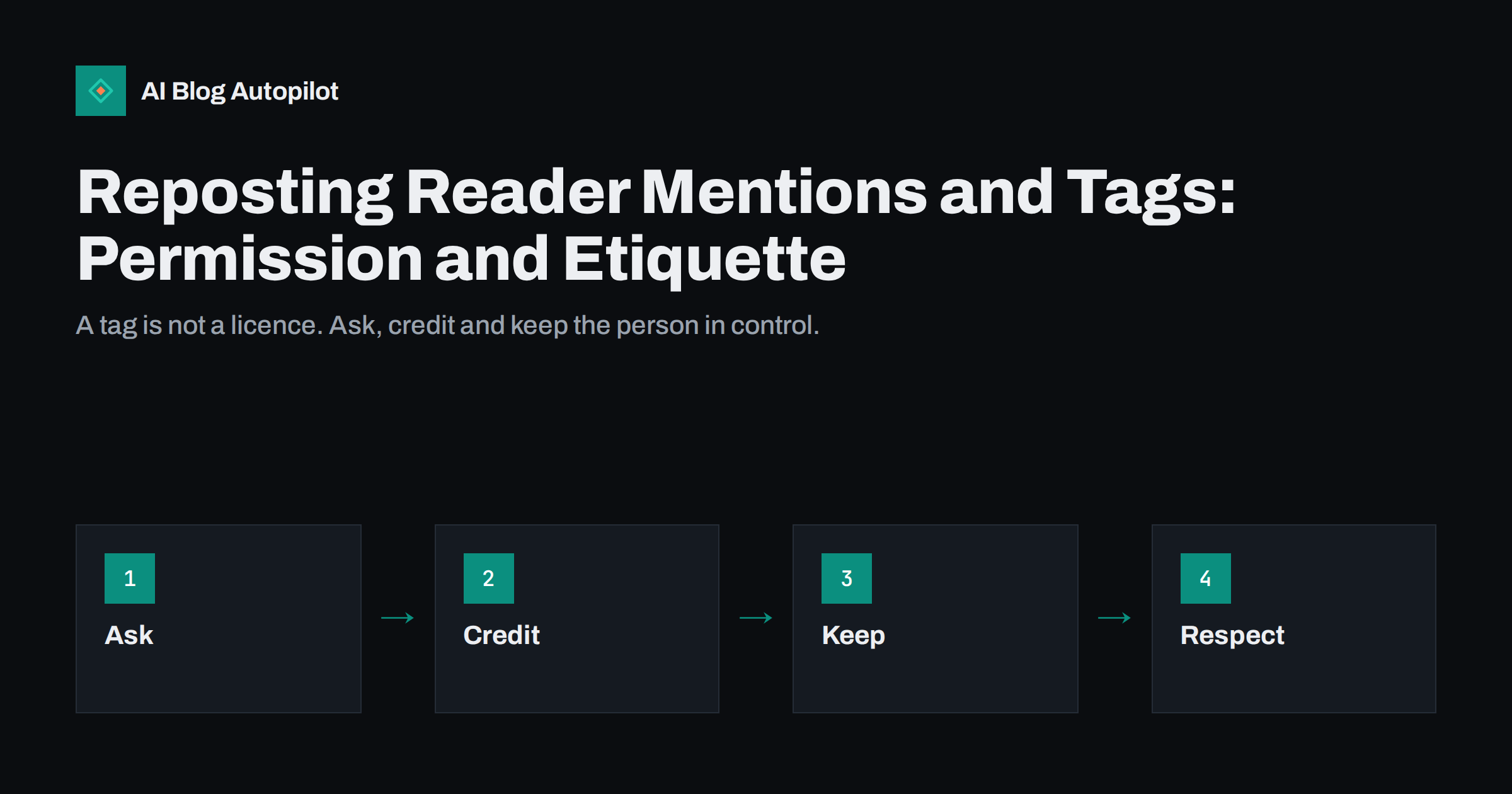
Short answer: you may usually like, reply to and use the built-in share function for a post that tags you, but copying a reader’s photo, words or video into your own post is different. Ask permission first, credit the person by name, do not change the meaning, tell them where it will appear and remove it if they ask. Treat the tag as a friendly invitation to talk, and not as a licence to reuse.
Few things please a small business more than a reader who shares a photo of a product, praises an article or recommends the blog to friends. The urge to repost it on your own account is natural, and it can be good for both sides. But there are points of courtesy, law and brand care to think about. This article explains how to do it well, with a simple process that a small team can follow.
The rules of each network differ, and so do laws on copyright and privacy. Treat this as general guidance, and check the terms of the networks you use.
Keep a balance, though. If your feed contains only reposts, it begins to look like an echo chamber, and followers wonder what you do yourself. Mix reader posts with your own articles, tips and news, and use reposts as a seasoning and not as the main dish. A steady mix feels more honest and is more interesting to follow.
Why readers’ posts are valuable
A post from a real customer carries a kind of trust that your own posts cannot. People believe other people more than they believe a brand, and a genuine photo or a plain sentence of praise says more than polished promotional text. Sharing such posts can also thank the person publicly, which strengthens the relationship.
They also give you ideas. A reader’s words show how your audience describes your work, which topics they care about and which problems they face. This can feed your content plan, as the article on social listening for a small blog explains.
The benefit is real only when done honestly. If a reader feels used, or finds their picture in an advert without notice, the effect is the opposite. Good manners protect both the relationship and your reputation.
Sharing versus copying
Most networks have a built-in way to share another person’s post, such as a repost or a share button. This shows the original post with the original name, and it stays under the author’s control. If the person deletes it, it disappears from your account too. This is the simplest and safest way to pass on a mention.
Copying is different. If you download a picture, take a screenshot or paste the text into your own post, you create a separate copy that the author no longer controls. In many places, the author keeps the copyright, and using their work in your post without permission may infringe it, even if they tagged you.
A tag shows that someone wants you to see their post. It does not say that they agree to its use in your marketing. When in doubt, use the share function, or ask. The same care applies to images on your blog, as discussed in image rights for blog posts.
Offer something in return where it is natural, such as a public thank you, a tag, or a link to the person’s own work or profile. Never present it as a trade that they must accept. For people who run their own business or blog, a link to their site is a real favour, and it often turns a mention into a friendly connection.
How to ask for permission
Write a short, friendly message, in the comments or in a private message. Say what you liked, where you would like to use the post, and what you will credit. For example: “Thank you for sharing this. May we post your photo on our page, with your name credited?” Be specific about where it will appear.
Wait for a clear yes before you use it. A like is not permission. If you do not get an answer, do not use the material. Keep the reply, which is your record. For anything that goes beyond a simple repost, such as use in an advert, on a website or in print, get a clearer written agreement.
Accept a no gracefully. Thank the person, and do not push. Respecting a refusal builds goodwill, and a person who feels respected is more likely to mention you again.
Be careful with older mentions. A post from several years ago may no longer reflect the person’s views, or they may have deleted their account or changed their name. Before you reuse something old, check that it is still public, and ask again if you plan a new kind of use, such as a larger campaign.
Credit and context
Credit the person in the way that they prefer. Use their name or handle, link to their profile where possible and say plainly that it is theirs. If they prefer to be anonymous, honour that. Do not crop out names or watermarks, or alter the picture in ways that change what it shows.
Keep the meaning. Do not edit a sentence so that it sounds more enthusiastic, and do not join several comments into one invented quote. If you shorten a message, mark the cut. The principle is the same one that applies to testimonials on your site, discussed in writing a case study without exaggerating.
Think about what else is in the post. A photo may show other people, a house number, a child or a car registration. Before reposting, check the whole picture for private details, and ask the person whether they would like parts blurred. If other people are clearly identifiable, you may need their agreement as well.
Children, health and sensitive subjects
Take extra care with anything that involves children, health, money problems or other sensitive subjects. A parent who tags your shop in a photo of their child may be happy to share it with friends, but not to see it used on a business page. When in doubt, do not repost, and thank the person privately.
The same applies to reviews that mention health or personal circumstances. A comment such as “this helped me through a hard time” can be moving, but it may be too personal to share. Ask, and let the person decide.
Some fields have rules about testimonials, for example in healthcare, finance or legal services. If you work in such a field, check the rules before you share anything that looks like an endorsement. The notes on sensitive topics on a business blog are a useful reminder.
Giveaways, rewards and disclosure
If you encourage readers to tag you in return for a reward, such as a discount or a prize, the posts are no longer purely spontaneous. Many places expect clear labelling when content is made in exchange for a benefit, and networks have their own rules. Tell the participants how the content will be used, and follow the rules for promotions, as discussed in giveaways and contests tied to a blog.
Avoid pretending that paid or rewarded posts are spontaneous. Readers notice, and regulators may act. Be honest in your own posts when you share something that you encouraged or rewarded.
Do not offer rewards for positive comments only. Invite honest opinions, and be ready to hear criticism. A feed of only glowing posts looks staged, and it loses the trust that you wanted to earn.
Add a short note on speed. People expect a thank you soon after they tag you, but permission and credit checks can take a day. Reply at once with thanks, and say that you will come back about sharing. That keeps the conversation warm, and it gives you time to do the checks without pressure.
A simple process for a small team
Write the process on one page. When a mention arrives, thank the person, check that it is genuine, decide whether to share with the built-in function or to ask for permission, record the answer and credit the person. Keep a folder with the permissions.
Decide who can approve a repost, and what is not allowed, such as posts that include other brands, rude language or controversial opinions. Agree on how to handle mentions that are critical: reply to them in the usual way, as in handling negative comments, and do not hide them without reason.
Review the page every year. Rules change, networks add features and your own policy may need to be updated. A routine takes little time, and it prevents awkward situations.
Measuring the effect
Look at how reposts perform against your own posts. Compare reach, replies and clicks, and note whether people respond differently to a genuine reader post. If you see a clear benefit, plan to invite more mentions in an honest way, such as by making it easy to tag you in a post.
Look at the long-term effect, too: do these readers return, buy or recommend you again? A thank you that is real often turns a casual fan into a regular. The ideas in social media metrics for bloggers help you choose what to track.
Finally, share some of the credit with your readers on your blog, where it fits. A short thanks, a link to a reader’s own work or a mention of a helpful comment shows that you value the community. This strengthens the sense that your blog is shared with its readers.
How AI Blog Autopilot helps
AI Blog Autopilot writes and publishes SEO articles for your WordPress blog and shares each one to your social networks, so there is always something worth tagging and talking about. The conversation that follows, including whether to repost a reader’s mention, stays a human decision. See the pricing page for plans.
Related reading
- Tagging and Mentioning Other Accounts When You Share Posts
- Customer Stories and Contributions on a Business Blog
- Social Listening for a Small Blog: Finding Mentions Without Tools Overload
The bottom line
Use the share button when you can, and ask before copying a reader’s words or photos. Credit the person, keep the meaning, protect private details and respect a no.
FAQ
Can I repost a photo that a customer tagged me in?
Using the network’s share function is usually fine. Copying the photo into your own post needs the person’s permission.
Does a tag mean I have permission to reuse the post?
No. A tag invites you to see it, but the author usually keeps the rights to the photo or text.
How should I credit a reader?
Use their name or handle in the way they prefer, link to their profile where you can and say clearly that the content is theirs.
What if a customer asks me to remove a repost?
Remove it promptly and thank them. Respecting a request builds trust.
Do I need to disclose rewarded posts?
Yes. If readers receive a reward for posting, follow the network rules and local advertising rules on labelling.