ENEnglish
 LTLietuviškai
 DEDeutsch
 FRFrançais
 RUРусский
 ESEspañol
 PLPolski
 ITItaliano
 UKУкраїнська
 CSČeština
 PTPortuguês
 JA日本語
 LVLatviešu valoda
 ETEesti
 HUMagyar
 IDBahasa Indonesia
 TRTürkçe
 HIहिन्दी
 ELΕλληνικά
 ARالعربية
 THไทย
 VITiếng Việt
 RORomână
 MSBahasa Melayu
 BNবাংলা
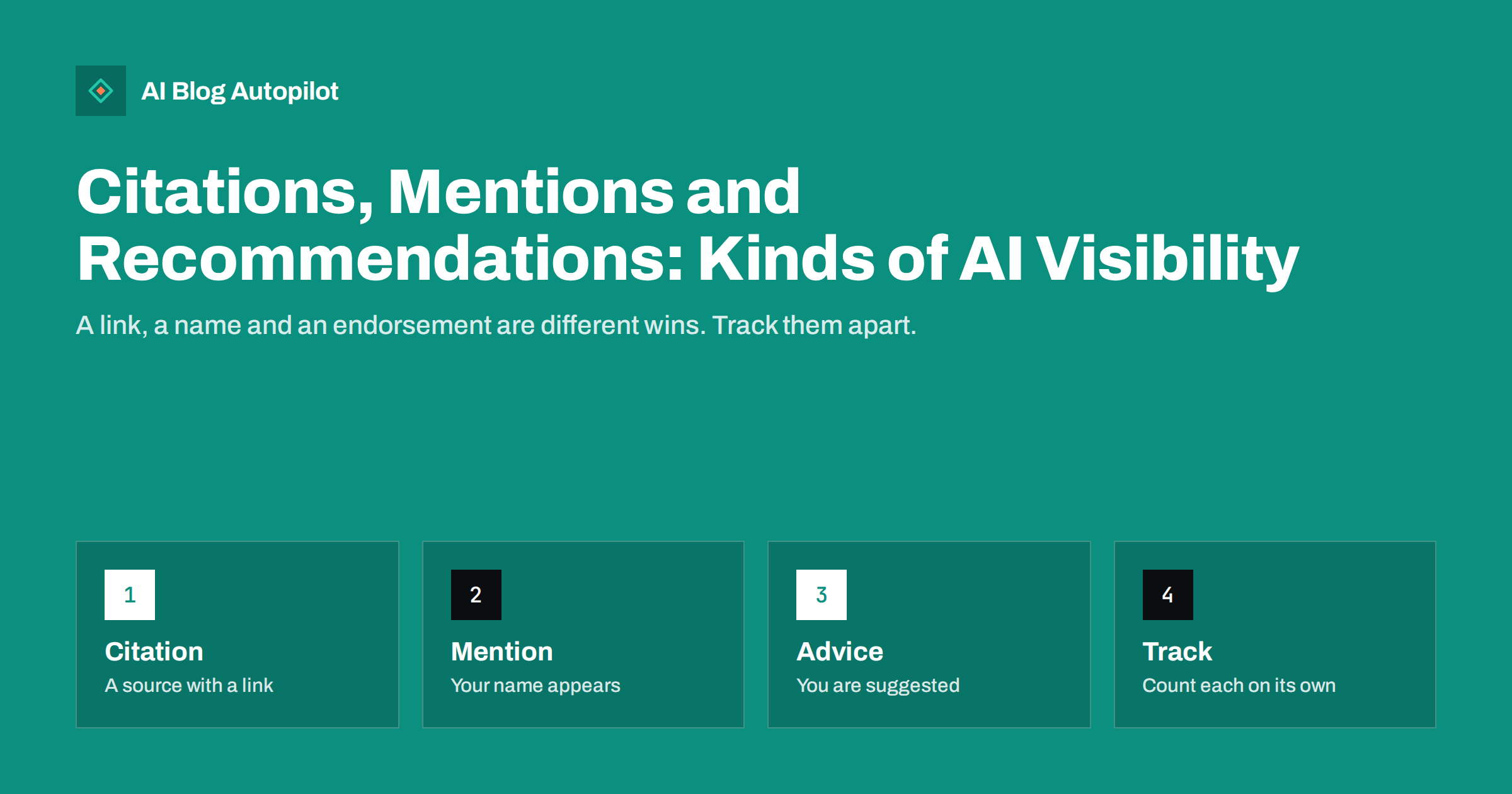
Short answer: when an AI assistant answers a question, your business can show up in three different ways. A citation is a link or reference to one of your pages as a source. A mention is your name appearing in the text of the answer, with or without a link. A recommendation is the assistant suggesting you as a good choice. Each needs different content and different tracking, so measure them separately and do not treat them as one number.
The term AI visibility is used loosely, and that causes confusion. A company may celebrate that “AI mentions us”, while the mentions are neutral, or a competitor may be recommended while it is only cited as a source. This article gives three plain definitions, shows how each one is earned and suggests a simple way to track them month by month.
The methods are the same for any assistant or answer feature. They are about how your pages and your reputation are used, not about a specific product.
Pay attention to which of your pages get cited. If the cited pages are not the ones you hoped for, such as an old post instead of your main guide, look at why. The old page may be clearer, or better linked, or it may carry the fact in a more direct form. Improving the page that you want cited is usually easier than trying to move attention away from the one that is.
Citations: your page as a source
A citation is a reference to a specific page that supported part of the answer. It often appears as a link, a footnote or a card next to the text. For you, it is the closest thing to a ranking position, since a reader can click through to your page.
Citations are earned by pages that give clear, accurate and well-structured answers to specific questions. A page that states a fact plainly, backs it with evidence and keeps its details current is easy to use as a source. The articles on how AI search picks sources and citing sources in blog posts explain the qualities that help.
A citation does not mean that the assistant agrees with you or praises you. It means that your page was used. A cited page can be used for a neutral fact, for a definition or even for a point that the answer then qualifies. Value it for the traffic and the trust that a visible link can bring.
Spelling and naming matter here. If your business is known by two names, or your product name is also a common word, assistants may mix you up with something else. Use one consistent name in titles, headings and profiles, and add a short description that says what you are, as covered in the article on ambiguous names in AI answers.
Mentions: your name in the answer
A mention is when the answer names your business, product or author, in the text. It may come with a link or not. A mention helps people to remember you, and it may lead them to search for you by name later, which shows up as branded traffic.
Mentions come from the wider web, not only from your own site. If many reliable sources describe you in the same terms, such as reviews, articles, directories and your own pages, an assistant is more likely to name you. The article on brand mentions in AI answers covers this.
A mention can be neutral, positive or negative. An assistant may list you as one example among many, or it may repeat a complaint. Read the context before counting a mention as a success. A name in a list of examples is useful, but weaker than a clear recommendation.
Think about who the recommendation is for. An assistant tends to tailor suggestions to the situation in the question, such as a budget, a size of firm or a place. If your pages state the situations you fit, with concrete examples, they give the assistant the facts that it needs to match you to a question, and they help human readers to decide quickly too.
Recommendations: you are suggested
A recommendation is stronger. The assistant says that, for a given need, you are a good choice, or it ranks you among the best. These answers often appear for questions such as “which tool should a small shop use” or “who is a good plumber near me”. They have a direct effect on decisions.
Recommendations are the hardest to earn. They tend to rely on evidence of quality: reviews, comparisons by independent sources, clear descriptions of who you are for and consistent facts across the web. Pages that say honestly who a product suits, and who it does not, help the assistant to place you correctly, as shown in honest fit statements.
Do not try to force a recommendation with exaggerated claims. If you claim to be best for everyone, an assistant has no reason to pick you for anyone in particular. Clear, specific positioning works better. The guide on how a local business gets mentioned in AI answers looks at how small firms get named.
How the three differ in practice
An example makes the difference clear. Suppose someone asks an assistant how to choose a bookkeeping tool. The answer cites an article on your site for a definition, which is a citation. It lists your product among several examples, which is a mention. And it says that your product suits freelancers best, which is a recommendation.
Each case teaches something different. A citation without a mention means that your content is useful but your brand is not linked with the topic. A mention without a citation means that people know your name, but your pages are not being used as sources. A recommendation without either is possible, but it is rare, and it may rely on reviews and other sites.
The mix shows where to work. If you are cited but not mentioned, strengthen your brand signals. If you are mentioned but not cited, improve the clarity and structure of your pages.
Keep your own questions neutral. If you ask “why is our product the best”, you will get a flattering and misleading answer. Ask what a customer would ask, without your name in the question, and see whether you appear. Add a few questions that include your name, to check what is said about you, as a separate test.
How to check each one
Build a fixed list of questions that your customers would ask, perhaps twenty to forty, and run them in a few assistants every month. Record the results in a sheet: the question, the tool, the date, whether you were cited, whether you were mentioned and whether you were recommended, with a line on the context.
Use the same wording each time, and note any changes in the tools. Answers can vary from one run to another, so repeat a question a few times if you want a sense of how stable the result is. Look at the trend over several months and not at a single day. The article on checking whether AI assistants mention your blog offers a method.
Add your analytics. Look for visits from assistants where they exist, and for growth in branded searches. The guide to tracking visits from AI assistants explains the signs. Keep in mind that many answers produce no click at all, so the visits are only part of the picture.
Give the work a rhythm. Each month, pick one citation gap, one mention gap and one recommendation gap from your sheet, and decide on one action for each, such as updating a page, correcting a profile or asking a happy customer for an honest review. Small, regular actions add up over a year.
How to earn more of each
For citations, improve the pages that answer specific questions. Put the answer near the top, give evidence, keep facts up to date and use clear headings. For mentions, make sure that your name is described the same way across your site, your profiles and the sources that talk about you.
For recommendations, collect real evidence of quality: honest reviews, case studies, independent comparisons and clear statements of who you serve. The article on reviews in AI answers shows what a business can do. Keep your claims modest and specific, so that they are easy to believe.
Across all three, avoid tricks. Hidden text, fake reviews and mass-produced pages risk your reputation and may be ignored. Steady work on real quality is slower, but it lasts.
Reporting without overclaiming
When you report AI visibility to a team or a client, give the three numbers separately, and explain the sample: how many questions, which tools and which month. Do not sum them into one score, since a citation and a recommendation are not equal.
Include a few quoted examples, with the question and the answer. These show the context, and they make the numbers real. Note any wrong or harmful statements about the business, and the steps you plan, as described in what to do when AI answers get your business wrong.
Be honest about the limits. Answers vary, tools change and your sample is small. The figures are a guide to direction, not a precise measure. A simple monthly report, as described in a monthly AI visibility report, is enough for most small businesses.
How AI Blog Autopilot helps
AI Blog Autopilot writes SEO articles around real search queries, with FAQ sections, tags and SEO meta, and publishes them on your own WordPress blog, which gives assistants clear pages to cite. It also shares each article to your social networks. Check each claim against your own facts before approval. See the pricing page for plans.
Related reading
- Brand Mentions: Why AI Answers Recommend Some Businesses
- Checking Whether AI Assistants Mention Your Blog
- A Monthly AI Visibility Report: What to Track and Show
The bottom line
A citation uses your page, a mention uses your name and a recommendation suggests you. Track the three separately, work on the content or the reputation that each needs and report them without overclaiming.
FAQ
What is the difference between a citation and a mention?
A citation points to one of your pages as a source. A mention is your name appearing in the text of the answer, with or without a link.
Is a recommendation better than a mention?
Usually, since it suggests you as a good choice for a need. It is also harder to earn, and it relies on evidence of quality.
How can I track these?
Keep a fixed list of customer questions, run them monthly in a few assistants and record each result in a sheet, with the date and the context.
Will answers be the same every time?
No. They can vary between runs and tools, so look at trends over months rather than single results.
Can I buy a recommendation?
You cannot reliably buy one. Clear positioning, honest reviews and consistent facts across the web are the lasting way to earn them.