ENEnglish
 LTLietuviškai
 DEDeutsch
 FRFrançais
 RUРусский
 ESEspañol
 PLPolski
 ITItaliano
 UKУкраїнська
 CSČeština
 PTPortuguês
 JA日本語
JA日本語 LVLatviešu valoda
 ETEesti
 HUMagyar
 IDBahasa Indonesia
 TRTürkçe
 HIहिन्दी
 ELΕλληνικά
 ARالعربية
 THไทย
THไทย VITiếng Việt
 RORomână
 MSBahasa Melayu
 BNবাংলা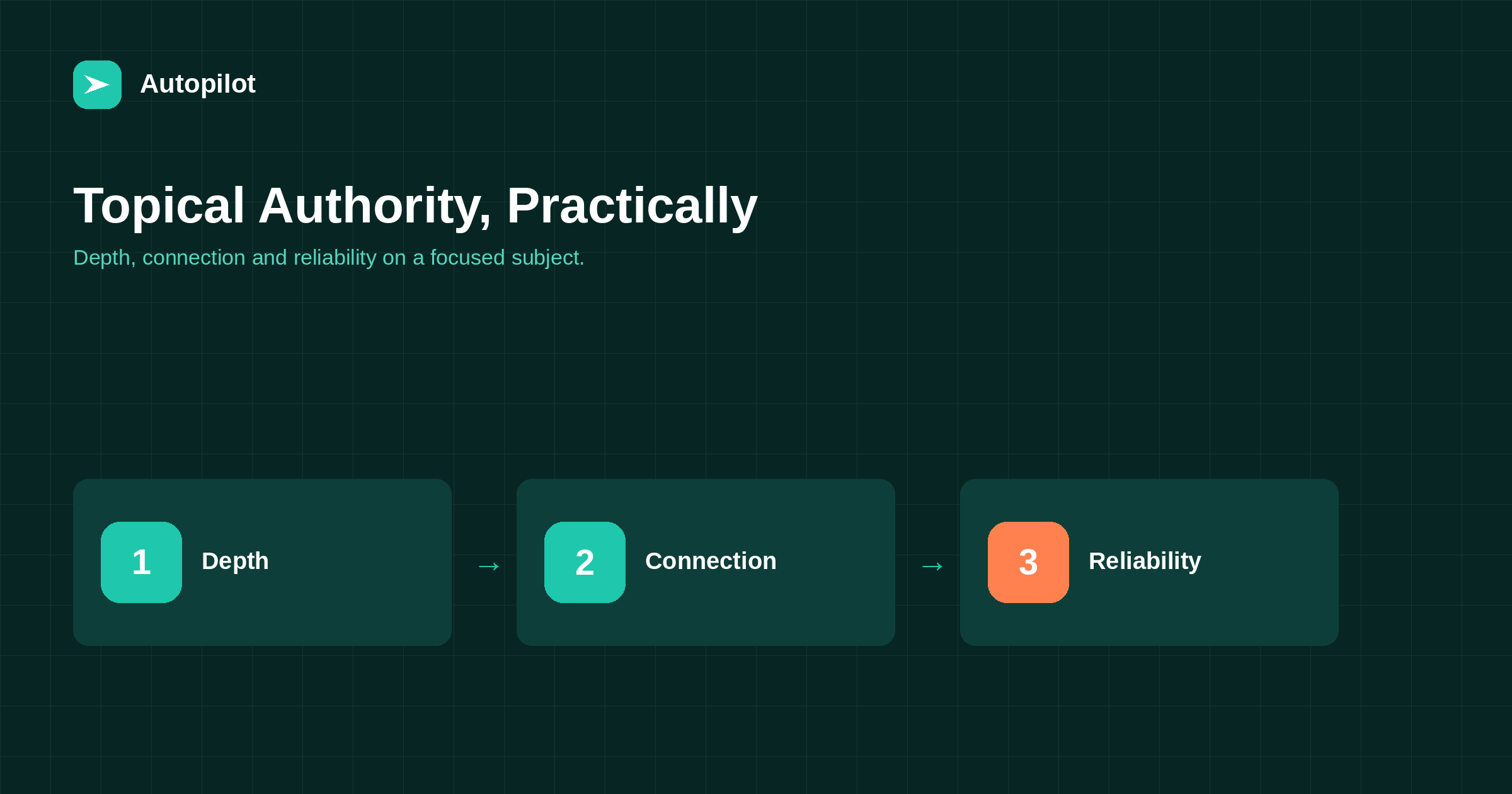
Short answer: topical authority is industry shorthand for a site covering a subject so thoroughly and reliably that search engines and readers treat it as a trusted source. In practice it means focusing on a few subjects, answering many distinct questions within each, connecting those articles through pillars and internal links, keeping them accurate and current, and showing real expertise. It is not a score, not a metric you can see, and not achieved by publishing many thin articles on the same subject.
Topical authority is one of the most used and least defined phrases in content marketing. It is not an official metric, and search engines do not publish a score for it.
It is still a useful idea, because it describes a pattern that genuinely helps: sites that cover a focused subject deeply and reliably tend to do better on that subject than sites that cover everything thinly.
What the phrase describes
When people talk about topical authority, they usually mean three things together.
- Depth: many distinct questions within a subject, answered well.
- Connection: those answers organised and linked so the whole subject is navigable.
- Reliability: accurate, current content from an accountable source with real expertise.
None of these is a trick. They describe what a reader would recognise as a good source on a subject.
Focus comes first
Depth requires focus. A blog covering twenty subjects with five articles each is shallow everywhere; one covering four subjects with twenty-five each can be deep in all of them.
Choose subjects where your business genuinely knows more than most — choosing what the blog is about covers the choice.
Depth means distinct questions
Depth is not the same as volume. Twenty-five articles answering distinct questions build a subject; twenty-five articles answering the same question in different words compete with each other.
| Builds depth | Does not |
|---|---|
| Distinct questions, each answered fully | Variations of one question |
| Beginner to advanced coverage | Only introductory articles |
| Specific cases and edge cases | Generic overviews repeated |
| Current, maintained articles | Outdated pages left to decay |
how many keywords one article should target covers keeping each article distinct.
Connection through structure
A pillar page on each subject, linking to supporting articles that link back, turns a set of articles into a structure readers and search engines can follow — clusters and pillar pages.
Internal links with descriptive anchor text show how articles relate. Orphan articles, however good, contribute less.
Reliability and expertise
Depth without accuracy is a liability. Keep facts current, cite sources, correct errors, and make clear who stands behind the content.
First-hand experience — your data, cases and views — is what distinguishes an expert source from a thorough summary. experience, expertise and trust covers the guidance on these qualities.
What it does not mean
Some interpretations of topical authority lead to poor decisions.
- Publishing hundreds of thin articles on one subject.
- Targeting every keyword variation with its own page.
- Expecting a measurable score to rise.
- Assuming coverage guarantees rankings.
How to build it
Pick one subject. Map the distinct questions readers ask, from basic to advanced. Write a pillar and supporting articles, linked together. Add experience and data. Maintain them. Then extend to the next subject.
Building one subject properly before moving to the next usually works better than spreading across many at once.
Authority and new sites
New sites have no history on any subject, which is one reason they struggle with broad, competitive queries. Starting with a narrow, specific subject and covering it thoroughly is usually the fastest way for a new site to become a credible source on anything.
Specific questions within that subject are often less competitive — long-tail keywords covers why — and each well-answered question adds to the site’s coverage. Broader queries become more reachable as the body of work grows.
Maintaining it
Coverage decays if it is not maintained. Articles go out of date, new questions arise, and competitors publish better answers. A subject you covered thoroughly two years ago may now be patchy.
Review each subject’s cluster at least yearly: update outdated articles, merge overlaps, add articles for new questions, and refresh the pillar page. Content decay covers spotting what has slipped.
Authority beyond your own site
Being a trusted source is also shaped by what happens elsewhere: other sites linking to and citing your articles, your experts quoted in the press, your team speaking at events or contributing to industry publications.
These are hard to manufacture and valuable when earned. Publishing something genuinely useful or original on your subject is usually what starts them — earning links honestly covers the approach.
A practical example
Consider a business selling scheduling software to clinics. A focused subject might be appointment scheduling for small clinics. Distinct questions include how to reduce no-shows, how to handle cancellations, how to schedule across several practitioners, how reminders should be timed, what to do about walk-ins, and how to choose scheduling software. A pillar explains appointment scheduling for clinics as a whole and links to each.
Twenty such articles, accurate and grounded in what the business sees across its customers, make it a genuinely useful source on that subject. The same twenty articles spread across twenty different subjects would not.
Where automation helps and where it does not
Automated drafting makes it much cheaper to cover many distinct questions within a subject, which is the depth part. It does not supply the reliability part on its own: accuracy, experience and accountability still depend on review and on material only the business has.
Measuring progress
There is no authority score, but there are signs: impressions and rankings across a growing range of queries within the subject, more pages from the cluster appearing, links from others in the field, and readers moving between articles in the cluster.
None guarantees future results. Together they suggest the site is becoming a better source on the subject.
Related reading
If this was useful, these cover the questions that usually come next.
- Clusters and pillar pages — the structure behind it
- Choosing what the blog is about — choosing where to build it
- Experience, expertise and trust — the related guidance
The bottom line
Topical authority is shorthand for depth, connection and reliability on a focused subject, not a score. Choose a few subjects, answer many distinct questions in each, connect them with pillars and links, keep them accurate and backed by real experience, and build one subject properly before the next.
KKK
What is topical authority?
Industry shorthand for a site covering a subject so deeply and reliably that it is treated as a trusted source on it.
Is topical authority a ranking factor?
It is not an official metric. It describes a pattern of depth, connection and reliability that tends to help.
How many articles build topical authority?
There is no number. Depth comes from distinct questions answered well, not from volume.
Can I build authority on many subjects at once?
It is usually better to build one subject properly before moving to the next.
Does publishing many articles on one topic help?
Only if they answer distinct questions. Variations of one question compete with each other.
How do I know if it is working?
Look for impressions and rankings across more queries within the subject, links from others, and readers moving between related articles.