ENEnglish
 LTLietuviškai
 DEDeutsch
 FRFrançais
 RUРусский
 ESEspañol
 PLPolski
 ITItaliano
 UKУкраїнська
 CSČeština
 PTPortuguês
 JA日本語
JA日本語 LVLatviešu valoda
 ETEesti
 HUMagyar
 IDBahasa Indonesia
 TRTürkçe
 HIहिन्दी
 ELΕλληνικά
 ARالعربية
 THไทย
THไทย VITiếng Việt
 RORomână
 MSBahasa Melayu
 BNবাংলা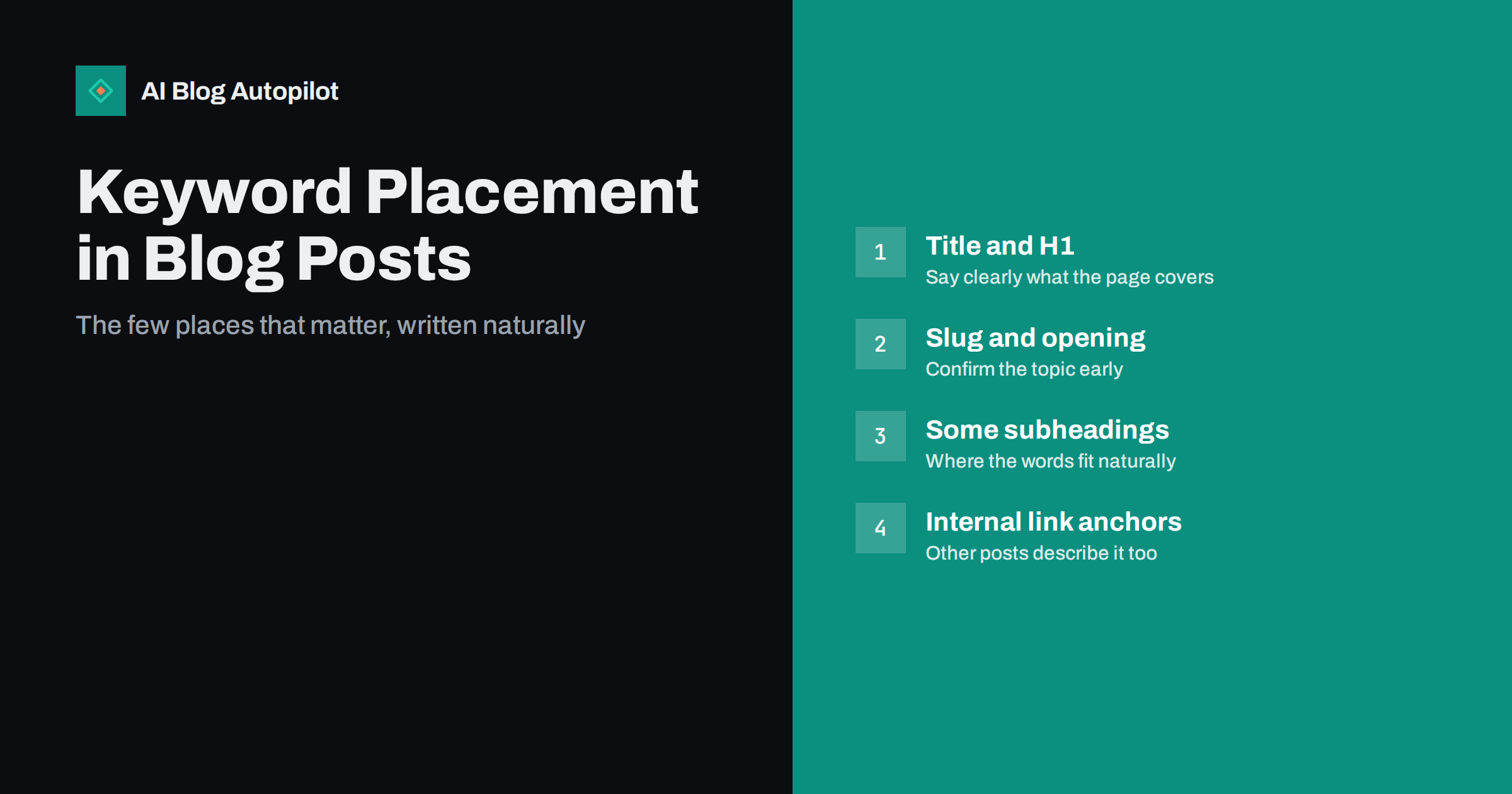
Short answer: put an article’s main search phrase, or a close natural variant, in the title tag, the H1, the URL slug and the opening paragraph, and use it or related wording in a few subheadings where it fits. Mention it naturally in the body, in image alt text only when it describes the image, and in the anchor text of internal links from other posts. There is no ideal keyword density: search engines understand synonyms and context, and forcing the exact phrase everywhere makes the article worse for readers.
Keyword placement is one of the oldest topics in SEO, and much of the advice still circulating comes from a time when search engines matched words far more literally. Today’s systems understand language much better, which changes the goal. You are no longer trying to repeat a phrase often enough to be noticed. You are trying to make it unmistakably clear, to readers and to search engines, what the page is about.
That still means using the main phrase in specific places. This guide explains which places matter, why, and how to do it without making the writing clumsy.
Start with the right phrase
Placement only helps if the phrase is right. Before you write, confirm:
- It matches the intent of the article. The results for the phrase should show pages like the one you plan to write.
- It is how people actually phrase it. Check wording in Search Console, keyword tools or “People also ask” boxes.
- It is one main phrase, not several competing ones. An article can rank for many related queries, but it should have one clear focus.
Once you have the main phrase, collect a few close variants and related terms. They will make the text read naturally while still reinforcing the topic.
The places that matter most
| Place | Why it matters | How to do it well |
|---|---|---|
| Title tag | A strong signal of the page’s topic and the headline in search results | Include the phrase or a natural variant, ideally near the start; keep it readable |
| H1 | Confirms the topic to readers and search engines on the page itself | Usually matches or closely mirrors the title |
| URL slug | A small signal and a readable address | Short, lowercase, keyword-first, without filler words |
| Opening paragraph | Confirms quickly that the page answers the query | Use the phrase naturally in the first two or three sentences |
| Subheadings | Structure the topic and match sub-questions | Use the phrase or related terms in some H2s, not all |
| Internal link anchors | Other pages describing this one reinforce its topic | Descriptive anchors that include the phrase or a variant |
Title tag and H1
The title tag is the most important single place for the main phrase. It tells search engines what the page is about and is usually the clickable headline in the results. Put the phrase near the beginning where it reads naturally, and make the rest of the title explain what is special about the article: “Keyword Placement: Where the Main Phrase Belongs in a Post” rather than “Keyword Placement Keyword Placement Tips”.
The H1 is the visible headline on the page. It usually matches the title or says the same thing in slightly different words. There is no need to make them different on purpose, and no need for them to be identical if a slightly longer on-page headline reads better.
URL slug and opening paragraph
A short, descriptive slug such as /keyword-placement-in-posts/ reads well in links and search results. It is a minor ranking signal at most, so do not twist it for exact matching, and never change the slug of an established post just to add a keyword.
The opening paragraph should confirm that the reader is in the right place. Using the main phrase in the first two or three sentences does that naturally. A direct answer at the top, followed by what the article covers, serves both skimming readers and search engines, and is also the part most likely to be quoted in search features.
Subheadings and body text
Subheadings organise the article and often match the sub-questions people search for. Use the main phrase or close variants in some of them where it genuinely describes the section, for example “How to choose keyword placement for a new post”. Do not put it in every heading. A page where every H2 repeats the same phrase reads like a template and helps no one.
In the body, write naturally. The main phrase will appear a few times simply because you are writing about it. Beyond that, use:
- Variants and synonyms that people use for the same thing.
- Related terms that naturally belong to the topic. An article about sourdough will mention starter, hydration and proofing without being told to.
- Specific examples that show expertise, which also bring in the vocabulary of the subject.
Search engines use this surrounding language to understand the topic and its depth. It matters more than how many times the exact phrase appears.
A before-and-after example makes the difference clear. Imagine an article targeting “how to descale a coffee machine”. A stuffed version might open: “How to descale a coffee machine is a question many ask. To descale a coffee machine, you need to know how to descale a coffee machine properly.” A natural version: “Descaling a coffee machine every one to three months, depending on your water hardness, keeps it brewing hot and tasting clean. Here is how to do it with vinegar, citric acid or a commercial descaler, and how to tell when it is due.” The second uses the phrase once, adds useful specifics and brings in related terms such as water hardness and citric acid, which make the topic clearer than repetition ever could.
Images, meta description and links
- Image alt text should describe the image for people who cannot see it. If the image genuinely shows the topic, the phrase may fit naturally. Do not add keywords to alt text of unrelated images.
- Image file names can be descriptive, such as
keyword-placement-checklist.png, which is better than a camera-generated name. - The meta description is not a direct ranking factor, but it is often shown in results, and words matching the query may be highlighted. Include the phrase if it fits a compelling summary.
- Internal links from other posts are an underrated placement. When related articles link to this one with anchors like “keyword placement guide”, they reinforce what the page is about.
- External links are about sources, not keywords. Link where it helps the reader.
What about keyword density?
Keyword density, the percentage of words that are the target phrase, was once treated as a target, with figures like “one to two percent” repeated widely. There is no evidence that modern search engines reward a particular density, and Google’s spam policies explicitly list keyword stuffing, repeating words unnaturally to manipulate rankings, as something to avoid.
A better test is to read the article aloud. If the phrase sounds forced or repeated, rephrase. If a reader would struggle to tell what the article is about, it is too vague. Clarity is the goal; frequency is a side effect.
Common placement mistakes
- Stuffing the exact phrase everywhere, including awkward grammatical forms such as “best running shoes beginners” instead of “best running shoes for beginners”.
- Leaving the phrase out of the title in favour of a clever headline that does not say what the page covers.
- Using a different main phrase in the title and the H1, which blurs the focus.
- Targeting the same phrase in several posts, which makes them compete. One phrase, one page.
- Burying the topic. An opening that takes three paragraphs to reach the subject loses readers and weakens the page’s clarity.
- Rewriting old URLs for keywords, which throws away accumulated signals unless redirected, and even then is rarely worth it.
A quick placement checklist
- Main phrase chosen and matches the intent of the search results.
- Phrase or natural variant in the title tag, near the start.
- H1 matches or closely mirrors the title.
- Slug short, descriptive and keyword-first.
- Phrase used naturally in the first two or three sentences.
- Phrase or related wording in some subheadings, not all.
- Variants, related terms and examples throughout the body.
- Descriptive alt text and file names for relevant images.
- At least a couple of related posts link to this one with descriptive anchors.
The same checklist works for existing posts. When a post ranks on page two for a query that matches its topic, check whether that query, or a close variant, appears in the title, the opening and at least one subheading. Often the article covers the subject well but describes it in different words from the ones people search with. Aligning the wording in those few places, without rewriting the rest, is one of the quickest improvements you can make to an older article.
How AI Blog Autopilot helps
AI Blog Autopilot plans every article around a real search query and writes the title, headings, SEO meta, tags and FAQ around it. Its automatic quality gate checks length, structure, keyword and meta before anything goes live, and weak articles wait for you instead of being published. You still choose the topics and keywords that matter to your business. See how Autopilot writes SEO articles.
Related reading
- Meta Titles and Descriptions: What to Write and What to Automate
- How to Write a URL Slug That Still Makes Sense in Two Years
- How Many Keywords Should One Article Target?
- Keyword Clustering: Grouping Search Queries Into Articles
The bottom line
Keyword placement is about clarity, not repetition. Use the main phrase in the title, H1, slug and opening, in some subheadings and in internal link anchors from related posts, and let variants, related terms and examples carry the rest. Ignore density targets, avoid stuffing, and read the article aloud: if it sounds natural and the topic is obvious, the placement is right.
KKK
Where should I put the main keyword in a blog post?
In the title tag, the H1, the URL slug and the opening paragraph, plus some subheadings where it fits naturally. Internal links from related posts with descriptive anchors also help reinforce the topic.
Is there an ideal keyword density?
No. There is no evidence that modern search engines reward a specific percentage, and repeating a phrase unnaturally counts as keyword stuffing. Write naturally and use variants and related terms.
Should the title tag and H1 be the same?
They can be identical or slightly different. What matters is that both clearly describe the same topic and include the main phrase or a close variant.
Do I need the exact keyword or are variations enough?
Close natural variants work, because search engines understand synonyms and word order. Use the most common phrasing in the title and let variations appear throughout the text.
Should I change old URLs to include keywords?
Usually not. Changing an established URL resets signals unless you redirect it, and the gain from a keyword in the slug is small. Improve the title and content instead.