ENEnglish
 LTLietuviškai
 DEDeutsch
 FRFrançais
 RUРусский
 ESEspañol
 PLPolski
 ITItaliano
 UKУкраїнська
 CSČeština
 PTPortuguês
 JA日本語
JA日本語 LVLatviešu valoda
 ETEesti
 HUMagyar
 IDBahasa Indonesia
 TRTürkçe
 HIहिन्दी
 ELΕλληνικά
 ARالعربية
 THไทย
THไทย VITiếng Việt
 RORomână
 MSBahasa Melayu
 BNবাংলা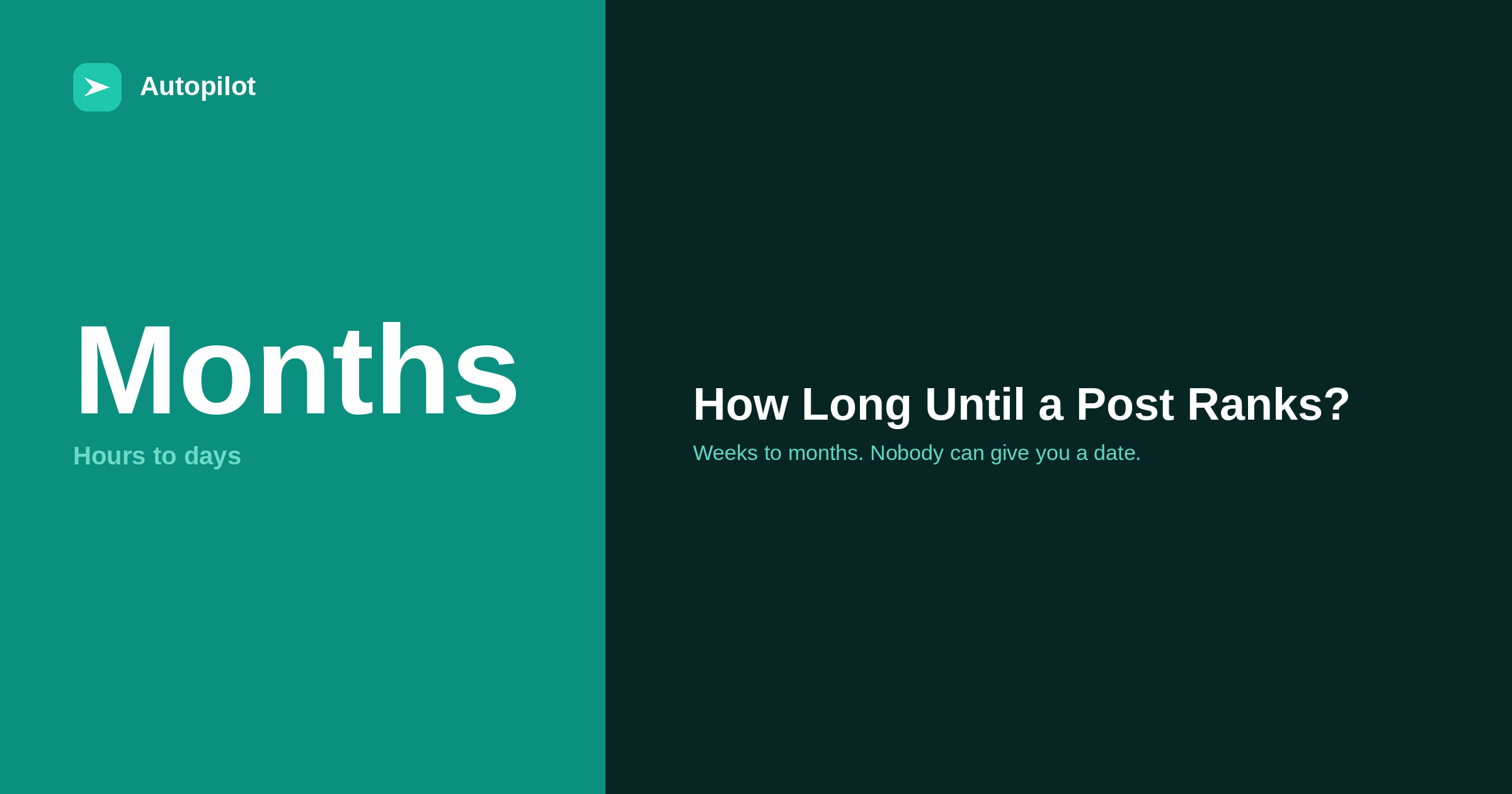
Short answer: there is no fixed timeline and nobody can honestly promise one. As a rough pattern, a new post on an established site is usually discovered within days and indexed within days to a couple of weeks, then its position moves around for weeks before settling, often somewhere in the range of two to six months. On a brand-new domain everything takes longer. Specific, low-competition questions settle faster than broad terms. You can speed up discovery with a sitemap, internal links and IndexNow; you cannot speed up how a search engine judges the page.
This is the question behind a lot of anxiety about new content, and it has an unsatisfying honest answer: it depends, it takes longer than you would like, and anybody who gives you an exact number is guessing.
What is useful is understanding the stages, because each one has different causes when it stalls and a different set of things you can actually influence.
The three stages
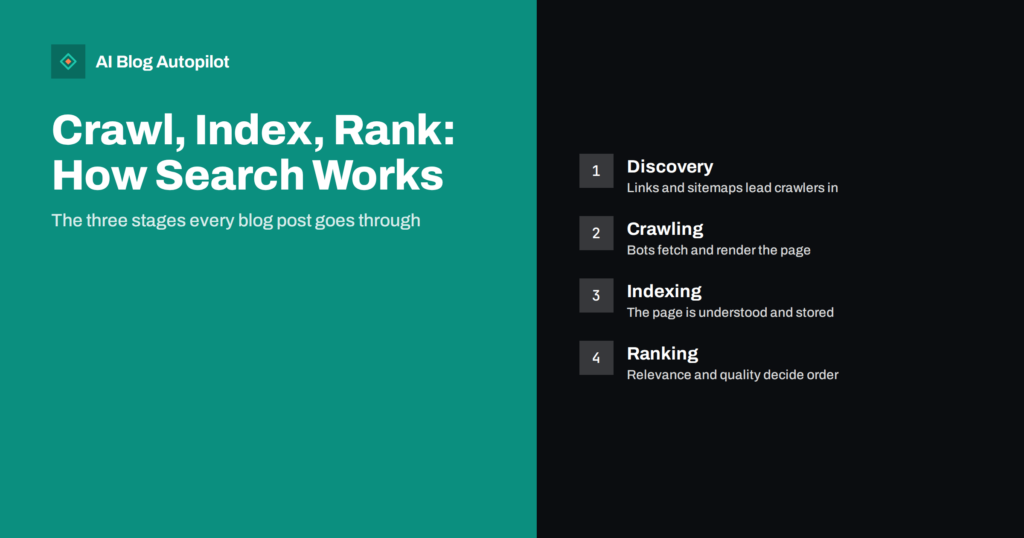
Between publishing and a stable position, a page goes through three distinct steps.
| Stage | What happens | Typical range | Can you influence it? |
|---|---|---|---|
| Discovery | A crawler learns the URL exists | Hours to days | Yes, a lot |
| Indexing | The page is fetched, processed and stored | Days to weeks | Somewhat |
| Ranking | Its position settles against competitors | Weeks to months | Only through quality |
The ranges are rough and vary with the site. A well-established site with frequent crawling moves through the first two quickly; a new domain can wait weeks just to be crawled regularly.
Speeding up discovery
Discovery is the stage you control most, and the three levers are all free.
- An XML sitemap, submitted in Search Console and kept current automatically. WordPress generates one by default.
- Internal links from pages already crawled. A new article linked from your homepage or a popular post is found faster than an orphan — see internal linking as you publish.
- IndexNow, which notifies participating search engines of a new or changed URL immediately. Several engines support it; Google does not currently use it.
Requesting indexing manually in Search Console also works for individual important pages. It is not something to do for every post, and doing it repeatedly does not help.
Why indexing sometimes stalls
A page that is discovered but not indexed is a different situation from one not yet found, and Search Console distinguishes them.
Crawled, currently not indexed usually means the page was fetched and judged not worth including for now — often because it is thin, very similar to another page, or on a site that has not yet earned much crawling. Discovered, currently not indexed usually means it is in the queue.
The first is a quality signal; the second is mostly patience. Technical blocks are a third possibility and worth ruling out early: a noindex tag, a robots rule, or a canonical pointing elsewhere. why posts do not rank goes through the checklist.
Why positions move around at first
New pages often appear, rise, drop and reappear over the first weeks. This is normal and not a sign that anything is wrong.
A search engine has very little information about a new page: no history of how searchers respond to it, few or no links, limited context. Its position is a provisional estimate that gets revised as information accumulates.
The practical advice is not to react to week-one positions. Rewriting a page in its second week because it dropped from 14 to 31 resets the process and removes the information that was accumulating.
What makes some pages settle faster
Four factors consistently shorten the wait.
Specific queries. A long-tail question with few competing pages can settle in weeks. A broad commercial term may take a year, or never happen — the argument in long-tail keywords.
An established site. Domains with history and regular crawling move faster through every stage.
Topical fit. A page on a subject the site already covers well has context around it.
Links. Internal ones immediately, external ones if they come naturally.
What to do while waiting
The worst use of the waiting period is watching one page. The best is publishing the next ones.
A steady publishing schedule means that at any moment several pages are at different stages, and the site as a whole gains information and crawl attention. That compounding is most of the argument for a regular cadence in how often to publish.
Check new pages once at two weeks to confirm they are indexed, and then leave them alone until three months. At that point you have enough data to judge, and a page that has not settled anywhere useful is a candidate for the fixes in refreshing old posts.
What nobody can promise
No tool, agency or publishing method can guarantee that a page will rank, or when. The factors include competitors you cannot see, changes to how queries are interpreted, and algorithm updates that are never fully documented.
That includes AI Blog Autopilot. What any publishing setup can do is make sure pages are technically sound, discoverable quickly, well structured and published consistently. Those are the preconditions. The outcome is decided elsewhere, and it is worth being suspicious of anyone who says otherwise.
Related reading
If this was useful, these cover the questions that usually come next.
- Why posts do not rank — when waiting is not the explanation
- The Search Console reports that matter — where to watch it happen
- Long-tail keywords — the queries that settle fastest
The bottom line
Discovery takes hours to days and you can speed it up. Indexing takes days to weeks and depends partly on quality. A settled position takes weeks to months and depends on the page, the competition and the site. Check at two weeks for indexing, judge at three months, and spend the time in between publishing the next articles.
KKK
How long does it take for a new blog post to rank?
There is no fixed timeline. Commonly, discovery takes days, indexing days to weeks, and a stable position somewhere between a few weeks and several months. New domains and competitive queries take longer.
How can I get a new post indexed faster?
Keep an XML sitemap submitted, link the new post from pages that are already crawled, and use IndexNow for the search engines that support it. For a single important page, request indexing in Search Console.
Why does my new post keep moving up and down?
A new page has little history, so its position is a provisional estimate revised as information accumulates. Fluctuation in the first weeks is normal; do not rewrite the page in response.
What does crawled, currently not indexed mean?
The page was fetched and not included for now, often because it is thin, very similar to another page, or on a site that has not yet earned much crawling. Improving the page usually helps more than resubmitting it.
When should I judge whether a post has worked?
Check at about two weeks that it is indexed, then wait until roughly three months before deciding. Earlier data is too unstable to act on.
Can any tool guarantee my post will rank?
No. Rankings depend on competitors, query interpretation and algorithm changes nobody controls. A publishing setup can make pages sound, discoverable and consistent; it cannot promise a position or a date.