ENEnglish
 LTLietuviškai
 DEDeutsch
 FRFrançais
 RUРусский
 ESEspañol
 PLPolski
 ITItaliano
 UKУкраїнська
 CSČeština
 PTPortuguês
 JA日本語
JA日本語 LVLatviešu valoda
 ETEesti
 HUMagyar
 IDBahasa Indonesia
 TRTürkçe
 HIहिन्दी
 ELΕλληνικά
 ARالعربية
 THไทย
THไทย VITiếng Việt
 RORomână
 MSBahasa Melayu
 BNবাংলা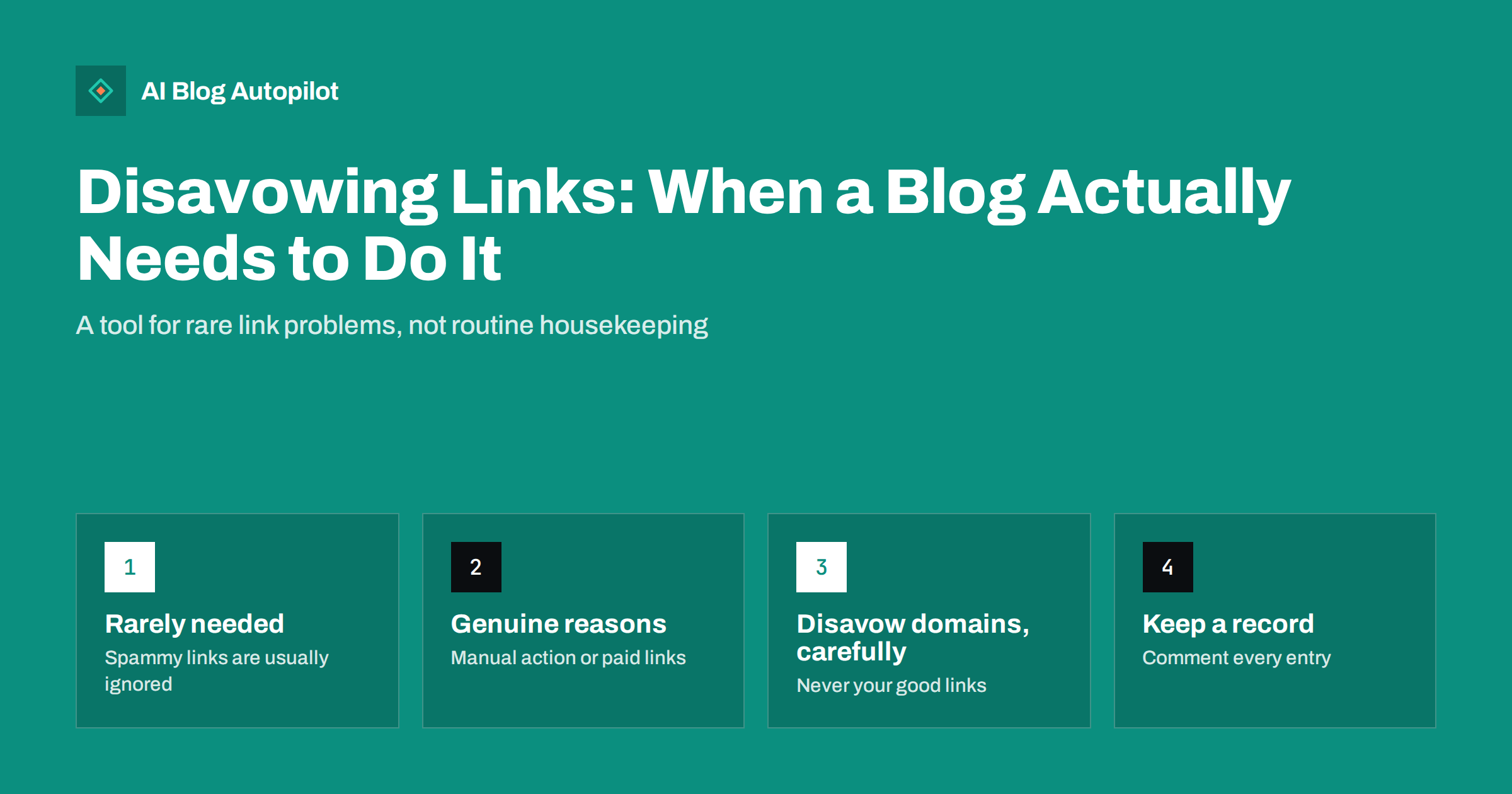
Short answer: disavowing links means asking a search engine to ignore specific links pointing to your site. Most blogs never need to do it. Search engines already ignore the random spammy links that every site collects over time. The disavow tool is meant for a narrow set of situations: a manual action for unnatural links, or a history of paid or manipulative links that you cannot get removed. Used carelessly, it can switch off links that were helping you.
Few SEO topics generate as much anxiety as “toxic backlinks”. Blog owners open a link report, see dozens of strange domains, foreign-language directories and scraper sites linking to them, and conclude they are under attack. Some tools add to the worry by giving each link a risk score.
The reality is calmer. This guide explains what disavowing does, why it is rarely needed on an ordinary blog, when it genuinely is, and how to do it safely if you must.
What the disavow tool does
Google provides a disavow tool through Search Console, and Bing offers a similar feature in its webmaster tools. You upload a plain text file listing URLs or whole domains, and the search engine treats links from those sources as if they had a nofollow attribute: they are not counted as endorsements of your site.
A few points are worth understanding before going further.
- It does not remove the links. The links stay on the other sites. Readers can still click them. Only the search engine’s treatment of them changes.
- It is a suggestion. Search engines treat the file as a strong hint, not a command they must follow in every case.
- It takes time. The file is applied as the search engine recrawls the linking pages, which can take weeks or months.
- It replaces the previous file. Each upload replaces the whole list, so the file must always contain everything you want disavowed.
Why most blogs do not need it
Every site that has been online for a while collects low-quality links it never asked for. Scraper sites copy content along with its links. Automatically generated directories list everything they find. Spam pages link to popular sites to look legitimate. None of this is something you did.
Search engines have dealt with this for years. Their systems are designed to identify and ignore spammy links rather than punish the sites they point to. Google’s own guidance says that most sites do not need to use the disavow tool, and that it is intended for cases where there are many spammy, artificial or low-quality links that you are responsible for, or that have led to a manual action.
That last part is the key distinction. The disavow tool addresses links that look like attempts to manipulate rankings, typically the result of past link building practices, not the random noise that every site receives.
When disavowing makes sense
There are a few situations where the tool is the right choice.
- You have a manual action for unnatural links. Search Console’s Manual actions report says so explicitly. Here, cleaning up the links, including disavowing those you cannot remove, is part of the path to a successful reconsideration request.
- You or a previous agency built manipulative links. Paid links without proper attributes, large link exchanges, private blog networks or links from article marketing schemes. If you know these exist and they are numerous, disavowing them is a reasonable precaution.
- You bought a domain with a history. A domain previously used for spam may carry links built by someone else. If the link profile is clearly manipulative, disavowing it gives you a cleaner start.
- A genuine, large-scale negative SEO attack that is clearly harming you. These are much rarer than people fear, and search engines usually ignore them. Consider disavowing only when there is a clear pattern and a clear drop that other causes do not explain.
When not to disavow
- Because a tool gave links a high “toxicity” score. Third-party scores are estimates based on the tool’s own rules. They are not what search engines use.
- Because traffic dropped. Traffic drops have many causes: algorithm updates, competitors, seasonality, technical problems, lost rankings for a few key pages. Disavowing links rarely fixes a drop that links did not cause.
- Because a linking site looks ugly or foreign. A plain-looking site in another language can be a perfectly normal link.
- To tidy up. Disavowing as routine hygiene risks removing links that were quietly helping.
How to review your links first
If you think you may be in one of the situations above, start by understanding the link profile before touching the disavow tool.
- Export your links. Search Console’s Links report lets you export top linking sites and sample links. A third-party backlink tool can add more data.
- Group by domain. Review domains rather than individual URLs. A single decision per domain is faster and more robust.
- Look for patterns, not individual oddities. Signs of manipulation include many links with exact-match commercial anchor text, links from networks of similar-looking sites, sitewide footer links from unrelated sites, and links from pages that exist only to sell links.
- Mark each domain. Keep, remove, or disavow. Most will be “keep”, including many that look unimpressive.
- Try removal for links you built. If you or your agency placed links, contact the site owners and ask for removal or a nofollow or sponsored attribute. Record your attempts. This matters especially when responding to a manual action.
Building the disavow file
The file itself is simple, but mistakes in it can be costly. Follow the format in Google’s help documentation for the tool, and keep these principles in mind.
- Plain text, one entry per line. Each line is either a full URL or a domain written as
domain:example.com. - Prefer domain entries. Spammy sites often link from many pages, and new ones appear. Disavowing the domain covers all of them.
- Use comments. Lines starting with
#are ignored by the search engine. Use them to note why an entry was added and when, so you or a colleague can understand the file later. - Never include your own domain or legitimate sites such as partners, press coverage, directories you are genuinely listed in, or social networks.
- Double-check before uploading. A single wrong line, such as disavowing a major site that links to you legitimately, removes real value.
Because each upload replaces the previous file, keep a master copy in a safe place and edit that, rather than starting from scratch each time.
After uploading
Once the file is uploaded, there is little to do except wait and monitor.
- If you have a manual action, submit a reconsideration request explaining what you found, what you removed, what you disavowed and what you have changed to prevent it happening again. Be specific and honest.
- If you disavowed as a precaution, watch rankings and traffic over the following months, but do not expect a sudden jump. Removing the influence of manipulative links can even cause a small drop if they had been helping.
- Review the file occasionally. If you disavowed something by mistake, remove it and upload the corrected file. The change takes effect as pages are recrawled.
Preventing the problem in the first place
The best way to avoid ever needing the disavow tool is to avoid the link practices that lead to it. Search engines’ spam policies, such as Google’s spam policies, describe link schemes in detail. In practice, for a blog, that means:
- Do not buy links that pass ranking value. If you pay for placement, the link should carry a
sponsoredornofollowattribute. - Be cautious with agencies that promise a number of links per month for a fee.
- Avoid large-scale guest posting done mainly for links, especially with keyword-rich anchor text.
- Earn links by publishing things people want to reference: original insights, useful tools, clear explanations and honest comparisons.
What a manual action for links looks like
Because the manual action is the clearest reason to disavow, it helps to know what one looks like. It appears in the Manual actions report in Search Console, and the site owner usually also receives a message. The report names the type of problem, such as unnatural links to your site, and says whether it affects the whole site or only some pages.
If that report says “No issues detected”, you do not have a manual action. Ranking changes without a manual action come from automated systems, and for links those systems mostly work by ignoring what they consider spam rather than penalising the target. That is why checking this report is the first step before any disavow work: it tells you whether you are dealing with a confirmed problem or a suspicion.
How AI Blog Autopilot fits in
AI Blog Autopilot writes and publishes SEO articles to your WordPress blog and shares each one to your social networks. It does not build or buy backlinks, so it does not create the kind of manipulative link profile the disavow tool exists for. What steady publishing of genuinely useful articles can do is give other sites more reasons to link to you naturally over time, which is the kind of link that never needs disavowing. You can see how it works on the AI Blog Autopilot home page.
Related reading
- Earning Backlinks Honestly: What Works for a Small Site
- Guest Posting: What Still Works and What Does Not
- What to Do When Your Blog Traffic Drops
- Google Search Console: The Five Reports That Matter
The bottom line
The disavow tool is a specialist instrument for manual actions and for cleaning up manipulative links you are responsible for. For an ordinary blog collecting the usual spammy links, search engines already ignore them, and disavowing out of worry can switch off links that were helping. If you do need it, review links by domain, try removal first, keep a commented master file, and change the practices that caused the problem.
KKK
Should I disavow spammy backlinks to my blog?
Usually not. Search engines are designed to ignore the random spammy links every site receives. Disavowing is meant for manual actions or for manipulative links you or someone working for you built.
Can disavowing links hurt my rankings?
Yes, if you disavow links that were genuinely helping. The tool tells search engines to ignore those links, so removing good ones reduces the value pointing to your site. Review carefully and avoid disavowing on the basis of third-party scores alone.
How long does a disavow take to work?
It is applied as search engines recrawl the linking pages, which can take weeks or months. There is no instant effect, and you should not expect an immediate change in rankings.
Is negative SEO a real threat to small blogs?
It is rarely effective, because search engines ignore most spammy links. If you see a sudden flood of clearly manipulative links together with a drop that nothing else explains, disavowing those domains is a reasonable precaution.
Should I disavow individual URLs or whole domains?
Whole domains in most cases. Spammy sites often link from many pages and add more over time, so a domain entry covers them all. Use individual URLs only when a site is otherwise legitimate and just one page is a problem.