ENEnglish
 LTLietuviškai
 DEDeutsch
 FRFrançais
 RUРусский
 ESEspañol
 PLPolski
 ITItaliano
 UKУкраїнська
 CSČeština
 PTPortuguês
 JA日本語
JA日本語 LVLatviešu valoda
 ETEesti
 HUMagyar
 IDBahasa Indonesia
 TRTürkçe
 HIहिन्दी
 ELΕλληνικά
 ARالعربية
 THไทย
THไทย VITiếng Việt
 RORomână
 MSBahasa Melayu
 BNবাংলা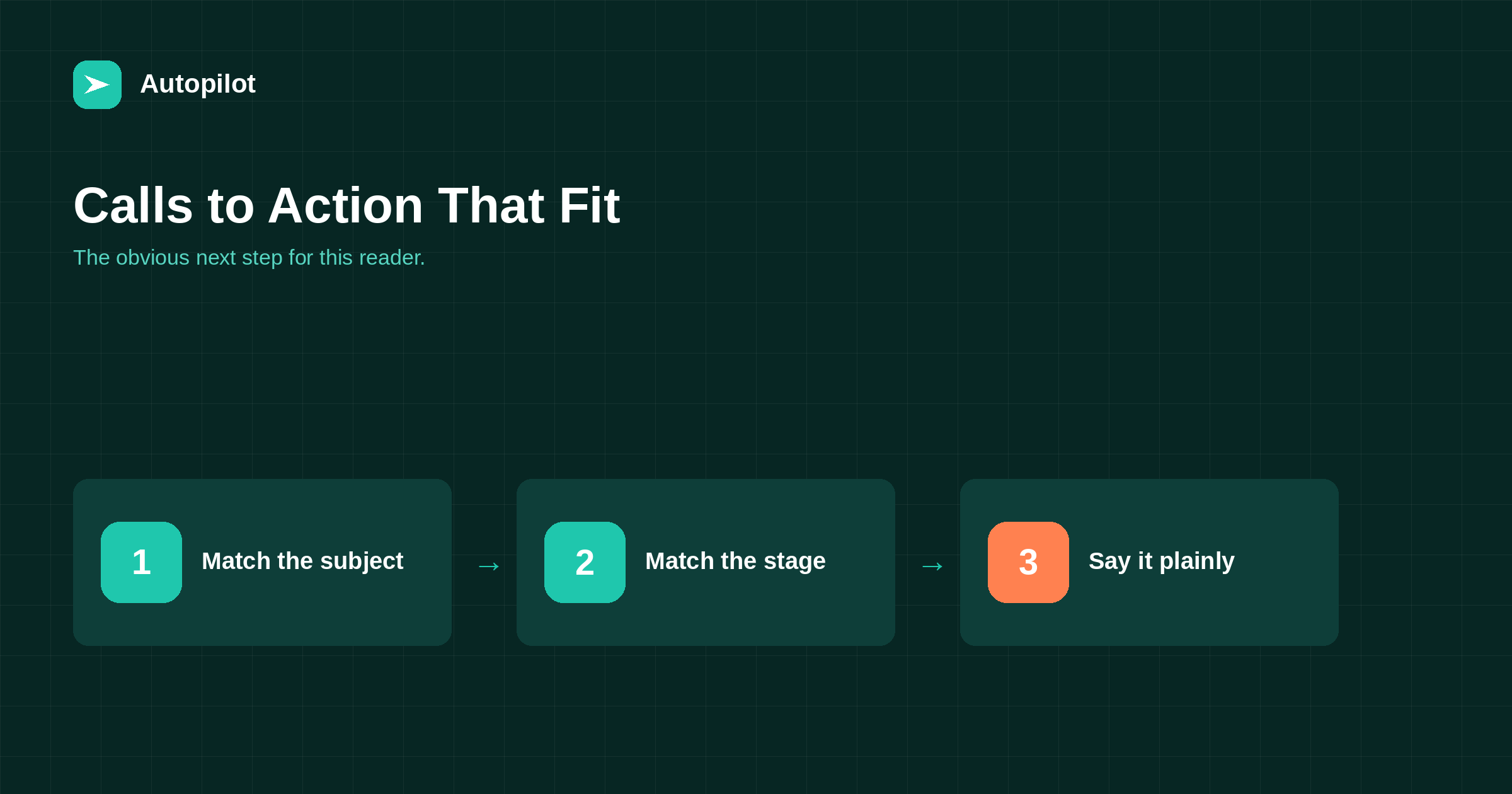
Short answer: a good call to action is the obvious next step for someone who has just read that particular article. Match it to the subject — the same problem, one step further — and to the reader’s stage: a guide or checklist for someone learning, a comparison or case study for someone choosing, a trial or conversation for someone ready. Say plainly what they get and what happens next. Use one primary offer per article, placed after the reader has been helped, rather than several competing ones.
Most blog calls to action are the same banner on every page: contact us, book a demo, subscribe. They are easy to set up and easy to ignore, because they are not connected to anything the reader was just thinking about.
A call to action that fits is different. It reads as the natural continuation of the article, which is why people act on it.
Match the subject
The strongest offers continue the article’s own subject.
An article about writing content briefs could offer a brief template. An article about choosing between approaches could offer a short comparison call. An article about a setup process could offer a checklist or a trial that does the setup. The reader has just spent several minutes on this problem; an offer about the same problem meets them where they are.
An offer about something else — a general newsletter, an unrelated product — asks them to switch context, and most will not.
Match the stage
Readers arrive at different distances from a decision, and the article’s subject usually tells you which.
| Reader stage | Typical article | Fitting offer |
|---|---|---|
| Learning | What something is, how it works | Related guide, checklist, newsletter |
| Choosing | Comparisons, costs, how to choose | Case study, comparison call, pricing |
| Ready | Setup, specific how-to for your product | Trial, demo, direct contact |
| Customer | Advanced use, troubleshooting | Support, upgrade, community |
Offering a demo to a learner feels pushy; offering a newsletter to someone ready to buy wastes their intent.
Write it plainly
A call to action should say what the reader gets and what happens when they click.
Get the brief template — a one-page document you can copy is better than Download now. Try it on your own site: the first three articles are free is better than Start your journey. Specific and plain beats clever, the same principle as in writing a headline people click.
If there is a condition — an email address, a sign-up — say so. Surprises after the click lose people and trust.
One primary offer
An article with a newsletter box, a demo banner, a product pop-up and a related-guide link gives the reader four decisions and usually results in none.
Choose one primary offer per article, the one that best fits. Secondary options, such as related articles, can remain as quiet links. The primary offer should be clearly the main next step.
Where to place it
After the reader has been helped. That usually means after the section that answered the core question or solved the hardest step, and again briefly at the end.
For long articles, a short mid-article offer and a fuller one at the end works well. Avoid placing it before any help has been given, and avoid pop-ups that cover the article on arrival — they are a poor experience, especially on phones, as reading on a phone explains.
Formats that work
The offer can take several forms within an article.
- A sentence with a link, woven into the text where it is relevant. Unobtrusive and often effective.
- A short box with a heading, one line and a button, visually distinct but not loud.
- An end-of-article block summarising the next step.
Match the visual weight to the offer. A related checklist does not need a flashing banner; a trial for a ready reader can be more prominent.
Examples by article type
A few pairings make the principle concrete. An article on writing alt text pairs naturally with a short alt text checklist. An article comparing three ways to produce content pairs with a cost worksheet or a short call. An article explaining how to connect a site to a publishing tool pairs with a free trial that performs that connection. An article on seasonal planning pairs with a calendar template.
In each case the offer is something the reader was already about to need.
Setting it up at volume
For a blog with many articles, writing a unique offer for each is impractical. A small set of offers mapped to categories and stages covers most of it: a learning offer, a choosing offer and a ready offer for each main subject.
Assign one per article when it is planned, alongside the question and intent, as described in planning a month of articles. Review the mapping every few months against which offers readers actually take.
Measuring it
Track clicks on each offer and, where possible, what those clicks lead to. An offer with many clicks and no outcomes may be well placed but poorly matched to what follows; one with few clicks may be invisible or irrelevant.
No wording or placement guarantees a conversion rate. A fitting offer, plainly written and well placed, simply gives interested readers an easy way to continue — getting more enquiries from existing readers covers the wider work.
Related reading
If this was useful, these cover the questions that usually come next.
- Getting more enquiries from existing readers — the wider conversion picture
- Templates and checklists worth subscribing for — offers for earlier-stage readers
- How to structure an article — where the offer sits in the shape
The bottom line
Make the call to action the obvious next step for the reader of that specific article: the same subject, one step further, matched to how close they are to a decision. Say plainly what they get and what happens, use one primary offer, place it after the reader has been helped, and map a small set of offers to subjects and stages at volume.
KKK
What makes a good call to action in a blog post?
It continues the article’s subject, fits the reader’s stage, says plainly what they get and what happens next, and appears after the reader has been helped.
How many calls to action should an article have?
One primary offer, possibly repeated briefly at the end, plus quiet links to related articles. Several competing offers usually result in none being taken.
Should every blog post have a demo or contact offer?
No. Readers who are still learning respond better to guides, checklists or a newsletter. Save direct offers for articles read by people close to a decision.
Where should the call to action go?
After the section that answered the reader’s main question, and again at the end. Not before any help has been given, and not as a pop-up on arrival.
How do I manage calls to action across many articles?
Create a small set of offers for each main subject and stage, and assign one to each article when it is planned.
What wording works best?
Plain, specific wording that says what the reader gets. Clever or vague phrases underperform clear descriptions of the offer.