ENEnglish
 LTLietuviškai
 DEDeutsch
 FRFrançais
 RUРусский
 ESEspañol
 PLPolski
 ITItaliano
 UKУкраїнська
 CSČeština
 PTPortuguês
 JA日本語
 LVLatviešu valoda
 ETEesti
 HUMagyar
 IDBahasa Indonesia
 TRTürkçe
 HIहिन्दी
 ELΕλληνικά
 ARالعربية
 THไทย
 VITiếng Việt
 RORomână
 MSBahasa Melayu
 BNবাংলা
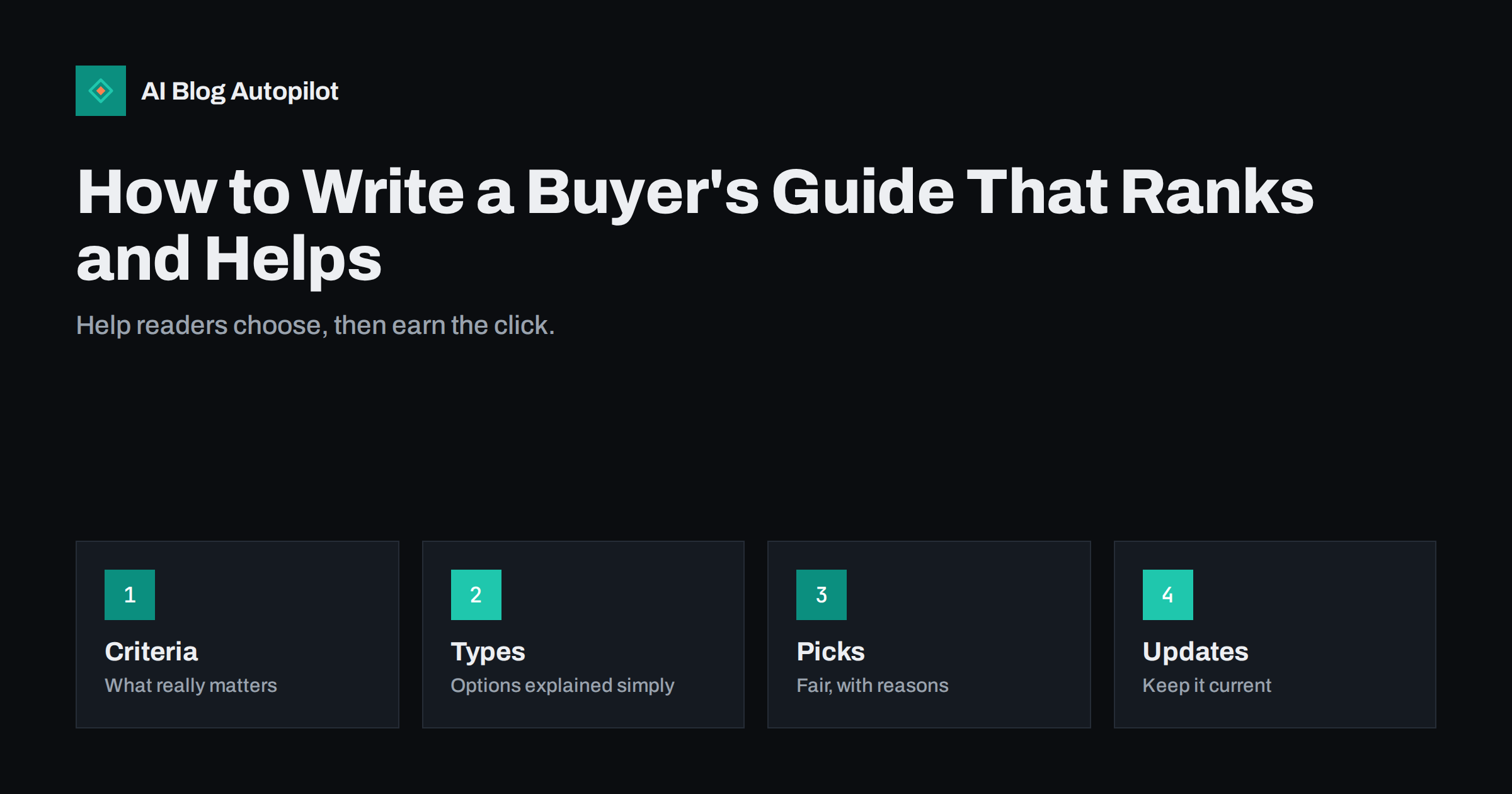
Short answer: a buyer’s guide helps a reader choose a product or service. Start by naming who it is for, explain the few criteria that matter most, describe the main types and their trade-offs, give a small number of picks with honest reasons, state how you evaluated them and when, and update the page on a schedule. Lead with the reader’s decision, not with your catalogue.
People search for buyer’s guides when they are close to a decision but still unsure: which laptop for a student, which boiler for a small house, which accounting software for a freelancer. They want a trusted voice to cut through technical detail and tell them what to look for. A guide that does this well earns trust, links and sales, and it can appear in many search and AI answers.
This guide explains how to plan and write a buyer’s guide for a business blog, how to be fair and transparent, how to structure the page for readers and search engines and how to keep it accurate over time. It suits shops, service providers, software companies and affiliate publishers, with notes on disclosure for each.
Know the reader and the decision
Begin with the person who will use the guide. Describe their situation in one sentence: a first-time buyer, a small business owner on a budget, a parent choosing for a child, a professional who needs reliability. A guide that tries to serve everyone ends up helping nobody, and the opening paragraph should let the right reader recognise themselves.
Identify the decision. Is the reader choosing between types of product, brands, price levels or providers? Do they need to decide now or in a month? The decision shapes the structure. A guide to choosing a type of product is different from a guide that compares specific models, and mixing them confuses readers.
Look at what people ask. Check the search suggestions, forum questions, customer emails and reviews to see which worries come up: price, size, compatibility, reliability, support, safety. Use their words in headings. The guide on search intent explains how to match the page to what the searcher wants.
Check the competition. Read the top guides on the subject and note what they cover and what they miss. You do not need to copy them, and you should not. Look for gaps: a missing explanation, an outdated figure, a group of readers they ignore. Fill those gaps with your own knowledge.
Think about different readers within the same guide. A beginner needs simple language and a safe default, an enthusiast wants detail and a professional wants reliability and support. Use short boxes or sections for each group, marked clearly, so that each reader can find a level of detail that suits them without feeling talked down to or overwhelmed.
Add a short glossary for the terms that readers will meet in shops and on product pages. When a reader understands the words on a label, they feel more in control, and are more likely to return to the guide when they compare options in a shop or online.
Explain the criteria that matter
The core of a buyer’s guide is the list of things to consider. Choose five to eight criteria, not twenty, and explain each in plain words: what it is, why it matters, what is good or poor and how to check it. Order them by importance, and say which ones most buyers can ignore.
Use examples and numbers carefully. A statement such as look for at least eight hours of battery life is only useful if it is true for the product type and the use. Give a reason and say how you reached the number. Where there is no clear threshold, explain the trade-off instead.
Offer a quick way to apply the criteria: a short checklist, a table or a set of questions that the reader can answer. For example, ask how many people will use it, where it will be used and what the budget is, and then show which type suits each answer. A tool that turns knowledge into action is more valuable than a long list of facts.
Warn about common mistakes and marketing tricks: buying on one number, ignoring running costs, paying for features that are never used and skipping the warranty details. Specific warnings are memorable and help readers trust that the guide is on their side.
Describe the types and the trade-offs
Most products come in a few types, and many readers do not know the differences. Explain each type: how it works, who it suits, typical price range, strengths and weaknesses. Use simple headings and short paragraphs, and add a comparison table if it makes the differences clearer. Keep the table small enough to read on a phone.
Be honest about trade-offs. Cheaper products may cost more over time, lighter ones may be less durable and complex ones may need more maintenance. Say what is gained and what is lost, rather than presenting one option as perfect. Readers sense when a page is balanced, and they reward it.
Include alternatives outside your own range. If another type of product or service suits some readers better, say so, and explain how to decide. This candour may cost a sale occasionally, but it builds the reputation that earns many more, and it is exactly what makes a guide worth citing.
Add context about prices and costs: the purchase price, running costs, accessories, installation and disposal. The guide on writing honest articles about what things cost explains how to present figures with dates and ranges.
Add real evidence where you can: your own photographs, measurements, notes from customers who use the product and returns data. Original details, such as which size is most often exchanged, make the guide different from others that repeat specifications. Only publish figures you can support, and say how you obtained them.
Make fair picks and show your method
Many buyer’s guides end with recommended products. If you include them, choose a small number, typically three to five, and explain for whom each is best, with reasons and drawbacks. Avoid labels such as best overall unless you explain the basis, and never claim to have tested something that you have not.
Describe how you evaluated the options: what you tested yourself, what came from specifications, what came from reviews and when it was done. If you use your own experience, say how long and in what setting. This transparency is part of the experience and trust that search engines and readers look for. The guide on how to write a product comparison shows a fair structure.
Disclose relationships. If you sell the products, say so. If you earn commission from links, say so near the top, in plain words. If a supplier provided a sample, say so. Disclosure is a legal duty in many countries, and it also protects your credibility. The guide to affiliate links on a blog explains how to do it well.
Be specific about limits. Prices, models and availability change, so give the date of your check and avoid promising that a product is in stock. If a pick is discontinued, update or remove it quickly, and note the change at the top of the page.
Structure the page for readers and search
Open with a short answer: who the guide is for and the main advice in two or three sentences, perhaps with a quick pick list. Readers who are in a hurry get what they need, and assistants can quote it. Then add a contents list for long guides, so that people can jump to the section they need.
Use clear headings that match questions: how much should I spend, what size do I need, which type is easiest to maintain. Keep paragraphs short, use lists where steps or items are parallel and add images that clarify, such as diagrams of sizes or labelled photographs. Give every image a useful text description.
Add a frequently asked questions section at the end with real questions and concise answers, and mark it up properly. Link to related guides and to the product or category pages where readers can act. Internal links help readers move on and help search engines understand how pages relate.
Keep the tone helpful and direct. Avoid hype, avoid unexplained jargon and avoid pressure. A call to action at the end should be calm: see the range, compare the options or ask for advice. The guide on calls to action that fit a blog post offers examples.
Ask your team to flag changes. Sales, support and buying staff often hear first about a discontinued model, a new regulation or a common fault. A simple shared note that goes to the person who owns the guide keeps it accurate between scheduled reviews and prevents readers from acting on outdated advice.
Keep the guide current
A buyer’s guide goes out of date quickly. Put a visible last-reviewed date on the page, and set a schedule: every three months for fast-moving products, every six to twelve for slower ones. At each review, check prices, availability, specifications, links and the criteria themselves.
Update the same page instead of publishing a new one each year, and keep the address stable so that links and authority carry forward. Explain major changes in a short note at the top. If you change recommendations, say why. The guide on how to refresh old blog posts explains the process.
Watch the results. Look at search queries, time on the page, clicks to product pages and questions from readers. If many visitors leave at a certain section, rewrite it. If a question appears repeatedly in comments or emails, add it to the guide.
Finally, build a family of guides. A main guide can link to focused ones, such as for beginners, for small budgets or for particular uses. Together they cover more searches, and each supports the others. Over time, such a set becomes one of the most valuable parts of a business blog.
How AI Blog Autopilot helps
AI Blog Autopilot can write and publish articles on your chosen topics, with FAQ sections, tags and SEO meta, and share them to your social networks. Give it your product knowledge and criteria, and check every claim, price and recommendation before each article goes live. See the pricing page for plans and monthly credits.
Related reading
- How to Write a Product Comparison
- Blog Strategy for an Online Store
- Affiliate Links on a Blog: How to Use Them Honestly
The bottom line
Name the reader and decision, explain a few criteria and the main types, give fair, transparent picks and review the guide on a schedule.
KKK
How long should a buyer’s guide be?
Long enough to cover the main criteria, types and picks, usually 1,500 to 2,500 words, with a short answer at the top.
How many products should I recommend?
Three to five, each with who it suits and its drawbacks, so readers can choose without being overwhelmed.
Do I need to disclose affiliate links?
Yes, in plain words near the top and wherever the law of your country requires it.
How often should I update a buyer’s guide?
Every three months for fast-moving products and every six to twelve for slower ones, with the date shown.
Should I include products I do not sell?
If they suit some readers better, yes. Honest alternatives build the trust that makes a guide worth citing.