ENEnglish
 LTLietuviškai
 DEDeutsch
 FRFrançais
 RUРусский
 ESEspañol
 PLPolski
 ITItaliano
 UKУкраїнська
 CSČeština
 PTPortuguês
 JA日本語
JA日本語 LVLatviešu valoda
 ETEesti
 HUMagyar
 IDBahasa Indonesia
 TRTürkçe
 HIहिन्दी
 ELΕλληνικά
 ARالعربية
 THไทย
THไทย VITiếng Việt
 RORomână
 MSBahasa Melayu
 BNবাংলা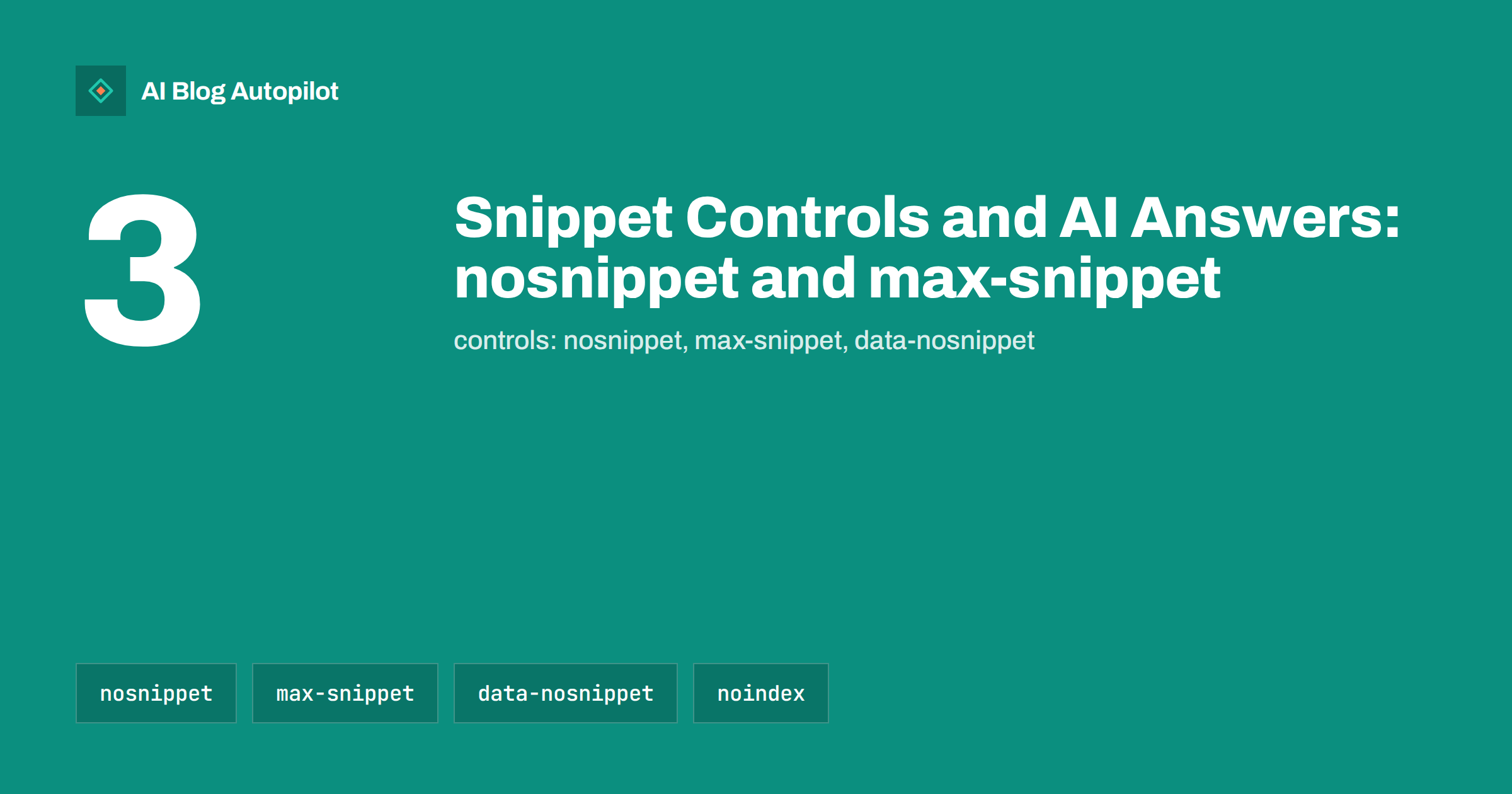
Short answer: snippet controls are robots directives that limit how much of your page a search engine may show as a preview. In Google Search, the same controls also apply to AI features such as AI Overviews and AI Mode: nosnippet stops text previews, max-snippet caps their length, and the data-nosnippet attribute hides chosen passages. For most blogs the right setting is no restriction at all, because a page that cannot be quoted is less likely to be shown, cited or clicked.
As AI answers take up more space in search results, some publishers ask whether they can control what those answers take from their pages. The honest answer is: partly, and at a cost. This article explains what each control does, how it interacts with AI features, and when a blog might reasonably use one.
What a snippet is and why controls exist
A snippet is the short text a search engine shows under a result to preview the page. It can come from your meta description or from the page’s visible text, whichever the search engine thinks answers the query best. Featured snippets, the larger boxes at the top of some results, are a bigger version of the same idea.
Snippet controls exist because some site owners have legitimate reasons to limit previews. A publisher may not want long passages of paid content visible without a click. A site may have text that makes no sense out of context, such as legal disclaimers or product codes. Search engines therefore offer ways to say “show less” or “do not show this part”.
It helps to separate three layers that people often mix up. Robots.txt decides whether a crawler may fetch a page at all. Indexing directives such as noindex decide whether a fetched page may appear in results. Snippet controls work one level lower still: the page is fetched and indexed, and the controls only limit how much of its text may be displayed. Each layer solves a different problem, and using the wrong one is a common source of accidental damage.
The four controls in plain language
nosnippetis a robots meta tag value. It tells search engines not to show a text snippet or video preview for the page at all. The page can still be indexed and ranked, but it appears with little or no description.max-snippet:[number]limits the snippet to a number of characters.max-snippet:0behaves like nosnippet, andmax-snippet:-1means no limit.data-nosnippetis an HTML attribute you add to specific elements such as aspan,divorsection. Text inside those elements is not used in snippets, while the rest of the page is.noindexis not a snippet control but belongs in the same conversation. It removes the page from search results entirely, and with it any chance of appearing in AI features.
There are related directives for media: max-image-preview controls the size of image previews, and max-video-preview the length of video previews. Google documents all of them in its robots meta tag specifications.
How snippet controls affect AI Overviews and AI Mode
Google’s documentation on AI features and your website is direct about this. To be shown as a supporting link in AI Overviews or AI Mode, a page must be indexed and eligible to be shown in Search with a snippet. To limit what is shown from your pages, Google points to the same controls: nosnippet, data-nosnippet, max-snippet and noindex.
In practice this means:
- A page with
nosnippetis not eligible to have its text used as a preview, and is therefore unlikely to be a supporting source in AI answers. - A page with a short
max-snippetgives AI features less text to draw on. - Passages wrapped in
data-nosnippetare excluded, while the rest of the page remains usable. - There is no separate “allow in search, block from AI Overviews” switch. AI features are part of Google Search, and Googlebot’s normal crawl feeds both.
Google also offers a robots.txt token called Google-Extended, which relates to how content may be used for training and grounding in some of its other AI systems. According to Google’s documentation it does not control inclusion in Google Search, and it is not a way to opt out of AI Overviews.
Other search engines and AI assistants
Snippet controls are a web convention, not only a Google feature, and other major search engines support some of the same robots directives. Each documents its own list, so check the webmaster help pages for any engine that matters to your audience.
Standalone AI assistants are a different case. Many of them retrieve pages through their own crawlers or through a search partner. Whether they respect snippet directives depends on each product. Where they identify their crawler, the reliable tool is robots.txt, which controls access rather than previews. The guide to AI crawlers, robots.txt and llms.txt covers that side.
How to implement each control
For a whole page, add a robots meta tag in the <head>:
<meta name="robots" content="nosnippet">removes text previews.<meta name="robots" content="max-snippet:160">limits previews to about a meta description’s length.<meta name="robots" content="max-image-preview:large">allows large image previews, which many publishers actively want.
For part of a page, wrap the text: <div data-nosnippet>…</div>. Keep the wrapped element valid HTML, because a broken structure may cause the attribute to be ignored.
For files that are not HTML, such as PDFs, use the X-Robots-Tag HTTP header with the same values. On WordPress, SEO plugins usually expose some of these settings per post or globally. Check what your plugin outputs by viewing the page source rather than trusting the settings screen, and confirm the result with the URL Inspection tool in Search Console.
When a blog might reasonably use them
For a business blog whose purpose is to be found, the default of no restrictions is almost always correct. There are a few narrow cases where a control makes sense:
- Boilerplate blocks. A long disclaimer, cookie text or promotional banner inside the content area sometimes ends up quoted instead of your answer. Wrapping it in
data-nosnippethelps search engines pick the useful text. - Member or paid sections. If part of an article is for subscribers, excluding it from snippets is reasonable, alongside proper markup for paywalled content.
- Internal or thin pages. Pages such as thank-you screens are better handled with
noindexthan with snippet limits. - Sensitive details. If a page must stay public but contains a detail you prefer not to see quoted out of context,
data-nosnippeton that passage is a precise tool.
The trade-off: less exposure, not more control over the answer
It is tempting to think that limiting snippets forces people to click. Usually it does the opposite. A result with no preview looks less useful, and a page that AI features cannot quote is less likely to be shown as a source at all. Your competitors’ pages, which do allow previews, fill the space instead.
Snippet controls also do not let you choose what an AI answer says. They only limit what can be taken from your page. If you want your blog to be represented accurately, the more effective approach is to make the right text easy to quote: a clear, correct answer near the top, concise definitions, and sections that make sense on their own. The guide to writing for featured snippets covers the same habits.
There is also a measurement problem. If you add restrictions and traffic changes, it is hard to separate the effect of the control from seasonal swings, algorithm updates or changes in how often AI answers appear for your queries. If you do experiment, change one group of similar pages, keep a note of the date and compare impressions and clicks in Search Console over several weeks rather than days.
Checking your blog for accidental restrictions
Accidental restrictions are more common than deliberate ones. A theme update, a plugin setting or a migration can leave a nosnippet or noindex on pages that should be open. A quick check:
- View the source of a few posts and search for
name="robots"anddata-nosnippet. - Check the HTTP headers for
X-Robots-Tag, which is invisible in the page source. - Search for one of your posts and see whether a normal description appears under the result.
- Use URL Inspection in Search Console to see what Googlebot received, as Google itself recommends when troubleshooting preview controls.
How AI Blog Autopilot fits in
AI Blog Autopilot does not add snippet restrictions to the articles it publishes. It writes each post with a direct answer near the top, clear sections and an FAQ, plus a title and meta description, which are the ingredients search engines and AI features can quote. Robots settings stay under your control in WordPress and your SEO plugin. You can see how Autopilot works on the home page.
Related reading
- AI Answers in Search Results: What They Mean for Traffic
- How to Get Your Blog Cited by ChatGPT, Perplexity and Google AI Overviews
- Zero-Click Searches: What They Mean for a Business Blog
The bottom line
Snippet controls let you limit previews, and in Google Search the same controls apply to AI Overviews and AI Mode. They are precise tools for boilerplate, paid sections and sensitive passages, not a strategy for winning clicks. For a blog that wants to be found and cited, leave previews open and make the best answer easy to quote.
FAQ
Does nosnippet remove my page from Google?
No. A page with nosnippet can still be indexed and ranked, but it appears without a text preview. To remove a page from search results entirely, use noindex instead.
Can I block AI Overviews but keep normal search results?
Not separately. Google treats AI Overviews and AI Mode as part of Search, and the same snippet controls apply to both. Limiting snippets reduces what can appear in AI features and in normal previews at the same time.
What does data-nosnippet do?
It is an HTML attribute that excludes the text inside a specific element from snippets, while the rest of the page stays eligible. It is useful for disclaimers, boilerplate or passages you do not want quoted out of context.
Does Google-Extended stop my content appearing in AI Overviews?
According to Google’s documentation, no. Google-Extended relates to use in some of Google’s other AI systems, while Search features, including AI Overviews, are controlled by normal robots directives and snippet controls.
Should a business blog use max-snippet?
Usually not. A length limit gives search engines less text to show, which can make your result less attractive. Leave it unset unless you have a specific reason, such as protecting paid content.
How long does it take for a snippet control change to take effect?
Only after search engines recrawl the page, which can take from a few days to several weeks depending on how often the page is visited by crawlers. Requesting indexing in Search Console can speed up the recrawl of an important page.