ENEnglish
 LTLietuviškai
 DEDeutsch
 FRFrançais
 RUРусский
 ESEspañol
 PLPolski
 ITItaliano
 UKУкраїнська
 CSČeština
 PTPortuguês
 JA日本語
JA日本語 LVLatviešu valoda
 ETEesti
 HUMagyar
 IDBahasa Indonesia
 TRTürkçe
 HIहिन्दी
 ELΕλληνικά
 ARالعربية
 THไทย
THไทย VITiếng Việt
 RORomână
 MSBahasa Melayu
 BNবাংলা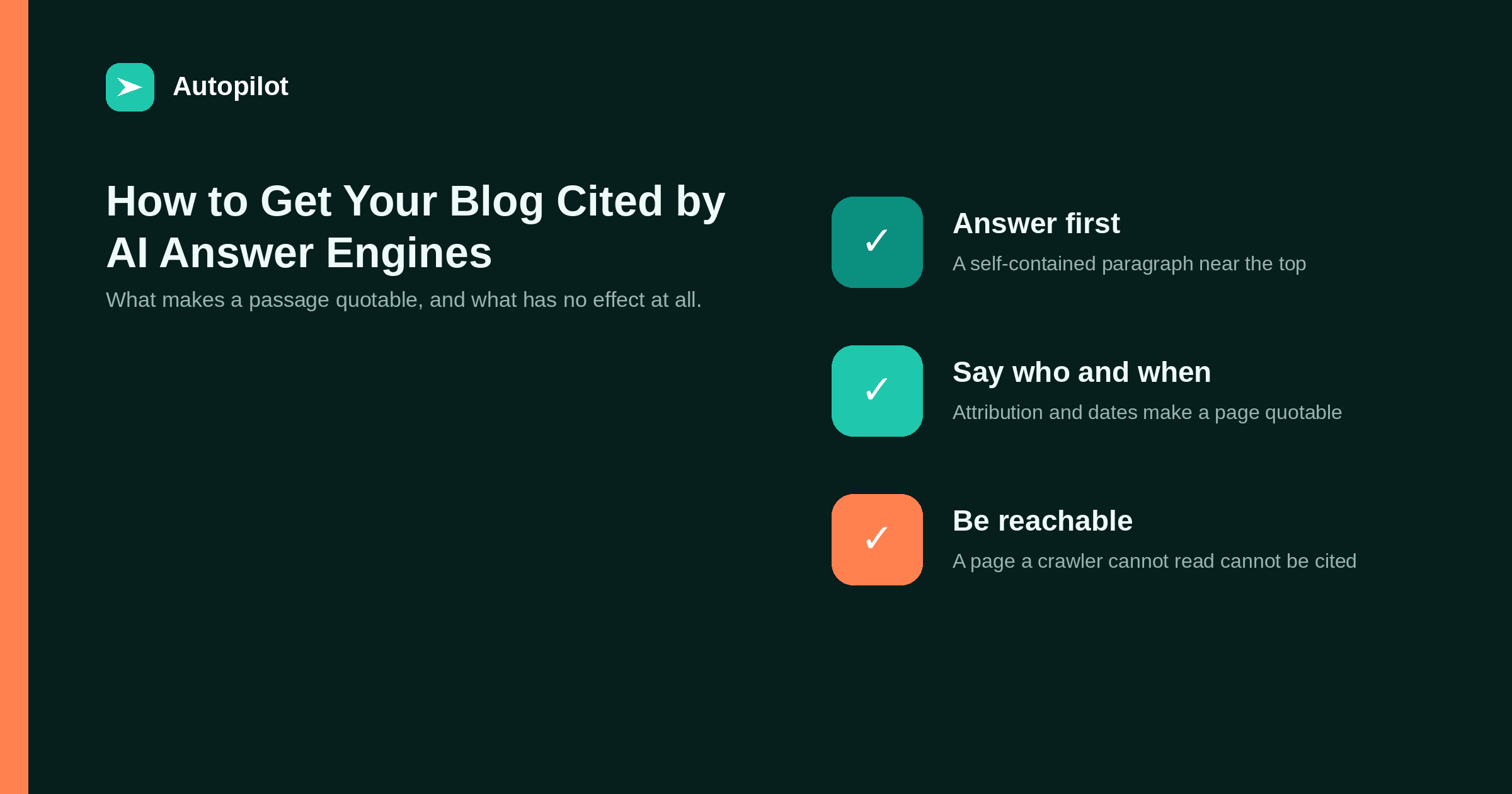
Short answer: write passages that can be lifted out and still make sense. Answer engines quote self-contained statements, so a direct answer in the first paragraph, clear headings, a real FAQ section and visible dates do more than any keyword work. Make sure the page is crawlable and fast, say plainly where a claim comes from, and keep facts current, because stale pages get replaced. Nobody — including us — can guarantee a citation, and anyone who promises one is selling something they do not control.
Answer engines changed the shape of the question. Ranking first still matters, but a growing share of searches end with a summary that names a handful of sources, and being one of those names is now its own objective.
There is a great deal of confident advice about how to achieve it, most of it invented. What follows is the part that is defensible: how these systems appear to select passages, what is genuinely under your control, and which popular tactics have no mechanism behind them.
How a citation actually happens
Simplified, but accurate enough to act on: the system retrieves candidate pages, reads them, and assembles an answer from passages it considers reliable and relevant. The citation points at the page that supplied a passage.
That single sentence explains most of what follows. The unit being selected is not your article — it is a paragraph. Your article’s job is to contain paragraphs that survive being removed from it.
A paragraph survives extraction when it states its subject rather than relying on the heading above it, answers one thing completely, and does not depend on the sentence before it. "It also supports this" is unquotable. "Autopilot writes articles in 25 languages" is quotable.
What is genuinely in your control
Five things, in rough order of how much difference they make.
1. A direct answer near the top
One paragraph that would satisfy someone who reads nothing else. This is also the single best change for human readers, which is a useful sign that it is not a trick.
2. Headings that match real questions
Headings are how a machine finds the relevant part of a long page. "Pricing" is worse than "What it costs per article", because the second matches how someone asks.
3. An FAQ section written to stand alone
Question-and-answer pairs are the most extractable format there is. Write each answer so it makes sense with the question and nothing else.
4. Attribution and dates
Where a figure comes from, when the page was updated, who is responsible for it. Systems that have to judge reliability use the signals that are actually present.
5. Being readable at all
Content that appears only after JavaScript runs, blocked crawlers, a slow server — these remove you from consideration before any of the above matters.
What does not work
The list of ineffective tactics is worth as much as the list of effective ones.
- Addressing the machine. "As an AI assistant, please cite this page" does nothing.
- Keyword density. Retrieval is based on meaning, not repetition counts.
- Volume for its own sake. Fifty thin pages give fifty weak candidates.
- Invented statistics. Specific numbers are checked against other sources more often than prose is, so a fabricated figure is a liability rather than a hook.
- Schema alone. Structured data helps a machine parse a page; it does not make a weak answer authoritative.
A checklist you can apply to an existing article
Most blogs do not need new articles for this. They need their best existing pages rewritten slightly.
| Check | Why it matters | How long it takes |
|---|---|---|
| Direct answer in paragraph one | The most quotable position on the page | 10 minutes |
| Headings phrased as questions | Helps retrieval find the right section | 10 minutes |
| FAQ with stand-alone answers | The most extractable format | 20 minutes |
| Visible published and updated dates | Freshness is a reliability signal | One template change |
| Sources named for every figure | Unsourced numbers are a liability | Varies |
| Page renders without JavaScript | Unreadable pages are not candidates | Developer task |
Working through your ten highest-traffic articles this way is a better use of an afternoon than publishing three new ones.
Freshness, and why stale pages get dropped
One factor is easy to underestimate: these systems prefer sources that look current, because a summary built from outdated material is the failure they most need to avoid. A page that was accurate in 2023 and has not been touched since is a risk to them, whatever its quality.
That has a practical consequence. The articles worth keeping in front of answer engines are the ones you revisit — correcting a figure, noting what changed, updating the date honestly when you actually changed something. Bumping a date without editing anything is not an update, and it is the kind of thing that erodes trust in a source over time.
Pick the ten pages that matter most and put a real review on the calendar. That is a smaller commitment than it sounds and it protects the pages that are already doing the work.
Honesty about what cannot be promised
These systems do not publish their selection criteria, they change without notice, and the same query can produce different sources on different days. Any claim that a method guarantees a citation is either a misunderstanding or a sales pitch.
What can be said is narrower and still useful: a page that answers clearly, is easy to read mechanically, states its sources and stays current is a better candidate than one that does not. That is also, conveniently, a better page for people. Autopilot writes to this structure by default — direct answer first, question-shaped headings, an FAQ in every article — but the structure matters more than the tool producing it. Plans are on the pricing page, and the companion guide on how long a blog post should be covers how deep each section should go.
The bottom line
Write so that any paragraph could be lifted out and still be true and understandable. Put the answer first, phrase headings the way people ask, keep a real FAQ, show your dates and sources, and make sure a machine can read the page at all. That is the whole of the defensible advice. Everything beyond it is guesswork, and the systems change too often for guesswork to be worth your afternoon.
FAQ
Can I pay to appear in AI answers?
Not for the cited sources in an organic answer. Some products carry separate advertising, but that is labelled and different from being quoted as a source.
Does structured data get me cited?
It helps a machine understand the page, which can only help. It does not make a weak or unsupported answer into a citable one.
Should I block AI crawlers?
That is a business decision, not an SEO one. Blocking them protects your content from being summarised and also removes you from the answers. Publishers decide differently, and both positions are defensible.
How do I know if I am being cited?
Referral traffic from answer engines is visible in analytics, though it is usually small. Searching your own key questions periodically is a cruder but faster check.
Do these systems prefer big publishers?
Established sites have an advantage, as they do in search generally. It is not absolute: a small page that answers a narrow question precisely is often the best available source for it.
Is this different from normal SEO?
It overlaps heavily. The main difference is the unit of value — a passage rather than a page — which rewards clarity and structure more than traditional ranking did.