ENEnglish
 LTLietuviškai
 DEDeutsch
 FRFrançais
 RUРусский
 ESEspañol
 PLPolski
 ITItaliano
 UKУкраїнська
 CSČeština
 PTPortuguês
 JA日本語
 LVLatviešu valoda
 ETEesti
 HUMagyar
 IDBahasa Indonesia
 TRTürkçe
 HIहिन्दी
 ELΕλληνικά
 ARالعربية
 THไทย
 VITiếng Việt
 RORomână
 MSBahasa Melayu
 BNবাংলা
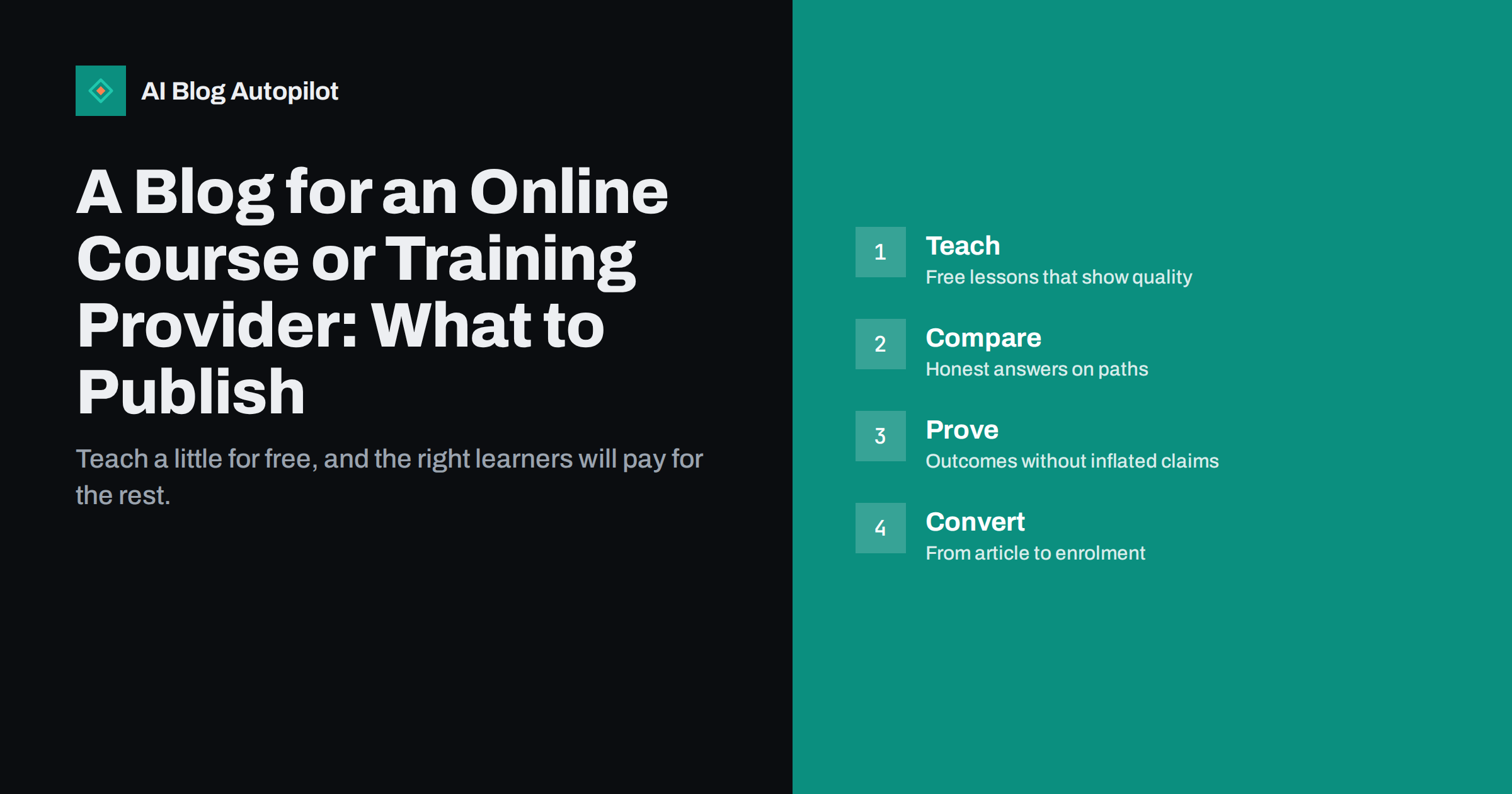
Short answer: a blog for an online course, academy or training company should do in public what the course does in private: teach. Short lessons on the subject, honest comparisons of learning paths, articles on what a qualification is worth, guides to choosing between options and realistic accounts of what the course involves attract people who are deciding whether to learn the subject and with whom. Keep promises about outcomes modest and evidenced, link every article to the relevant course page and avoid the generic “benefits of learning” pieces that every competitor also publishes.
Education is a trust purchase. Nobody can try a course before they take it, so prospective learners look for proof that the provider can explain things clearly, knows the subject and is honest about what the course will and will not do for them. A blog is the cheapest place to supply that proof. It also happens to be where most learners start: with a question about the subject, not with a search for a course. This article covers the topics that work for a training provider, the ones that waste effort and the structure that turns a reader into an enrolment without hype.
Who is reading, and what they want
Readers of a training blog fall into recognisable groups. Beginners want to know whether the subject is for them and how hard it is. People who have decided to learn want to compare routes: self-study, a short course, a certification, a degree, a bootcamp. Working professionals want to know whether a qualification will change their pay or prospects, and how long it takes alongside a job. Employers and managers want to know what a course will give their team. Existing students want supporting material. Each group needs a different kind of article, and the blog should serve the ones that matter most to your business rather than all of them equally.
Decide early which learner you want more of. A provider of professional certifications for accountants writes very differently from one teaching hobby photography or language skills. The subject, the level and the reason for learning shape every topic that follows.
Teaching articles: lessons in public
The strongest content a training provider can publish is a genuine lesson. Pick a question beginners ask, explain it properly and stop. A reader who learns something from a free article has a reason to believe the paid course will teach them more.
- Foundational explainers of the core concepts in your subject, written at the level your beginner course starts from.
- Worked examples that show how a task is actually done, step by step, with the mistakes people usually make.
- Glossary-style articles on terms that confuse newcomers, with plain definitions.
- Practice exercises with answers, which also show what your course assignments look like.
- “How to get started with” articles for the tools, software or equipment the subject needs.
Keep these articles complete. Cutting a lesson in half and demanding an email address for the rest irritates readers and tells search engines the page is thin. The course sells itself through depth, structure, feedback and credentials, not through withheld paragraphs. Our article on how-to articles explains how to write instructions people can actually follow.
Decision articles: choosing a path
People close to enrolling are comparing options, and they will read whoever answers honestly. Comparison and decision articles bring these readers and work best when they admit the cases where your course is not the right choice.
- Self-study versus a structured course: what each suits, with the honest advantages of free resources.
- Certification A versus certification B, or your course versus the main alternatives, compared on content, time, cost, recognition and prerequisites.
- Is this qualification worth it? Answer with what it is typically used for, who requires it and what it does not guarantee.
- How long it really takes to learn the subject to a given level, with realistic weekly hours.
- Prerequisites: what someone needs to know before starting, and how to fill the gaps.
- What the course involves, module by module, including assessment, time commitments and support, so that nobody is surprised after paying.
A fair comparison that sends some readers elsewhere earns more trust, and more enrolments from the right people, than one that pretends every reader should buy. Our guide to writing fair comparison articles covers the method.
Showing outcomes without inflated claims
Training marketing is full of claims about salaries, job offers and pass rates, and regulators in several countries have acted against providers who could not back them up. Treat outcome content as a factual exercise. If you publish a pass rate, say what it measures, over which period and how many students it covers. If you share salary figures, cite the source and date and note that the course does not control the job market. Student stories should be real, consented and specific about what the student did, not only about what they achieved. Case studies about employers who trained a team are useful when they describe the problem, the programme and the result in plain terms. Avoid “guaranteed” anywhere near results, and keep testimonial quotes honest rather than polished into marketing copy.
Content for existing students and employers
A blog is not only for prospects. Articles that help current students, such as study techniques for your subject, exam preparation, common assignment errors and how to use what they learned at work, reduce support questions and make students more likely to finish and to recommend the course. They also rank for the searches those students make. For employers, write about how to choose training for a team, how to measure whether it worked and how to budget for it. Those articles bring corporate enquiries that are worth more than individual enrolments, and they rarely face much competition.
Tutors are the best source for all of this. Ask each one for the three questions students ask most often in the first week and the three mistakes that appear in every assignment. Each answer is an article, and because it comes from real teaching it will be more specific than anything a competitor writes from a keyword list. Record the tutor’s name on the article where that is appropriate, since a named, qualified author is a trust signal in its own right for an education business, and it gives prospective learners a sense of who will be teaching them.
Topics that waste effort
Some articles are easy to write and bring almost nothing.
- “Ten benefits of learning X” and other generic motivation pieces that every provider has published.
- News about your company that nobody outside it searches for. A short news section is fine, but it is not strategy.
- Trend round-ups about the future of the industry, unless you have original data.
- Thin summaries of topics that your course covers in depth, which neither teach nor rank.
- Articles that only exist to hold a keyword, with no real answer in them.
When in doubt, ask whether an article would help a learner even if they never bought from you. If the answer is no, it will probably not help you either.
From article to enrolment
The path from reading to enrolling should be obvious but not pushy. Each teaching article should end with a natural next step: the course that goes deeper, a syllabus download, a free introductory lesson or a short “is this course right for me” page. Decision articles should link to the specific course they discuss and to your pricing and dates. Keep course pages and blog articles linked in both directions, so that search engines and readers see them as one body of material. Measure enquiries, trial sign-ups and enrolments by article, not only visits, so that you learn which topics bring learners who actually buy. A beginner explainer with large traffic may produce fewer enrolments than a comparison article read by a few hundred people a month.
Keeping the blog current
Course content, prices, dates, accreditation and exam formats change. Put a visible “last updated” date on articles that contain any of these, review them each intake and correct the article rather than leaving old details to mislead. When a course is retired, redirect its articles to the replacement or add an honest note at the top. Teaching articles age more slowly, but tools and standards change, and a lesson that references an old interface or a withdrawn standard undermines the credibility you were trying to build.
- Keep a list of articles that mention prices, dates, exam formats or accreditation, and review it before every intake.
- Check that screenshots and tool references still match the current versions your course teaches.
- Update student stories when a graduate’s situation changes, or ask whether they are still happy to be featured.
- Note the date of any change at the top of the article, so that returning readers can see what moved.
How AI Blog Autopilot helps
AI Blog Autopilot writes SEO articles for your WordPress blog from the topics, keywords, audience and tone you set, with a quality check before anything goes live and an approval mode if your tutors want to read each article first. For a training provider, give it the questions learners ask and the subject level of each course, and check every outcome figure and claim yourself before publishing. Each article is also shared to your connected social networks with its own text and timing. Plans are listed on the pricing page.
Related reading
- How to Write a How-To Article People Can Actually Follow
- How to Write a Fair Comparison Article
- Top, Middle and Bottom of Funnel: Mapping Blog Topics
- Templates, Checklists and Other Reasons to Subscribe
The bottom line
A training provider’s blog should teach in public, compare options honestly and describe outcomes with evidence rather than promises. Write complete lessons for beginners, decision articles for people choosing a path, practical material for current students and buying guides for employers. Skip generic motivation pieces, keep dates and prices current, link each article to the course it supports and measure enrolments by article so that the blog grows in the direction that actually brings learners.
FAQ
What should a course provider’s blog write about first?
Start with the questions beginners ask about the subject itself and with honest comparisons of the learning routes available. Those two groups of articles bring readers who are deciding whether and where to learn.
Should free lessons be cut short to sell the course?
No. Complete, useful lessons prove that you can teach. The course sells on depth, structure, feedback and credentials, not on withheld paragraphs.
Can we publish pass rates and salary figures?
Yes, if they are accurate, sourced and explained: what they measure, over which period and for how many students. Avoid guarantees and present job-market figures as context, not promises.
Is it worth writing for existing students?
Yes. Study guides, exam preparation and common-mistake articles reduce support questions, help students finish and rank for the searches they make.
How do we know which articles bring enrolments?
Track enquiries, trial sign-ups and enrolments by the article the visitor read, not only page views. Comparison and decision articles often convert better than high-traffic explainers.