ENEnglish
 LTLietuviškai
 DEDeutsch
 FRFrançais
 RUРусский
 ESEspañol
 PLPolski
 ITItaliano
 UKУкраїнська
 CSČeština
 PTPortuguês
 JA日本語
 LVLatviešu valoda
 ETEesti
 HUMagyar
 IDBahasa Indonesia
 TRTürkçe
 HIहिन्दी
 ELΕλληνικά
 ARالعربية
 THไทย
 VITiếng Việt
 RORomână
 MSBahasa Melayu
 BNবাংলা
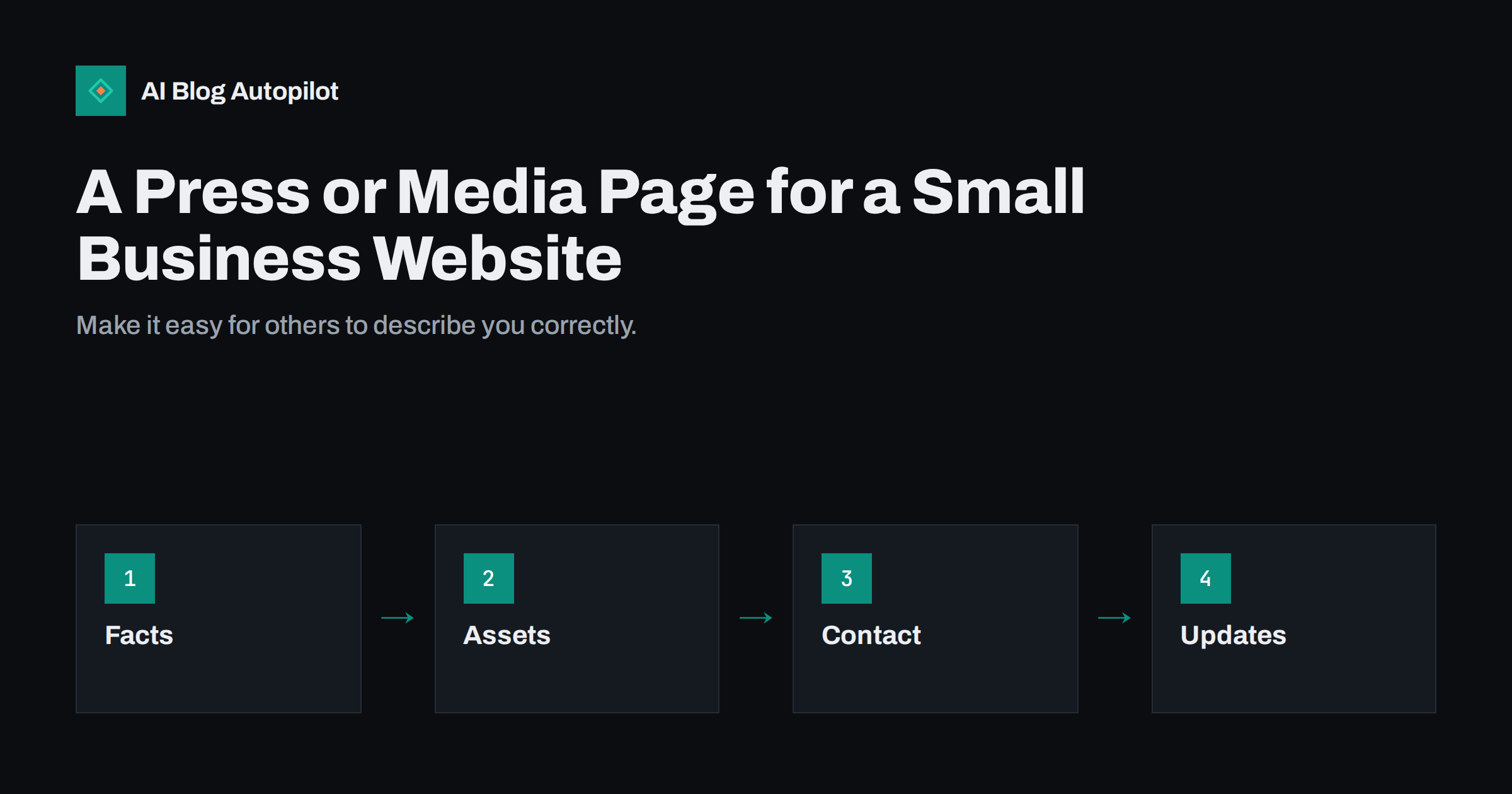
Short answer: a press or media page is a single place on your website that gives journalists, bloggers, podcast hosts and event organisers everything they need to write about you correctly: a short company description, key facts, approved logos and photographs, a few quotable lines, recent news and the name and email of a person who answers. It saves them time, reduces errors in coverage and gives search engines and AI assistants one clear, current source of facts about your business. A small business does not need a large press room; one tidy page is enough.
When someone writes about you, they look for details. How do you spell the company name, what do you do, when was it founded, who runs it, what image can they use? If the answers are hard to find, they guess, copy from an old profile or give up. A press page prevents that. It also supports the wider habit of earning mentions that we describe in our guide to digital PR on a small budget.
Who the page is for
The main readers are people with a deadline: reporters writing a feature, bloggers compiling a list, podcast producers preparing an introduction and conference organisers who need a speaker biography. They want to confirm facts quickly and use material without asking permission for each item. A second audience is less obvious: automated systems. Search engines and AI assistants look for clear statements about who you are and what you do, and a well-structured press page is a good place for them to find those statements. The article on how assistants learn about a business explains why this matters.
Think also about the people who will find the page by accident: prospective customers, partners, investors and job applicants. They treat a press page as a quick way to confirm that a business is real and established. For them, a tidy page with a clear description, recent news and a named contact is a trust signal in its own right. That is a good reason to keep the language plain and the layout simple, rather than aiming only at professional journalists.
The company summary
Start with a short description in plain words, in two or three sentences, that someone could paste into an article: what the business does, for whom, where it is based and when it started. Add a one-line version for captions. Use the same wording across your website, social profiles and listings so descriptions do not contradict one another. Keep it factual and avoid superlatives that a journalist would have to remove. If the name has a particular spelling or capitalisation, say so.
Add a short fact list: legal name, founding year, location, number of staff if you are comfortable sharing it, main products or services and a link to the about page. Only publish facts that you are happy to see repeated, and keep them current. Our guide to the about page covers the longer version.
Prepare the summary in several lengths: one sentence, one short paragraph and a longer version of around a hundred and fifty words. Writers can then pick what fits their space without cutting your text and changing the meaning. Check the wording for accuracy, such as the number of employees or customers, and date every figure that may change. Review the summary when the business changes direction, since an outdated description is repeated by others for years.
People and quotes
Include a brief biography for each person journalists may want to speak to: name, role, a couple of sentences of relevant background and a photograph. Offer two or three approved quotes on topics where you have something worth saying. They save time, and they ensure that what is printed is what you meant. Make clear who may be interviewed and on which subjects, so requests reach the right person. If a founder is the public face of the business, link to their profile page as described in our article on founder profile or company page.
Logos, photos and usage rules
Provide downloadable files that are ready to use: the logo in light and dark versions and in common formats, product images, photographs of the team and, if relevant, the premises. Use sensible file names, add alt text and keep file sizes reasonable. Say in one or two sentences how the assets may be used, for example that editorial use is welcome and that logos should not be altered. Only offer images you own or have licensed for this purpose; our article on image rights for blog posts explains the checks.
Credit lines save arguments. If a photographer must be credited, write the exact credit next to the image.
Add short guidance on how your name is written, how to display the logo and which colours to use. Give the exact colour codes and minimum sizes if they matter, and explain what not to do, such as stretching or recolouring the logo. If you have a photograph policy, state whether people may crop images and whether captions must be kept. Keeping the instructions on one screen makes it likely that they will be read and followed.
News, coverage and awards
List your announcements and the coverage you have received, with dates and links. Keep the list short and real: new products, partnerships, events, awards and milestones. A dated list shows that the page is maintained, and links to genuine coverage provide proof. Do not pad it with minor mentions. If you have a blog, link to relevant articles, such as a product update post or an original study, so a reader can follow the story to its source. Archive old items rather than deleting them, because journalists and AI assistants may refer back to them.
Contact details that work
Give a named person, an email address and, if you want calls, a phone number, plus a realistic note on response times. A generic form that disappears into an inbox discourages busy writers. Check the address regularly and make sure whoever monitors it knows what to do with a request: reply the same day if possible, agree a deadline and ask what the journalist needs. Our guide to contact and trust pages shows what else belongs near this information, and the editorial policy page is a useful place to link if you publish articles yourself.
Think about what a busy writer needs in the first thirty seconds: a name, an email address, a rough timezone and a promise of how quickly you reply. Add a line about what you can offer, such as interviews, data, product samples, photographs or access to the workshop, and what you cannot. If requests come mostly by email, create a dedicated address so they are not lost among other messages. If someone writes to you, reply even if the answer is no; a polite refusal still leaves a good impression and often leads to later coverage.
Where to put it and how to keep it fresh
Name the page clearly, for example “Press” or “Media”, link it from the footer and from the about page, and make sure it is indexable. Add a review date to your calendar and check it every quarter: update the facts, replace old photographs, remove dead links and add new coverage. After any significant change, such as a rebrand or a new product, update it the same week. A press page that is two years old tells readers that you are not paying attention.
What to prepare before a journalist calls
A press page works best when the people behind it are ready. Write down your three or four main messages in one sentence each, and gather the evidence for them: figures with their source, examples with permission and the story behind the business. Decide who speaks on which topic and who approves quotes. Agree what you will not discuss, such as client names or financial details, and how you will say so politely.
When a request arrives, ask about the angle, the deadline and the format, and whether the piece will be checked with you before it is published. Offer to review facts, not to approve the article. After publication, thank the writer, share the piece on your own channels with a link and add it to the coverage list. If there is an error, point it out courteously with the correct information, and keep a record. Over time, these habits build relationships, and a reputation for being easy and accurate to work with is worth more than a single mention.
It also helps to prepare a short fact sheet with answers to the questions you are asked most often, such as how the business started, how many customers it serves, which markets it works in and what makes it different. Keep every figure sourced and dated, and update the sheet when something changes. The same information then serves the press page, the about page, proposals and directory profiles, which keeps your story consistent.
How AI Blog Autopilot helps
AI Blog Autopilot writes full SEO articles for your WordPress blog from the topics, keywords, audience and tone you set, with FAQ sections, tags and SEO meta included, and it shares each one to your social networks. A press page is something you write yourself, because the facts and quotes must be yours. The articles that the tool publishes then give journalists and readers fresh material to link to from that page. With approval mode you can read each one first. See the pricing page for plans.
Related reading
- Digital PR on a Small Budget
- Earning Backlinks Honestly: What Works for a Small Site
- The About Page a Business Blog Needs
- Contact, Privacy and Terms Pages: Trust Signals for a Blog
The bottom line
A press page is a small piece of housekeeping with outsized returns. Put an accurate summary, a few facts, approved images, quotable lines, dated news and a real contact in one place, keep it current, and journalists, bloggers and AI assistants will describe your business the way you would. It costs an afternoon to build and a few minutes each quarter to maintain.
FAQ
Does a small business really need a press page?
It helps once anyone might write about you, such as a local reporter, a podcast host or a partner. A single tidy page is enough.
What should a press page include?
A short company description, key facts, logos and photos with usage notes, approved quotes, dated news and coverage, and a named contact.
Should I publish a press kit as a PDF?
A web page is easier to keep current and easier for search engines and AI assistants to read. You can offer a downloadable archive of images alongside it.
How often should the page be updated?
Review it every quarter and update it whenever something significant changes, such as a new product, a rebrand or a change of contact.
Can a press page help with links?
Indirectly. It makes accurate coverage easier to write and link to, but links still depend on having something worth reporting.