ENEnglish
 LTLietuviškai
 DEDeutsch
 FRFrançais
 RUРусский
 ESEspañol
 PLPolski
 ITItaliano
 UKУкраїнська
 CSČeština
 PTPortuguês
 JA日本語
 LVLatviešu valoda
 ETEesti
 HUMagyar
 IDBahasa Indonesia
 TRTürkçe
 HIहिन्दी
 ELΕλληνικά
 ARالعربية
 THไทย
 VITiếng Việt
 RORomână
 MSBahasa Melayu
 BNবাংলা
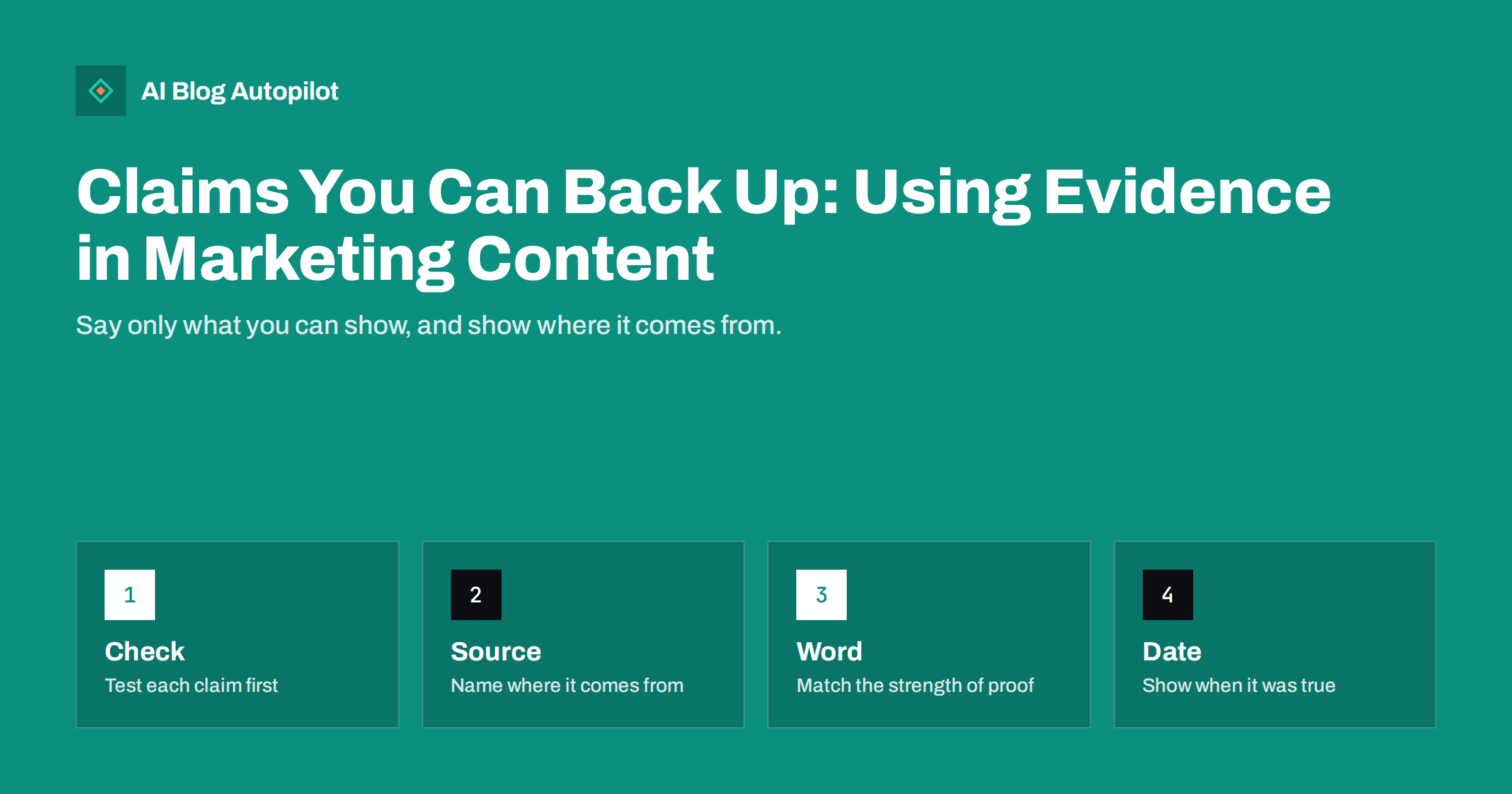
Short answer: before you publish a marketing claim, ask what evidence supports it, where that evidence comes from and whether it is still true. Replace unsupported superlatives with specific, checkable statements; name your sources and give dates; match the strength of the wording to the strength of the proof; and keep a simple record of where each claim came from. This protects customers and your reputation, helps content meet advertising rules in many countries, and makes your articles more useful to readers and to AI tools that look for reliable sources.
Marketing content tends to drift towards big words: best, fastest, most trusted, guaranteed. They feel persuasive when written and carry little weight when read, because readers have heard them all before. A claim that comes with evidence is the opposite. It is slower to write, and much more likely to be believed. This article gives a practical method for checking and writing claims on a business blog.
What counts as a claim
A claim is any statement of fact that a reader might rely on when making a decision. It does not have to appear in an advertisement. Facts in a how-to article, a comparison, a case study, a testimonial or a caption can all work as claims if they affect what someone buys or does.
- Performance: “reduces costs by 30 percent”, “loads in under a second”.
- Comparison: “cheaper than competitors”, “the only tool that does this”.
- Superlatives: “the best”, “the leading”, “number one”.
- Results and testimonials: “our clients doubled their traffic”.
- Safety, legal and health statements: anything that could affect wellbeing or rights.
- Environmental and ethical statements: “sustainable”, “carbon neutral”, “ethically sourced”.
A useful test is to imagine a sceptical customer or a regulator asking, “How do you know?” If you cannot answer in a sentence, the claim needs work.
Watch for claims that hide inside other words. “Our proven method” claims that the method has been tested. “Recommended by experts” claims that experts exist and said so. “Award-winning” claims an award, which readers will expect to be named. Each phrase carries an assumption that you need to be ready to defend, and removing the phrase is often better than finding the proof.
Why evidence matters
There are three reasons to take claims seriously. The first is legal and ethical. Advertising and consumer-protection rules in many countries require that claims are truthful and can be substantiated, and rules usually apply to blog content when it promotes a product or service. Check the rules that apply where you operate, and ask a qualified adviser if you are unsure, since this article is general guidance, not legal advice.
The second reason is trust. Customers learn quickly that vague promises do not hold, and a business that states specific, verifiable facts stands out. The third reason is search. Search quality guidelines emphasise experience, expertise and trust, and AI tools that build answers prefer sources that are specific, consistent and attributed. A blog full of unsupported superlatives gives neither readers nor machines anything solid to rely on.
A simple method for checking a claim
You do not need a legal department to improve your claims. A short, repeatable check, applied before publication, catches most problems.
- Write the claim in one sentence. Strip out adjectives and see what is left.
- Ask what proves it. Data, documents, tests, independent reports or customer records.
- Check that the proof is current. A figure from three years ago may no longer be true.
- Check the scope. Does the proof cover the same product, market, period and conditions as the claim?
- Look for exceptions. If a result applied only to some customers or settings, say so.
- Decide on the wording. Use the strongest wording the proof really supports, and no stronger.
Write the result next to the claim in your draft notes. If the proof is missing, change the claim or remove it. It is better to publish a more modest sentence that is true than a bold sentence that is not.
Strength of wording deserves a closer look. “Can help reduce” is not the same as “reduces”, and “in our tests” is not the same as “always”. When the proof comes from a small sample, one customer or a single period, the wording should say so. Qualifiers are not weakness; they are accuracy, and readers recognise the difference between honest caution and empty hedging.
Replace vague words with specifics
Many claims can be made stronger simply by being more precise. Specifics are more believable and more useful. Compare these pairs.
- “Fast delivery” becomes “orders placed before noon on a working day are dispatched the same day”.
- “Trusted by thousands” becomes “used by customers in more than twenty countries”, if that is true and you can show it.
- “Best price” becomes “our standard plan costs the same as last year, and the price list is on this page”.
- “Guaranteed results” becomes a description of what you will do, what you will measure and what happens if the target is missed.
- “Eco-friendly” becomes a statement of what changed, such as “packaging is now made from recycled card”.
Specific language gives readers something to check for themselves, and that is exactly what makes it persuasive. It also helps in search: a precise statement can be quoted, compared and matched to a question, while a general boast matches nothing.
Name the source and show the date
When a claim relies on outside facts, such as a study, a statistic or a regulation, name where it comes from and when. Link to the original document where possible, not to a summary that repeats it. Readers who care can verify, and those who do not will still notice that you were willing to be checked.
- Cite the organisation and the title of the report, with the year.
- Describe the method in a few words if it affects the meaning, for example a survey of a stated number of respondents.
- Do not quote a number without saying what it measures.
- Prefer primary sources, such as official statistics, to articles that report on them.
- Add a “last checked” line to pages that carry figures likely to change.
Our guide on citing sources for AI answers explains how clear attribution also helps assistants represent your content faithfully.
Handling comparisons and testimonials
These two forms of claim are the most persuasive and the most often challenged, so they deserve their own rules.
Comparisons with competitors need extra care. A fair comparison uses the same criteria for both sides, states the date, and is based on information you can check. Avoid claims that a competitor lacks a feature unless you have confirmed it recently, since products change often. If you are not certain, say what you know about your own product and let readers compare for themselves.
Testimonials and case studies should reflect what typical customers can expect. If you quote an exceptional result, say that it was exceptional, and describe the circumstances. Get written permission from the customer, check the figures with them and update the page if the situation changes. Never invent or edit reviews, and do not select only the flattering ones in a way that gives a false picture. Where a customer received something free or a reward for their comments, say so clearly.
Be careful with “green” and wellbeing claims
Some subjects need more caution than others, because the consequences of a wrong claim are larger.
Environmental, health and safety claims are among those most closely watched by regulators, because they affect decisions in ways that customers cannot easily check. Words like “natural”, “sustainable” or “clean” are hard to prove and easy to challenge. If you make such a claim, define it, point to the evidence and limit it to the specific product or activity involved. For health-related topics, avoid implying a cure or treatment unless you have the proper approval and evidence, and recommend that readers consult a qualified professional for personal advice.
Build a claims record
The checks above work best when they leave a trail, so that the next article does not start from zero.
Keep a simple spreadsheet of the claims that appear on your site. For each, note the page, the exact wording, the evidence, its location, the date checked and who approved it. This takes little time while writing and saves hours later, when a customer questions a statement or a product changes. It also gives writers, human or automated, a list of statements that are approved for reuse.
Review the record twice a year, and add a date to each line so that it is obvious which claims are due for a recheck. Remove claims you can no longer support, update figures and replace dead links. If you use automated tools to draft articles, tell them in your guidance which claims are off limits and which facts must come from your approved list, and review the drafts for any statement that goes beyond it. A short “claims to avoid” list, with examples of wording that has been rejected before, is one of the most useful pieces of guidance you can give any writer.
How AI Blog Autopilot helps
AI Blog Autopilot writes full articles with FAQ, tags and SEO meta, and runs an automatic quality check before anything goes live. You can also switch on approval to see every article first, which is the right moment to check any claim against your own evidence. See the pricing page for plans.
Related reading
- How to Fact-Check Content Before You Publish
- Citing Sources in Blog Posts: Why It Helps in AI Answers
- E-E-A-T on a Blog That Publishes Automatically
- How to Put Something Original in an Article You Automated
The bottom line
A claim is only as good as the proof behind it. Test each statement, replace vague superlatives with specifics, match the wording to the evidence, name sources and dates, treat comparisons, testimonials and green claims with extra care, and keep a record of what you have approved. Content built this way takes longer to write, and earns more trust from every reader, regulator and machine that checks it.
FAQ
Do blog posts need the same evidence as advertisements?
If a post promotes a product or service, many consumer-protection rules apply to it too. Check the rules where you operate and ask an adviser if unsure.
Can I use words like best or leading?
Only if you can show the basis, such as a named ranking or survey with a date. Otherwise use a specific, checkable statement instead.
How do I show where a statistic comes from?
Name the organisation, the report title and the year, link to the original document and say what the number measures.
How should I handle testimonials?
Get permission, check the figures, say if the result was exceptional and disclose any reward or free product the customer received.
How often should I review claims?
At least twice a year, and whenever a product, price or regulation changes. A simple spreadsheet makes this quick.