ENEnglish
 LTLietuviškai
 DEDeutsch
 FRFrançais
 RUРусский
 ESEspañol
 PLPolski
 ITItaliano
 UKУкраїнська
 CSČeština
 PTPortuguês
 JA日本語
JA日本語 LVLatviešu valoda
 ETEesti
 HUMagyar
 IDBahasa Indonesia
 TRTürkçe
 HIहिन्दी
 ELΕλληνικά
 ARالعربية
 THไทย
THไทย VITiếng Việt
 RORomână
 MSBahasa Melayu
 BNবাংলা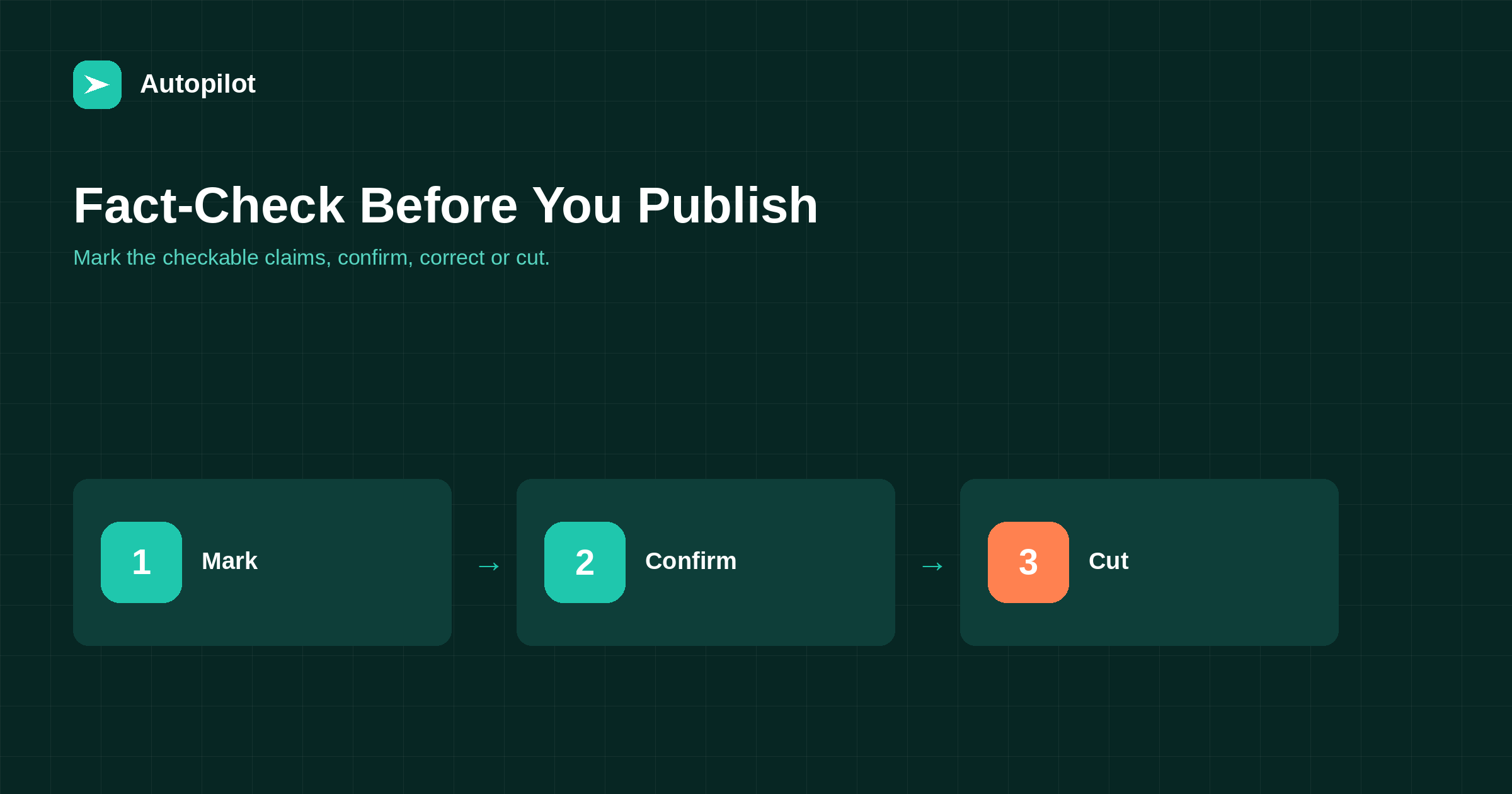
Short answer: mark every statement in the draft that a reader could check — numbers, dates, prices, version numbers, names, legal deadlines, anything called current — and then confirm, correct or cut each one. Cut is the default when you cannot find a source in a couple of minutes. Never soften an unverifiable claim into something vaguer and publish it, because that keeps the risk and loses the usefulness. For a normal article this is five to ten minutes of work, and it is the only editing pass that is genuinely not optional.
Fact-checking has a reputation as something newsrooms do with a dedicated desk and three weeks. For a blog post it is a ten-minute pass with a clear rule, and it is the difference between a page you can stand behind and one you quietly hope nobody reads closely.
This matters more, not less, when drafts arrive quickly. Fluent writing makes a wrong number look as confident as a right one, and volume means a single unchecked habit repeats across thirty pages.
What actually needs checking
Not every sentence. Most of an article is explanation and argument, which needs to be right but cannot be checked against a source. Mark the parts that can.
- Numbers of any kind. Percentages, counts, averages, ranges.
- Dates and deadlines. Especially anything regulatory.
- Prices. Yours and anybody else’s.
- Version and feature claims. What a product includes, what a platform supports, what was removed.
- Names and titles. People, companies, standards, laws.
- Anything called current, latest, new or recently. These are claims about time and they expire.
- Attributed research. Studies show, research suggests, a report found.
In a typical 1,500-word article that is between five and fifteen marks. Marking is the part people skip, and it is what makes the pass finite rather than endless.
Confirm, correct or cut
Each mark gets exactly one of three outcomes.
Confirm. You found a source you would be comfortable citing publicly — the primary document, the vendor’s own pricing page, the official register, the study itself rather than an article about the study. Leave the claim, and consider linking the source.
Correct. The source says something different. Change the claim to what the source says, including its date.
Cut. You cannot find a source in two or three minutes. Delete the sentence. The article is almost always fine without it, because a claim you could not verify was probably decorative.
The rule that matters is the one about not softening. Turning 73% of marketers say into many marketers say does not make an unsourced claim safe; it makes it unsourced and useless.
Where to look, fast
Speed comes from going to the right kind of source first rather than searching generally.
| Claim type | Go to | Not |
|---|---|---|
| A price | The vendor’s own pricing page, today | A comparison article from last year |
| A statistic | The original study or dataset | A listicle citing it |
| A legal deadline | The official text or a regulator page | A law firm’s blog summary |
| A product feature | Current official documentation | Memory, or an old changelog |
| A definition of a standard | The standards body | An encyclopedia paraphrase |
| Your own numbers | Your billing or analytics | An estimate you have repeated before |
The recurring trap is the citation chain: three blogs each citing the one before, with the original either misread or nonexistent. If you cannot reach a primary source in two clicks, treat the number as unverified.
Statistics deserve their own rule
Statistics are the claims most likely to be wrong and the hardest to remove, because they feel like evidence.
Three questions settle nearly all of them. Who collected it, and do they sell something the number flatters? When, and does the year change what it means? And who was surveyed, because a finding from 200 self-selected respondents is not a finding about an industry.
Always publish the date with the number. A statistic from 2019 presented without a year is a claim about now, and it is usually wrong.
Your own claims are the risky ones
External facts are easy to be disciplined about. The claims that cause real problems are the ones about your own business, because nobody outside will check them and everybody inside assumes someone already did.
Pricing is the obvious one: an article saying a plan costs a particular amount is wrong the day you change it, and it is the page a prospect reads. Write prices in a form that survives, or point at the pricing page and let the live page be the answer. The same applies to counts of features, integrations or languages supported, which change.
Results claims are the other one. Do not publish typical customer outcomes you cannot evidence, and do not promise a search position, because nobody can. what search engines actually say about AI content covers what can honestly be said about content and search visibility.
Making it survive volume
A checking habit that works for four articles a month has to be simplified to survive thirty.
Three things make it survive. Write the forbidden claims into the brief, so drafts stop containing them; writing a brief an AI can use is where that belongs. Keep a short list of the facts about your own business that articles are allowed to state, and update it when something changes. And send anything touching prices, law or medical subjects through review rather than publishing unattended, which is the practical shape of draft, approve or full auto.
None of that removes the ten-minute pass. It reduces how much the pass finds.
Facts expire after you publish
A checked article is checked on the day it is published. Prices change, deadlines pass, features are removed, and the article keeps stating the old version to everyone who arrives.
Two habits help. Keep a list of the articles that contain your prices or any dated claim, so you know what to edit when something changes rather than searching your own blog. And when you revisit a page for other reasons, recheck its numbers as part of the job — refreshing old posts treats this as half of what a refresh is. FAQ sections age fastest, because they are where the specifics live.
Related reading
If this was useful, these cover the questions that usually come next.
- Editing a draft — where this pass fits in the full edit
- Experience, expertise and trust — why checkable claims matter beyond accuracy
- Refreshing old posts — the facts that quietly go stale after publication
The bottom line
Mark the checkable claims, then confirm, correct or cut each one, and default to cut when a source does not appear in two minutes. Never soften an unverifiable number into a vague one. Give your own prices and feature counts more scrutiny than anyone else’s numbers, because nobody outside will catch them. Ten minutes per article, and a note of which pages contain facts that will expire.
FAQ
How long should fact-checking a blog post take?
Five to ten minutes for a typical 1,500-word article. Marking the checkable claims first is what keeps it bounded; without that step the pass feels infinite and gets skipped.
What if I cannot find a source for a claim?
Delete the claim. Making it vaguer keeps the risk and removes the usefulness, and the article is nearly always fine without a number that was there for decoration.
Is it enough to cite another blog that cites the study?
No. Citation chains are where statistics get misread and where numbers with no original survive for years. Reach the primary source, or treat the figure as unverified and cut it.
Should I put a date next to every statistic?
Yes. A figure without a year reads as a claim about now, which is usually wrong. Naming the year also lets a reader judge whether it still applies.
Which claims go wrong most often?
Your own. Prices, plan contents, feature counts and anything about results, because everyone internally assumes somebody else verified them and nobody outside will tell you.
Do I need to recheck articles after publishing?
The ones containing prices, deadlines or product specifics, yes. Keep a list of which pages those are so an update takes minutes, and recheck numbers whenever you edit a page for any other reason.