ENEnglish
 LTLietuviškai
 DEDeutsch
 FRFrançais
 RUРусский
 ESEspañol
 PLPolski
 ITItaliano
 UKУкраїнська
 CSČeština
 PTPortuguês
 JA日本語
 LVLatviešu valoda
 ETEesti
 HUMagyar
 IDBahasa Indonesia
 TRTürkçe
 HIहिन्दी
 ELΕλληνικά
 ARالعربية
 THไทย
 VITiếng Việt
 RORomână
 MSBahasa Melayu
 BNবাংলা
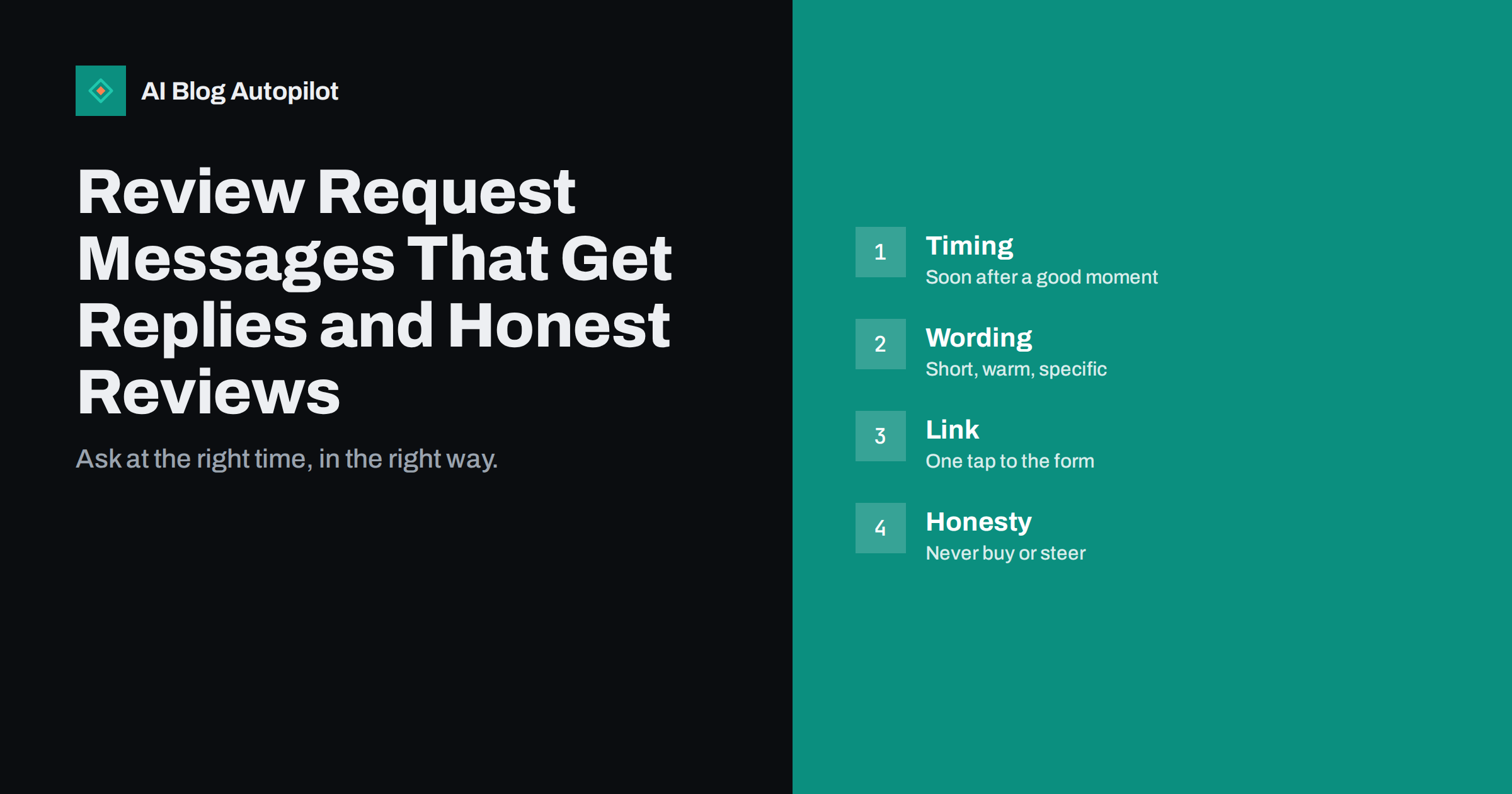
Short answer: ask for a review soon after a good experience, in a short and friendly message that names what you hope they will say about and gives a direct link. Ask every customer, not only happy ones, never offer rewards for positive reviews, reply to every review and follow the rules of each review platform.
Reviews influence which business a person picks, and they also feed local search results. Yet most satisfied customers never write one, simply because nobody asked or because it felt like effort. A good request removes that effort and makes the customer feel their opinion matters.
This guide covers timing, wording, channels, follow-ups, replies and the rules to keep in mind. The examples are written to be adapted to your own style, and they apply to shops, services and professional practices alike.
Why asking matters
Customers who had a poor experience are often more motivated to write than those who were happy. If you never ask, your reviews may lean towards complaints, even though most of your customers are satisfied. A steady, polite request balances the picture by giving quieter customers a voice.
Reviews also help new customers decide. People read the number, the recent dates and the content of reviews, and they notice how a business replies. A page with a few recent, specific reviews feels more reliable than one with many old, brief ones.
For local businesses, recent reviews can support visibility in map results. The guide to Google Business Profile updates explains how reviews fit with your other local details. Do not treat reviews as a trick; they work best as a record of real experiences.
Choose the right moment
Ask while the experience is fresh and the value is clear. For a repair, that might be a day after the job is done and the customer has seen it working. For a meal or a visit, it might be the same evening. For a long project, ask at a milestone or at handover, when the customer has just seen the result.
Avoid asking at awkward moments: during a complaint, in the middle of a delivery problem or before the customer has had time to try the product. If something went wrong, solve it first. A customer who sees you fix a problem well may write a better review than one who never had a problem.
Use the right channel for the person. Some customers prefer a text message, some an email, some a card handed over in person. Choose the one you already use to talk to them, and send only one request with at most one polite reminder.
Write a short, warm message
A good request is brief. Greet the person by name, thank them for choosing you, say why their opinion matters and give a single link that leads straight to the review form. Keep it to a few sentences. Long messages feel like a chore.
An example: “Hello Anna, thank you for letting us service your boiler today. If you have a minute, a short review would help other homeowners in the area choose with confidence. Here is the link: [link]. If anything was not right, just reply to this message and we will put it right.” This version is polite, specific and offers a route for problems.
Ask for specifics gently. Suggest that they mention what they needed and how it went, since specific reviews help readers more than “great service”. Do not script the answer or give them words to copy. Reviews that all sound alike look suspicious and may be removed.
Make the link easy
Every extra step loses people. Send the direct link to your review page, not a link to a general page where they must search for the form. Test it on a phone, since most customers will open it there. Check that it works when the customer is not signed in, or explain which account they need.
A QR code on a receipt, a card or a table can work well in a physical shop. Place it where customers wait and explain in one line what it is for. The guide to QR codes from print to web shows how to create ones that scan reliably.
Consider offering more than one platform, but do not overwhelm. Choose the one that matters most to your customers, perhaps your map listing, and mention a second only if it is relevant to your trade.
Ask everyone, not just the happy ones
Many platforms forbid selectively asking only for positive reviews, and customers can sense when a request is filtered. Ask every customer in the same way, and let them say what they think. This protects you from rule breaches and gives you honest feedback that you can use to improve.
Do not offer discounts, gifts or entries into a prize draw in exchange for positive reviews. Even an offer for any review, positive or negative, is against the rules of some platforms and the law in some countries. If you want to thank customers, do it without conditions and after the fact.
Never write reviews yourself, ask friends and family to review as customers or pay a service to post reviews. These practices can lead to removal of reviews, penalties and damage to your reputation. Check the guidelines of each platform and the consumer rules in your country.
Consider sending requests in the customer’s language. A short message in the language in which the service was delivered feels more personal and gets more answers than a generic one in another tongue. If you serve people in several languages, prepare a version for each and ask a native speaker to check the wording.
Think about accessibility. Not all customers find it easy to write reviews on a phone, and some prefer to speak. Offer to take a few words by phone or in person if someone says they would like to help but find the form difficult, and then ask them to confirm the text themselves, so the review remains their own.
Reply to every review
Replies show that you listen. Thank people for positive reviews in a way that is personal rather than copy-pasted, and mention a detail if you can. Keep replies short, and avoid using them as advertisements.
For negative reviews, stay calm. Thank the reviewer, apologise where fitting, explain briefly what you will do and offer to continue in private. Do not argue, reveal private details or blame the customer. A polite reply to a hard review often persuades readers more than a dozen praising ones. The article on negative comments on social posts has a useful approach.
If a review is fake or breaks the platform’s rules, report it through the proper process and leave a short, factual reply in the meantime. Do not threaten the reviewer. Keep a record of the steps you took.
Teach your team what to say in person. A simple line such as “if you were happy with today’s work, it would help us a lot if you left a short review; I will send you the link” is natural and respectful. Role-play it once so that it sounds like the person saying it, and make sure staff understand that they should never pressure, bargain or hint at special treatment.
Check how your reviews look to someone who has never heard of you. Search for your business name and read the first results as a stranger would: ratings, recency, replies and the tone of the whole page. This outside view often shows a gap, such as no recent reviews in the last six months, that you can fix with a gentle, steady routine.
Finally, remember legal and platform rules differ by place. In some countries, there are specific rules on review practices, and platforms update their policies from time to time. Read the current terms of every platform you use before you build a process, and review them yearly.
Use reviews in your content
Reviews are a rich source of language. Read them to see which words customers use, what they value and what worries them. These words often make good topics and headings, because they match how people search. The article on turning customer questions into topics works the same way.
With permission, you can quote reviews on your website, but do not edit them to change their meaning, and do not select only the best ones in a way that misleads. The guide to testimonials in blog posts shows how to present them honestly.
Track the effect over time. Count new reviews each month, note the average rating and watch for patterns in the feedback. Share good reviews with your team, and treat repeated complaints as a to-do list.
Build the habit into your routine
Requests work best when they are part of a routine, not a campaign. Decide who sends them, when and how, and write the steps down. For example: after each completed job, the team member marks it as done, and a message goes out the next morning. Keep the system simple enough to survive a busy week.
Prepare two or three message versions for different situations, such as in-person services, online orders and long projects. Review the wording every few months and replace anything that sounds stale. Ask a colleague to read it and say whether they would respond.
Finally, be patient. Reviews accumulate slowly, and a steady stream of honest ones is worth more than a sudden burst. A business that asks politely and replies well will build a record that customers trust.
How AI Blog Autopilot helps
Articles that answer customers’ questions bring the visitors who later become reviewers. AI Blog Autopilot writes and publishes those articles on your topics and shares them to your networks. See the plans, and try the three free articles first.
Related reading
The bottom line
Ask every customer soon after a good experience with a short, honest message and a direct link, never reward or steer reviews, and reply to all of them.
FAQ
When is the best time to ask for a review?
Soon after the customer has seen the result, such as the day after a job or at handover, while the experience is fresh.
Can I offer a discount for a review?
No. Rewards in exchange for reviews break the rules of many platforms and, in some places, the law.
Should I ask only happy customers?
No. Ask everyone in the same way. Selective requests can breach platform rules and hide useful feedback.
How should I reply to a bad review?
Stay calm, thank the reviewer, apologise where fitting, say what you will do and move the conversation to private.
How many reminders are acceptable?
One request and at most one polite reminder. More than that feels like pressure.