ENEnglish
 LTLietuviškai
 DEDeutsch
 FRFrançais
 RUРусский
 ESEspañol
 PLPolski
 ITItaliano
 UKУкраїнська
 CSČeština
 PTPortuguês
 JA日本語
JA日本語 LVLatviešu valoda
 ETEesti
 HUMagyar
 IDBahasa Indonesia
 TRTürkçe
 HIहिन्दी
 ELΕλληνικά
 ARالعربية
 THไทย
THไทย VITiếng Việt
 RORomână
 MSBahasa Melayu
 BNবাংলা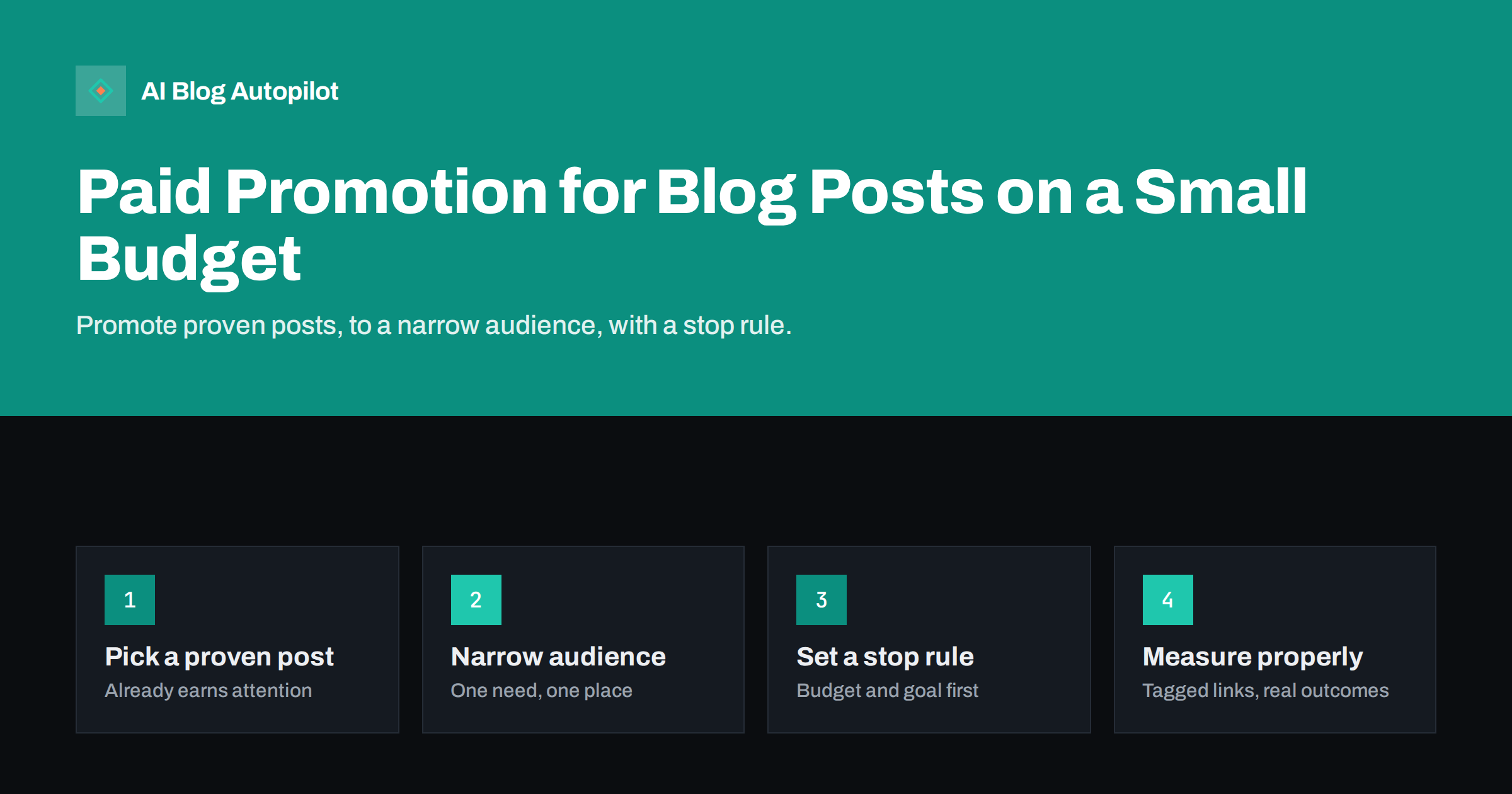
Short answer: paid promotion of a blog post is worth testing when the article already performs well organically, the audience can be defined narrowly, and you have a clear goal such as newsletter sign-ups or enquiries. Start with a small fixed budget, promote one or two posts, tag every link, and decide in advance when you will stop. Do not use it to rescue a weak article or to chase vanity numbers. If the cost per useful result is too high after a fair test, return the money to better content.
Many small blogs rely on search and social sharing, and that is a sound base. But sometimes an article deserves a push: a seasonal guide with a short window, a strong how-to that answers a real need, or a report you want in front of a specific audience. This guide explains how to do that without wasting a small budget, and how to judge the results honestly.
When paying makes sense
Paid promotion is a way to buy attention, not to create value. It works best when the content is already good and the next step for the reader is clear. It works poorly when you hope that spending will fix problems in the article, the offer or the site.
- The post has a proven record. It gets steady reading time, shares or comments from the people it was written for.
- The topic has a window. A guide for a seasonal need, an event or a deadline benefits from faster reach.
- The goal is specific. Newsletter sign-ups, a download, a booking or a return visit can all be measured. “More traffic” cannot be judged.
- The page is ready. It loads quickly on a phone, answers the question and offers a sensible next step.
If the answer to any of these is no, fix that first. Money spent on a slow page with no next step is wasted regardless of how clever the targeting is.
Choose the post and the goal
Review your recent articles and pick the one that has the best signs from organic reach. Good signs include a high share of readers who scroll to the end, saves and shares from relevant people, and search impressions that suggest strong demand. Avoid promoting an article that is mostly about your company, since cold audiences do not care yet.
Then write down the goal in one sentence, including what counts as success. For example: “Gain thirty newsletter sign-ups from readers of the invoicing guide in two weeks”. A number is not a promise, only a yardstick that lets you stop the test or continue it. If you cannot define success, you are not ready to spend.
Define a narrow audience
The main advantage of paid reach is control over who sees the post. Use it. A broad audience wastes money on people who have no use for the article, and small budgets run out quickly.
- Start from your reader profile. Who is the article for, what do they do and what are they trying to solve?
- Choose the network where they spend time, not the one you like most. A professional topic may suit a business network, a visual how-to may suit an image-led one.
- Use simple targeting. Location, language and one or two interests or job-related options are usually enough. Many layers shrink the audience and raise the cost.
- Exclude people who already know you if the tool allows it, such as existing customers or subscribers, so you pay for new readers only.
Targeting options differ between networks and change over time, so check the current options in the tool you use rather than relying on a guide, including this one.
Write the promoted post for a cold reader
People who see a paid post do not know you and did not ask for it. The text has to earn attention in the first line, as with any social post. Lead with the reader’s problem or the surprising fact from the article, not with your name. Keep the promise honest, because a misleading hook produces clicks that leave at once and teaches the network that your content is poor.
- Use an image or short graphic that matches the article and reads well at a small size.
- Write two or three versions of the first line and test them with a small share of the budget.
- Make the next step plain, such as “Read the guide” or “Get the checklist”.
- Follow the rules of the network and the law on disclosure for any paid or sponsored content that applies in your country.
Set the budget and the stop rule
Decide the total you can afford to lose before you start. A small test should be small enough that a poor result does not hurt, but large enough to collect a meaningful sample. Spread it over a limited period, such as one or two weeks, instead of a few hours, so that the network has time to learn and you can see day-to-day differences.
Write a stop rule on paper. For example: “If after seven days the cost per sign-up is more than we can accept, or fewer than a set number of people have reached the second page, stop and review.” Without such a rule, it is easy to keep spending in the hope that the next day will improve. Check the tool daily at first, but avoid changing many settings at once, because then you cannot tell what caused any change.
It also helps to think about timing. Promote while the topic is relevant, and avoid launching during a week when you cannot check the results or reply to comments. Replies matter: people often ask questions under promoted posts, and a prompt, helpful answer shows the audience that a real business stands behind the content. Assign someone to watch the comments for the first few days and note common questions, since they are material for future articles.
Tag links and measure outcomes
Every paid link needs tracking tags so that you can see its traffic separately from organic shares. Use a consistent naming pattern, with the network, a “paid” label and the campaign name, and record the pattern in a sheet. Then look at what readers did, not only at clicks.
- Cost per useful action: sign-up, download, enquiry or visit to a key page.
- Quality of visits: time on page, scroll depth and pages per visit, compared with organic readers.
- Later behaviour: do paid readers return, subscribe or buy later?
Be careful about interpretation. A cheap click that does not read is worse than an expensive one that does. Also remember that paid promotion can have indirect effects, such as more shares or brand searches, which you cannot always attribute. Note them, but do not count them as proof.
Keep a simple log of each test: the article, the audience, the dates, the spend, the main result and what you would change. After three or four tests, the log becomes a useful guide to what works for your business, and it prevents the same mistakes from being repeated by someone new in the team. It also gives you a clear basis for deciding whether paid promotion deserves a place in the yearly plan, or whether your budget is better spent on writing, updating older articles or improving the pages that already receive visits.
A small test, step by step
A simple plan for a first test looks like this. Choose a guide that has performed well and has a clear next step. Define a narrow audience on one network. Prepare three versions of the opening line and one image. Set a modest budget over ten days, with tagged links. After three days, pause the weakest line and move budget to the best. After ten days, compare the cost per sign-up with your goal and with what other channels cost you. Write down what you learned, including what you would change, and decide whether to repeat, adjust or stop.
If the test works, repeat it with a second article before increasing spend, because one success may be luck. If it fails, look at the likely cause: the article, the audience, the opening, the page or the offer. Change one thing and test again only if you believe the idea is sound.
One last point concerns expectations. Paid reach rarely produces sales from a single exposure to a single article. Readers often need several contacts before they act, so a promoted guide may be the first step in a longer path that includes an email series, a retargeted reminder or a later search for your name. Plan what happens after the click, and give the test enough time to show whether that path leads anywhere useful for your business.
Common mistakes to avoid
- Promoting everything. Spreading a small budget over many posts gives no useful data on any of them.
- Chasing likes. Reactions are cheap and rarely connect to business results.
- Ignoring the landing page. Slow or cluttered pages waste the click.
- No tracking. Without tagged links, you cannot tell paid from organic traffic.
- Raising the budget too early. Scale only after repeated, explainable results.
How AI Blog Autopilot helps
AI Blog Autopilot asks for your topics, keywords, audience and tone, and writes full SEO articles with FAQ, tags and meta for your WordPress blog. A steady library of well-structured articles gives you more candidates to find a proven post to promote, and clear audience settings make the targeting decision easier. See the pricing page for plans.
Related reading
- How to Promote a Blog Post After You Publish It
- UTM Tags for Social Shares: See Which Posts Bring Readers
- Sharing Blog Posts on a Facebook Page: What Still Works
- How to Measure Whether a Blog Is Working
The bottom line
Treat paid promotion as an experiment with a limit. Pick an article that already works, define one goal and a narrow audience, write the post for people who do not know you, tag every link and set a stop rule before spending. Judge the results by useful actions, not by clicks or likes, repeat only what you can explain, and put the money back into content when the numbers do not justify the cost.
FAQ
How much should I spend to test promotion for a blog post?
Spend an amount you can afford to lose, spread over one to two weeks. The right figure depends on your market and goal, so set it before you start.
Which post should I promote first?
One that already gets good reading time or shares organically, matches a clear need and has a sensible next step for the reader.
Is promoting a post better than creating a new one?
It depends. If a strong article is under-seen, promotion can help. If the article is weak, writing or improving content is the better use of money.
How do I know if the test worked?
Compare the cost per useful action, such as a sign-up or enquiry, with your goal and with other channels, using tagged links.
Do I need to disclose paid promotion?
Follow the network’s rules and the law in your country on sponsored content. Most promoted posts carry a label added by the platform.