ENEnglish
 LTLietuviškai
 DEDeutsch
 FRFrançais
 RUРусский
 ESEspañol
 PLPolski
 ITItaliano
 UKУкраїнська
 CSČeština
 PTPortuguês
 JA日本語
 LVLatviešu valoda
 ETEesti
 HUMagyar
 IDBahasa Indonesia
 TRTürkçe
 HIहिन्दी
 ELΕλληνικά
 ARالعربية
 THไทย
 VITiếng Việt
 RORomână
 MSBahasa Melayu
 BNবাংলা
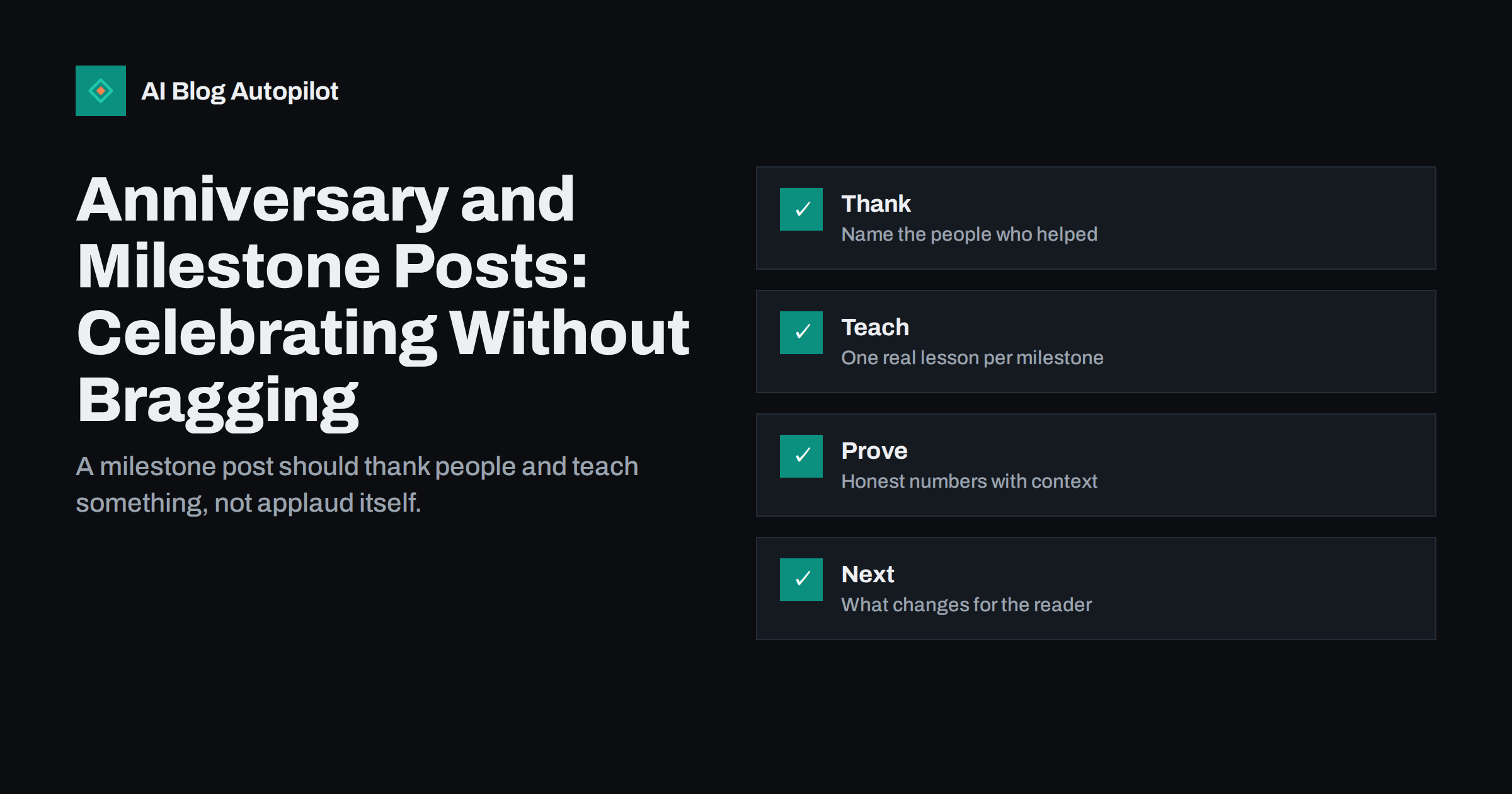
Short answer: an anniversary or milestone post works when it is about the readers and the lessons rather than about the company’s greatness. Thank the people who helped, share what you learned, use honest numbers with context, say what will change for the reader and keep it short. Avoid bragging, vague superlatives and numbers that cannot be checked.
Every business reaches dates worth marking: the first year, the tenth, the thousandth customer, the hundredth article, a move to a new shop. Such posts are tempting because they are easy to write and feel good. They are also easy to get wrong, because readers have little patience for self-congratulation. The best milestone posts treat the date as a reason to say something useful, and they are written for the person reading, not for the person writing.
Choose milestones that mean something
Not every number deserves a post. A round figure for followers or visits says little to a reader, while a milestone that changes what you can offer, such as ten years of service, a new location or the first product that customers asked for, has real meaning. Ask whether the reader will learn something, benefit from something or feel included. If the answer is no, a short thank-you on social media is enough.
Keep a simple list of dates that matter to customers: the founding date, the launch of major services, the anniversary of a notable project or the day you reached a goal that you had told the public about. Put them in your content calendar, as described in our guide to seasonal content planning, so that you have time to prepare something good instead of rushing a post on the day.
Check the facts before you celebrate them. Founding dates, counts and claims of “first” or “largest” must be accurate and provable. A wrong date or an inflated claim on an anniversary post is remembered and quoted, and the embarrassment is out of proportion to the benefit.
Start with thanks
The natural centre of a milestone post is gratitude. Thank the customers who came back, the staff who built the work, the suppliers and partners who helped and the readers who commented and corrected you. Be specific: “thank you to the families who trusted us with their first move” means more than “thank you to all our customers”. Name people only with their permission and avoid ranking anyone.
Show thanks with action where you can. A small gift, a useful free guide, a donation to a cause your customers care about or an open day shows more than words. If you offer a discount, make the terms plain and keep the promise, and think about whether existing customers will feel overlooked by an offer made only to newcomers.
Share what you really learned
A look back is valuable only if it contains something the reader can use. Choose three to five lessons, each with a short story: a mistake you made, a decision you would change, a habit that paid off or an assumption that proved wrong. Readers appreciate honesty about difficulties, and an account of a failed experiment is more memorable than a list of successes.
Keep the lessons practical and connect them to the reader’s world. A shop owner might share what customers asked for most. An agency might describe a change in how it briefs clients. A software company might explain which features were removed because nobody used them. Our guide to storytelling in business blog posts offers ways to tell these stories with a clear shape and without fluff.
Avoid the temptation to turn every lesson into a triumph. If something is still unresolved, say so. Admitting that you are still working on a problem builds more trust than a tidy narrative in which everything worked out.
Use numbers honestly
Numbers give a milestone post weight, but only when they are true and explained. Say what you counted, over what period and how, and avoid figures that sound impressive but mean little, such as total impressions or “reach”. If a number is small, it may still be worth sharing when put in context: forty-two repeat customers in a village shop is an achievement. If you cannot prove a figure, leave it out.
Compare carefully. Year-on-year growth from a very small base can mislead, and comparisons with competitors invite challenge. Our guides to claims you can back up and statistics round-ups done honestly cover the discipline that applies here. Keep a note of where each number came from so that you can answer if someone asks.
Sometimes the most useful thing a milestone post can do is to restate the basics for newcomers. Many readers will arrive on the page through a link and know little about you. A short paragraph that says what you do, who you serve and where to start gives them a way in, and it turns a celebratory post into a doorway. Link to the pages that explain your services, prices and contact details so that interest can become action.
Say what changes for the reader
A milestone is a good moment to look forward, but the reader wants to know what it means for them. Will prices change? Will a service expand or be withdrawn? Are hours different? Is there a new way to get help? Put these answers in plain words, with dates, and avoid promises that you cannot keep. A line such as “from next month we will answer questions within one working day” must be one that you can sustain.
Be careful with plans you have not yet decided. It is fine to share direction, such as “we are testing a new range”, but say that it is a plan and what could change. Remember that public statements about the future are remembered, and a missed promise costs more than saying nothing. Our article on what a year of automated publishing looks like is a good example of describing a period honestly and modestly.
Think about how the post will look to a stranger. A photograph from the early days, an old price list or a picture of the first shop sign adds charm and proof of history, as long as you own the rights and the image is clear. Add a caption with the year and a few words of context, and use alt text that describes the picture. Visual details make a milestone feel real and are worth far more than a paragraph of adjectives.
Choose a format and a length
Match the format to the message. A short letter-style post works for thanks and plans. A photo story suits a physical business that has a history to show. A timeline works for a company with many stages, as long as each entry is brief and dated. A round-up of the most read guides suits a blog, and our article on annual round-ups explains when it is worth writing. A video or interview may suit a founder with a story to tell.
Keep the post short: five hundred to a thousand words is usually enough for a milestone. Put the point near the top, use the date in the title and in the text and avoid long lists of everything you have done. If you have much to say, divide it across several posts, linked in a series, rather than creating a single endless page.
Involve the readers
Invite customers to share their own memories, photographs or questions. A short call such as “tell us the first thing you bought from us” can produce material that is more interesting than anything you would write alone. Ask permission before publishing contributions, use first names or initials where requested and keep moderation light but firm. Our guide to customer stories and contributions on a business blog explains how to do it safely.
If you run a giveaway to mark the date, read giveaways and contests tied to a blog first, since rules and laws vary and a careless contest creates complaints. Keep the terms clear, the selection fair and the prize delivery prompt.
Finally, keep a record. Save the text, the numbers and the photographs in a folder with the date, and note what you promised. On the next milestone you will have a reliable starting point, and you can check whether the promises were kept. This record is also a useful history for new staff, who often know little about how the business began, and for anyone who later writes the story of the company.
Reuse and measure the post
A milestone post should have a life after the day. Share it on your social channels with a line that makes a clear offer to the reader, include it in your newsletter and link to it from your about page, where visitors look for the history of the business. Update the page next year if the milestone recurs, or add a short note that the figures are as of the original date.
Measure the result in simple terms: how many people read it, replied, signed up or visited a related page. Our guide to measuring whether a blog is working helps you judge it. If the post did not bring much, you have still marked the date and thanked people, which is a worthwhile aim by itself.
How AI Blog Autopilot helps
AI Blog Autopilot writes full SEO articles for your WordPress blog from the topics, keywords, audience and tone you set, with FAQ sections, tags and SEO meta included, and it shares each one to your social networks. It keeps the everyday articles flowing so that you can put your time into the personal posts, like a milestone, that only you can write. Approval mode lets you read each article first. See the pricing page for plans.
Related reading
- What a Year of Automated Publishing Looks Like
- Annual Round-Ups: When They Are Worth Writing
- Customer Stories and Contributions on a Business Blog
- Claims You Can Back Up: Using Evidence in Marketing Content
The bottom line
A milestone post should serve the reader. Pick a date that matters, start with thanks, share real lessons, use honest and explained numbers, say what changes and keep it short. Celebrate quietly and let the facts do the work.
FAQ
Which milestones are worth a blog post?
Those that matter to readers or change what you offer, such as long service, a new location or a long-requested product. Round numbers alone rarely qualify.
How do I avoid sounding boastful?
Thank people, share lessons including mistakes, use verifiable numbers with context and focus on what changes for the reader.
Should I offer a discount for an anniversary?
Only if it makes sense for your business. State the terms clearly, keep the promise and consider how existing customers will feel.
How long should a milestone post be?
Five hundred to a thousand words is usually enough. Split a long story into a short series instead of one huge page.
Can I update the post next year?
Yes, if the milestone recurs. Otherwise add a note that the figures are as of the original date.